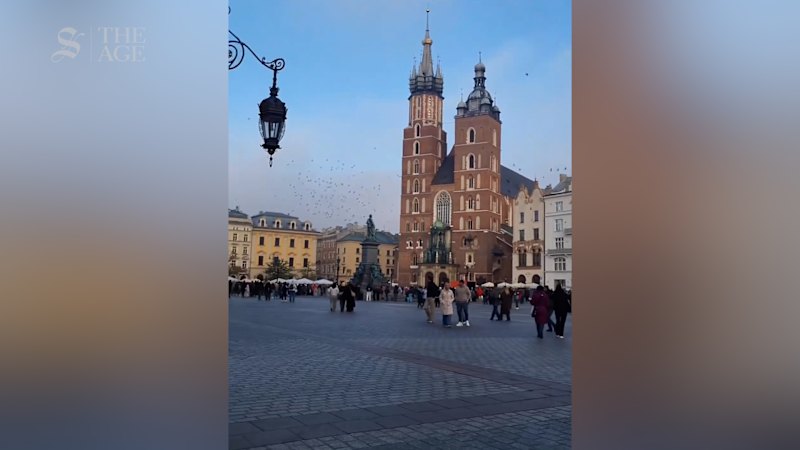
When gunfire erupts in Krakow, Poland, the shock runs far deeper than the immediate police cordon. For decades, Poland’s historic southern capital built its modern identity on order, low violent crime rates, and predictable urban safety. When a gunman opens fire in a city where civilian firearm ownership remains tightly restricted and street shootings are statistical anomalies, the incident forces an uncomfortable examination of how weapons enter the country, how municipal threat detection operates, and why public perception of European urban security is lagging behind reality.
Short bursts of violence carry outsized weight in low-crime jurisdictions. Unlike cities accustomed to routine firearm offenses, Krakow operates under a legal and cultural framework where guns are rare, visible policing is calibrated toward public order and tourism, and emergency protocols rely heavily on rapid containment rather than constant tactical saturation. You might also find this connected article insightful: Inside the Provocation Economy of Jake Lang and the Seattle Diwali Disruption.
The Anatomy of a Rare Shooting in Poland
Poland maintains some of the strictest civilian gun control laws in the European Union. Under the Polish Act on Weapons and Ammunition, acquiring a firearm permit requires a documented, legally recognized justification—such as sport shooting, hunting, collection, or verified personal protection—alongside rigorous medical, psychological, and background evaluations.
Because legal ownership is heavily filtered, firearm incidents in cities like Krakow almost always fall into narrow, distinct categories. When shots are fired in public or semi-public spaces, investigators immediately look at three primary channels: As reported in detailed articles by The Washington Post, the results are significant.
- Illicit cross-border trafficking moving along Central and Eastern European transit corridors.
- Converted or reactivated blank-firing weapons originally manufactured as non-lethal acoustic or gas pistols.
- Isolated breakdowns involving legally held permits or black-market handguns tied to localized criminal disputes.
The distinction matters. A targeted dispute involving a single illegal handgun requires a fundamentally different law enforcement response than an indiscriminate attack in a crowded pedestrian zone. Yet in the initial hours after gunfire breaks out, witnesses, local media, and bystanders experience the exact same sensory panic—sharp acoustic cracks echoing off centuries-old stone facades, sudden crowd dispersal, and conflicting reports of multiple shooters.
Why Historic Urban Centers Amplify Acoustic Panic
Krakow’s architecture complicates both witness perception and tactical response. Dense medieval street grids, narrow cobblestones, and enclosed courtyards create severe acoustic reverberation. A single gunshot fired near the Old Town or surrounding districts bounces off limestone and brick walls, frequently leading witnesses to report automatic gunfire or multiple gunmen operating simultaneously.
Police units responding to these calls face immediate spatial friction. Narrow lanes designed centuries before motorized transport restrict armored vehicle access, forcing rapid-response officers to dismount and clear blocks on foot while managing panicked crowds of residents and international visitors.
In high-tourism hubs, language barriers further slow initial crowd control. Visitors unfamiliar with Polish emergency broadcasts or municipal alert systems often freeze, record video on their phones, or run toward secondary choke points rather than seeking hard cover. Security analysts who study European urban incidents consistently point out that smartphone filming during active threats delays evacuation by critical seconds.
The Shadow Supply Chain Behind European Gun Incidents
To understand how a gunman acquires a weapon in a strictly regulated country, you have to look beyond national borders. Within the Schengen Area, the absence of routine internal border checks facilitates trade and tourism, but it also lowers friction for smuggling networks moving contraband from conflict zones and legacy stockpiles in Eastern Europe and the Balkans.
Law enforcement agencies across Central Europe have tracked a steady evolution in illicit firearms over the past decade. Rather than relying solely on military-grade smuggling, mid-level criminal networks increasingly turn to alarm and signal weapons—pistols legally sold in certain jurisdictions for self-defense or signaling that are later drilled out and fitted with rifled barrels in underground workshops.
These converted firearms are cheaper to move, harder to trace through traditional ballistic registries, and lethal at close range. When Polish police investigate urban shootings, tracing the weapon's origin often takes far longer than apprehending the suspect, frequently leading back to cross-border gray markets rather than domestic gun shops.
How Polish Law Enforcement Responds to Active Threats
Poland’s policing structure separates routine municipal patrol duties from specialized counter-terrorist and tactical operations. When an active shooting is reported in Krakow, standard patrol officers serve as the immediate containment ring, tasked with isolating the perimeter and evacuating civilians.
Simultaneously, regional counter-terrorist subdivisions—known as Samodzielny Pododdział Kontrterrorystyczny Policji (SPKP)—deploy to neutralize the threat. Following shifts in European security doctrine over the last ten years, Polish patrol units have undergone updated active-shooter training emphasizing immediate entry rather than waiting passively for tactical teams to arrive when lives are actively at risk.
Still, response times depend heavily on early, accurate dispatch data. In dense urban environments, emergency call centers are often flooded within sixty seconds by dozens of callers reporting conflicting locations due to echoing gunshots. Filtering out acoustic distortion to pinpoint the exact street address remains one of the hardest operational bottlenecks during the opening minutes of a shooting.
The Gap Between Crime Statistics and Public Risk Perception
Statistically, Krakow remains overwhelmingly safe compared to major metropolitan areas in Western Europe and North America. Violent crime involving firearms represents a minuscule fraction of annual police reports across the Lesser Poland Voivodeship.
That statistical reality creates a double-edged sword. Low baseline violence fosters high social trust and vibrant street life late into the night, but it also breeds institutional and public complacency. Businesses rarely invest in hardened entryways, security staff at commercial venues are typically trained for crowd management rather than armed intervention, and bystanders often mistake initial gunshots for fireworks or vehicle backfires.
When an incident breaks that equilibrium, the psychological impact is disproportionate. Media coverage spreads globally within minutes, compressing a localized criminal act into a viral spectacle that can distort international perceptions of citywide safety overnight.
What Urban Security Analysts Watch After the Cordon Clears
Once suspects are detained and forensic teams finish cataloging shell casings, the real investigative work shifts to systemic vulnerabilities. Security planners evaluating shootings in cities like Krakow focus on several concrete indicators rather than surface-level headlines:
- Ballistic provenance: Whether the firearm was a legacy Cold War weapon, a smuggled modern handgun, or a reactivated blank-firing pistol determines which enforcement unit takes long-term jurisdiction.
- Digital footprint and warning signs: Investigators examine encrypted messaging channels, prior misdemeanor records, and psychiatric red flags that may have fallen through gaps between local precincts and national databases.
- Emergency alert latency: How quickly regional broadcast systems—such as Poland's Alert RCB SMS infrastructure—can issue localized geo-targeted warnings without triggering unnecessary mass panic across unaffected districts.
Even the best-funded municipal surveillance network cannot prevent every isolated act of violence. High-resolution CCTV cameras and automated license plate readers accelerate post-incident tracking and prosecutions, yet they remain fundamentally reactive tools when an individual decides to pull a trigger in a public square.
True urban resilience in low-crime cities rests on a quieter foundation—tightening cross-border ballistic intelligence, closing regulatory loopholes around convertible blank guns across the European Union, and ensuring frontline patrol officers have the medical trauma kits and tactical training required to contain a crisis before the first ambulance arrives.