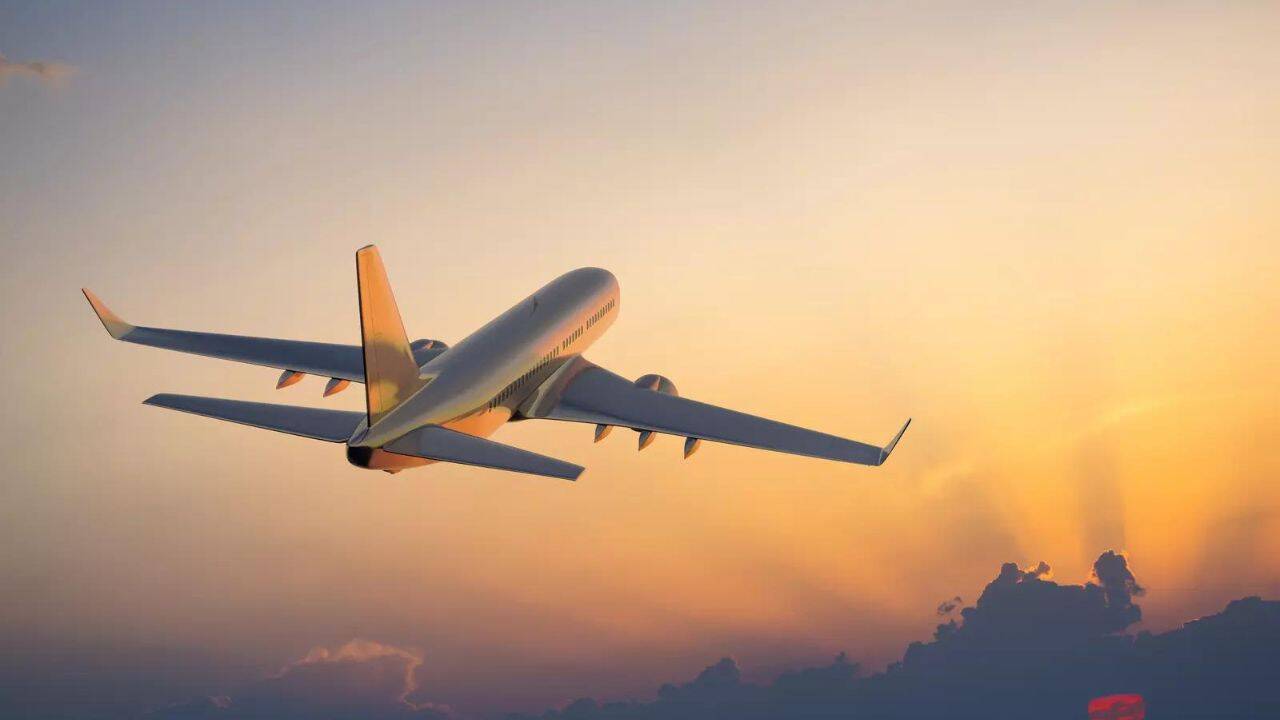
You're sitting at 35,000 feet somewhere over central Europe, half-asleep with your headphones on, when the plane suddenly banks hard and starts dropping faster than a normal descent. No warning. Just a sharp turn and a tense voice over the intercom telling you the flight is diverting immediately.
Multiple flights across Europe have been forced down in recent years due to coordinated bomb threats—many of them turning out to be hoaxes, though nobody in the air can afford to treat them that way. While news headlines love the phrase "mid-air chaos," the reality inside air traffic control centers and flight decks is the exact opposite of chaotic. It's a rigid, high-stakes choreography built on decades of aviation security protocols. You might also find this similar article interesting: What the Train Attacker Zimmer Frame Trial Reveals About UK Self Defense Laws.
Most coverage stops at the viral phone footage of passengers walking down mobile stairs onto a remote tarmac surrounded by flashing red lights. They miss the economics, the military intercepts, the psychological warfare behind mass hoax campaigns, and what happens to your rights as a stranded passenger once the bomb-sniffing dogs leave.
The Anatomy of a Coordinated Aviation Scare
When multiple flights in Europe divert due to bomb threats within hours of each other, it's rarely a coincidence. Aviation security analysts and agencies like the European Union Aviation Safety Agency (EASA) have tracked waves of emailed threats targeting airlines, airports, and regional hubs simultaneously. As extensively documented in detailed reports by NPR, the implications are worth noting.
In May 2021, a notorious incident saw Ryanair Flight 4978 forced to land in Minsk, Belarus, under the pretext of a bomb threat—a move later condemned by the International Civil Aviation Organization (ICAO) as an unlawful interference used to arrest a dissident journalist. More recently, across 2023 and 2024, waves of anonymous emailed bomb threats hit dozens of European airports and commercial flights in France, Poland, Greece, and the Baltics.
Here's why these threats work so well as disruption tools.
Airlines operate on a zero-tolerance risk model. Even if an intelligence agency suspects an email came from an automated bot farm or a known nuisance actor, the captain and the airline's operations center don't have the luxury of gambling with 180 lives. If a threat meets specific credibility thresholds—or simply can't be ruled out fast enough—the aircraft goes down. Period.
What Actually Happens in the Cockpit and on the Ground
Forget Hollywood depictions of panicking pilots. The moment a threat reaches an airline's security desk, a strict chain reaction kicks off.
First, the airline's Security Operations Center assesses the threat alongside national law enforcement. If they decide the flight must divert, they notify the relevant Air Navigation Service Provider—like Eurocontrol or national bodies such as NATS in the UK or DFS in Germany.
Then comes the squawk code.
The pilots dial 7700 (general emergency) or 7500 (unlawful interference, depending on the exact nature of the threat) into their transponder. That four-digit code lights up radar screens across the sector. Instantly, air traffic controllers clear the airspace beneath and ahead of the aircraft. Other commercial jets are vectored out of the way so the threatened flight gets a straight, uninterrupted descent to the nearest suitable airport.
When Fighter Jets Show Up Outside Your Window
If a flight loses radio contact or a threat is deemed severe, national air forces launch Quick Reaction Alert (QRA) interceptors. Passengers looking out the left window might suddenly see a Eurofighter Typhoon, Dassault Rafale, or F-16 flying wingtip-to-wingtip just meters away.
Those fighter pilots aren't there to shoot the plane down—that's an absolute last resort reserved for confirmed 9/11-style scenarios. Their primary job is visual inspection and escort. They check the fuselage for visible damage, verify whether the pilots are responsive in the cockpit, and shepherd the airliner into a designated isolation zone at the diversion airport.
The Remote Stand Protocol
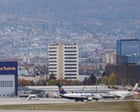
Once the wheels touch the runway, the plane doesn't taxi to Terminal 2. It rolls to a far corner of the airfield, well away from fuel farms, terminals, and other parked jets.
- Engine shutdown and slides vs. stairs: Unless there is immediate smoke or fire, captains avoid deploying emergency evacuation slides. Slides injure people—broken ankles and friction burns happen constantly during evacuations. Instead, mobile stairs are brought up, and passengers disembark leaving every single carry-on bag behind.
- Secondary screening: Buses take passengers to a secure holding area where local police re-screen everyone and their personal documents.
- Baggage sweep: Explosive ordnance disposal (EOD) teams and detection dogs systematically empty the cargo hold and overhead bins, matching every bag to a passenger manifest. That process alone takes four to six hours on a narrow-body jet like an Airbus A320 or Boeing 737.
Why European Airspace Is Uniquely Vulnerable to Hoax Waves
Europe's geography makes mass diversions particularly messy. Unlike a domestic cross-country flight in the United States, a two-hour hop from London to Warsaw or Paris to Rome crosses four or five sovereign jurisdictions.
Each country has its own national police force, civil aviation authority, and military command. Coordinating a diversion over central Europe means handing off responsibility across borders in real time.
There's also the sheer density of European traffic. According to Eurocontrol data, European skies regularly handle over 30,000 flights a day during peak seasons. Closing a single major runway for three hours while bomb squads sweep a diverted plane creates a domino effect. Missed slots, timed-out flight crews, and grounded aircraft ripple across the continent by dinner time.
Bad actors know this. You don't need explosives to paralyze a regional airline network anymore—you just need an encrypted email account, a VPN, and a list of flight numbers scraped from Flightradar24.
The Hidden Financial Toll Nobody Mentions
Diverting a commercial airliner isn't cheap. Aviation economists estimate that a single unscheduled diversion of a narrow-body aircraft costs an airline anywhere from $15,000 to over $50,000. For a wide-body long-haul jet like a Boeing 777 or Airbus A350, that figure easily crosses $100,000.
Where does that money go?
- Dumped or burned fuel: Planes take off heavy. If a long-haul flight has to land an hour after departure, it's often above its maximum structural landing weight. Pilots either have to fly holding patterns to burn fuel or dump thousands of gallons of jet fuel mid-air before touching down.
- Unscheduled landing and handling fees: Airports charge steep fees for emergency landings, remote stand security, and last-minute ground handling crews.
- Crew duty limits: Pilots and flight attendants operate under strict legal flight-time limits set by EASA. A four-hour security sweep on the ground usually means the original crew "times out." The airline has to fly in a relief crew or put 180 passengers in hotels overnight.
- Aircraft positioning: That diverted plane was supposed to fly three more legs that day. Now it's stuck in Bucharest or Lyon, stranding hundreds of other travelers waiting at different airports.
When ten flights divert on the same afternoon, airlines bleed millions of dollars in operational losses—and almost none of it is recoverable because the perpetrators are rarely caught or financially solvent.
What Passengers Actually Need to Know About Their Rights
If you ever find yourself on a flight diverted due to a bomb threat, the confusion on the ground can feel worse than the flight itself. Knowing how European aviation law treats security diversions saves you from wasting time arguing at the wrong desk.
Under EU Regulation 261/2004 (and its UK equivalent, UK261), airlines normally owe passengers up to €600 in cash compensation for delays exceeding three hours. Bomb threats are an automatic exception.
Because security threats and air traffic control restrictions fall under "extraordinary circumstances" completely outside the airline's control, you will not get cash compensation for the delay. Don't waste your energy filing a claim through third-party compensation sites—they'll reject it or take a cut of nothing.
What the Airline Still Owes You
Even though you won't get cash compensation, your Right to Care under EU261 remains 100% intact. Regardless of why the plane diverted, the operating airline is legally required to provide:
- Meals and refreshments proportional to the waiting time (usually once delays pass two hours).
- Hotel accommodation if the security sweep forces an overnight stay, plus transport between the airport and the hotel.
- Re-routing on the earliest available flight to your final destination at zero extra cost—even if that means booking you onto a rival airline when their own flights are full.
Practical Steps If Your Flight Diverts
If you're ever sitting on a plane that makes an unscheduled emergency landing for a security sweep, follow these steps immediately once you reach the terminal holding area:
- Leave your bags during disembarkation, no exceptions. Trying to grab a backpack from an overhead bin slows evacuation and immediately flags you as a person of interest to armed police waiting at the bottom of the stairs.
- Keep your passport and phone in your pocket before takeoff. If you put your jacket and passport in the overhead bin, you'll spend hours in a sterile holding room without ID or a charger while EOD teams clear the cabin.
- Screenshot your boarding pass and delay notices. Once the airline rebooks you, digital boarding passes often vanish from airline apps, making expense reimbursement harder later.
- Book your own hotel and food if the airline collapses. During multi-flight disruptions, ground staff at small diversion airports get overwhelmed fast. If no vouchers appear within two hours, pay for reasonable meals and a mid-range hotel yourself, keep itemized receipts (not just credit card slips), and submit them directly through the airline's EU261 expense portal.
- Check your travel insurance policy. While EU261 won't pay cash for security delays, many comprehensive credit card travel policies include "trip delay" coverage that pays out $200 to $500 per ticket once a delay hits six or twelve hours, regardless of the cause.
Airlines and intelligence agencies continue tightening pre-flight digital screening to filter out automated hoax campaigns before planes ever leave the gate, keeping European skies among the safest in the world despite the occasional afternoon of grounded jets and delayed connections.