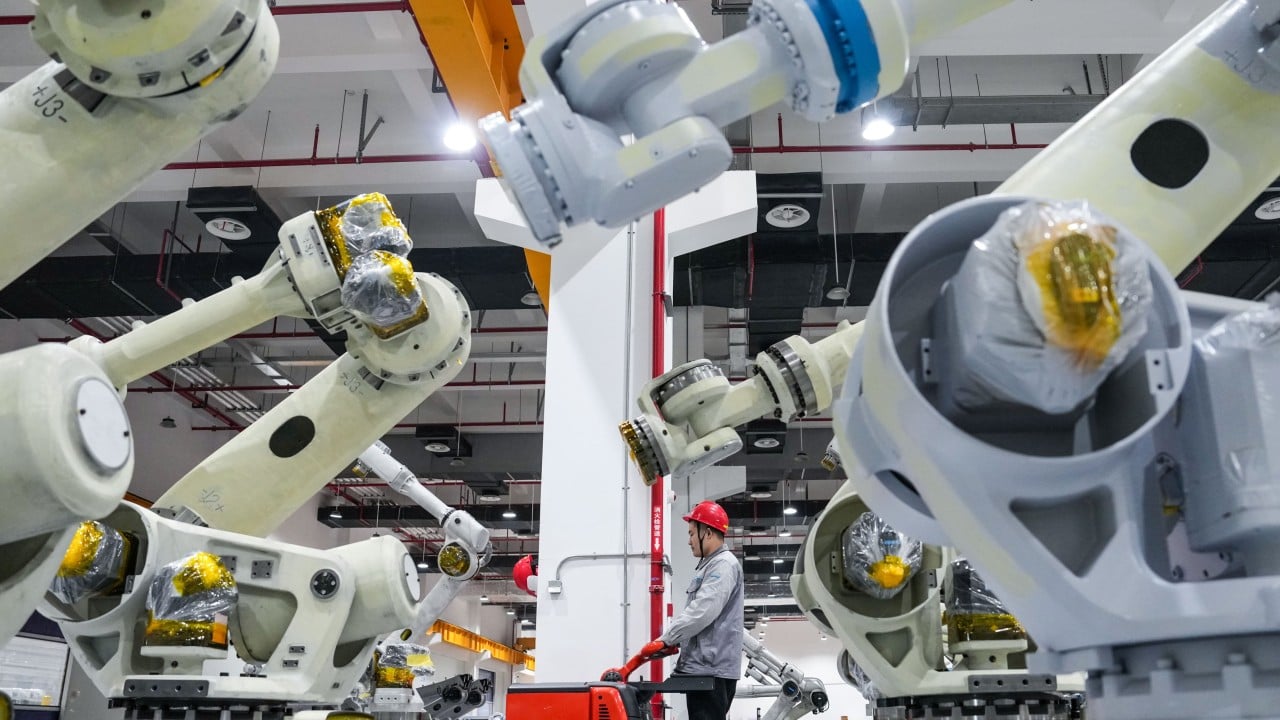
The investment world is currently obsessed with a comfortable, shiny lie: that Asia’s dominance in the physical supply chain—the silicon, the substrates, and the assembly lines—guarantees it a seat at the head of the AI table. Jenny Foo at Granite Asia and a chorus of venture capitalists are betting big on the idea that "proximity to the factory floor" is the ultimate moat.
They are dead wrong.
We are watching a repeat of the 1980s PC revolution, where IBM and the hardware titans did the heavy lifting while Microsoft and Intel captured the value. Only this time, the gap between the "builders" and the "owners" is an abyss. Owning the supply chain in an AI world is like owning the world's best paper mill in the age of the internet. You’re busy, you’re essential, and you’re broke compared to the people writing the code.
The Manufacturing Trap
The consensus view suggests that because Asia (specifically the "Dragon" economies and Southeast Asia) controls the logistics and the hardware fabrication, it will naturally pivot to AI leadership. This ignores the brutal reality of margin compression.
In the semiconductor world, Taiwan’s TSMC is a god among mortals. But TSMC is a foundry. It is a service provider. In 2023, while Nvidia’s gross margins touched nearly 74%, the companies actually assembling the "AI boxes" in Asia were fighting for scraps.
If you look at the ethnic breakdown of the global AI workforce, the "Asia advantage" looks even more lopsided. A 2023 study from the Paulson Institute’s MacroPolo found that while China produces a massive percentage of the world’s top-tier AI researchers (roughly 47%), the vast majority of them—nearly 60%—end up working in United States-based institutions.
Asia is effectively a talent and hardware farm for Silicon Valley. You can build the most efficient supply chain in Malaysia or Vietnam, but if the intellectual property, the weights of the models, and the proprietary data sets are sitting in servers in Ashburn, Virginia, you aren't a competitor. You’re an employee.
Logic vs. Logistics
The "Supply Chain Edge" argument falls apart because AI is not a physical product. It is an optimization layer.
I have watched hardware-first companies in Singapore and Shenzhen burn through hundreds of millions trying to "verticalize." They think that because they can build a custom ASIC (Application-Specific Integrated Circuit) cheaper than a US startup, they win. They forget that by the time their chip is taped out and manufactured, the software architecture has shifted.
The US has something Asia’s supply chain can’t replicate: Architectural Flexibility.
In the US, the feedback loop between the software engineer at OpenAI and the hardware designer at Nvidia is instantaneous. In the "supply chain" model, there is a lag. You are building to spec. But in AI, the spec changes every Tuesday.
The Sovereignty Myth
Governments across Southeast Asia are pouring billions into "Sovereign AI." They want their own LLMs trained on local data. They cite cultural nuance as the "moat."
This is a vanity project.
Language and culture are thin veneers over the underlying logic of transformer models. A model trained on 10 trillion tokens of global data will understand Thai or Vietnamese nuances better than a "sovereign" model trained on a fraction of that data, simply due to the emergent properties of scale.
By focusing on the supply chain, Asian markets are doubling down on Linear Growth in an era of Exponential Returns.
- Linear: Building a bigger factory to produce more H100 components.
- Exponential: Using 10,000 H100s to automate the design of the next 100,000 chips.
The US is focused on the latter. Asia is still focused on the former.
The High Cost of "Efficiency"
Asia’s strength has always been efficiency—squeezing every cent out of a process. But AI development is inherently inefficient. It requires massive, "wasteful" R&D, high failure rates, and a tolerance for burning billions on models that might be obsolete in six months.
The supply chain mindset hates waste. It prizes Six Sigma, JIT (Just-in-Time) delivery, and predictable yields. This is the exact opposite of the "Move Fast and Break Things" ethos required to lead in generative intelligence.
I’ve sat in boardrooms in Tokyo and Seoul where projects were killed because the ROI couldn't be calculated to the third decimal point. Meanwhile, Sam Altman is out here trying to raise $7 trillion for a future he can't even fully describe yet. You cannot "optimize" your way to a breakthrough.
The Data Desert
The most glaring hole in the "Asia Strength" narrative is the data.
While Asia has the most internet users, the data is fragmented across high-walled gardens like WeChat, Kakao, and Line. These are not open ecosystems. The US, for all its flaws, operates on a relatively unified English-speaking data layer that powers the global standard.
If you are building AI in a supply-chain-heavy environment, you are looking at the world through a keyhole. You see the flow of goods, but you don't see the flow of intent.
The Wrong Side of the Power Curve
Let's look at the actual numbers of the "AI Race."
The US attracted $67.2 billion in AI venture investment in 2023. China, the nearest "supply chain" rival, pulled in $7.9 billion. The gap isn't closing; it's widening. The "supply chain" is a consolation prize for countries that can't figure out how to foster a software-first ecosystem.
Stop asking how Asia’s factories will help it win the AI race. They won't. They will just make the winners’ hardware cheaper to produce.
If you want to win, stop looking at the assembly line and start looking at the model weights. The value is migrating from the atom to the bit, and the people holding the soldering irons are going to be the last ones to realize the power has been cut.
Don't buy the "supply chain" hype. It's a trap designed to keep you investing in the low-margin basement of the future.
Build the mind. Let someone else build the box.