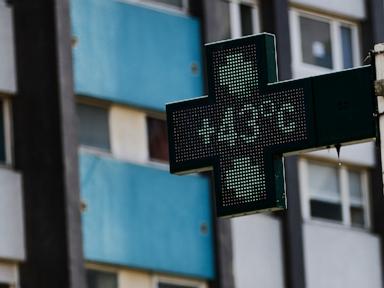
When Météo-France triggers a heat red alert over France, it isn't just warning people to stay indoors. It's signaling that the climate math has broken down. For decades, Western Europe treated extreme heat as a freak occurrence, a multi-decade anomaly that you handled with a few extra bottles of water and an extra fan. That era is over. A red alert is the highest possible level of meteorological warning in the French system, meaning that the weather poses a direct, severe threat to public health and daily infrastructure.
We are seeing temperatures that don't just edge past old records but shatter them entirely. When towns in southern France start registering temperatures North Africa usually sees, it forces a complete rewrite of how cities run, how energy is produced, and how people survive. You can't just brush this off as a hot week. It's a fundamental shift in the continent's geography of habitability.
The real issue isn't just the daytime peak. It's the nights. When the air stays suffocatingly warm after dark, the human body never gets a chance to cool down, causing heat stress to compound rapidly day after day.
What a heat red alert over France actually means for infrastructure
Most people think a heatwave is an individual health crisis. It is, but it's also an infrastructure crisis. European cities were built to retain heat, not shed it. Thick stone buildings, narrow streets, and a historic lack of widespread air conditioning turn cities like Paris, Lyon, and Marseille into massive heat blocks.
When a heat red alert over France goes live, the state gains emergency powers to shut down public events, restrict travel, and even close down outdoor workplaces. The economic toll hits instantly. Here is what happens behind the scenes when the thermometer spikes past the danger threshold.
Nuclear power plants go offline
France relies heavily on nuclear energy for its electricity. But these plants need water from rivers to cool their reactors. When river temperatures rise too high, or water levels drop too low, dumping hot wastewater back into the river would completely wipe out local aquatic ecosystems. The government faces a brutal choice: keep the power on and boil the local rivers, or throttle electricity production just when everyone needs fans and cooling systems. During severe spikes, energy giant EDF routinely cuts output or shuts down reactors entirely, forcing France to import power from neighbors.
Transport grids literally buckle
Railways are vulnerable. Steel tracks expand under direct, intense sunlight. If they expand too much, they bend out of shape, a process engineers call sun kinks or track buckling. When temperatures push past 40 degrees Celsius (104 degrees Fahrenheit), train operators have to slow down express lines drastically to prevent derailments. Asphalt on highways can soften, and overhead electrical lines sag, stalling commuter networks and cutting off supply lines precisely when cities are most vulnerable.
The ghost of 2003 and the French response system
To understand why French authorities react so aggressively today, you have to look back at August 2003. That summer, a catastrophic heatwave struck Europe, resulting in an estimated 15,000 deaths in France alone. The healthcare system collapsed under the weight of the crisis, morgues ran out of space, and refrigerated warehouses had to store bodies. It was a national trauma.
The biggest failure in 2003 was societal and bureaucratic. Thousands of elderly citizens lived alone in top-floor apartment units—often called chambres de bonne—which lack insulation and bake under tin roofs. Many died unnoticed because their families were away on traditional August vacations and hospitals were understaffed.
France learned its lesson the hard way. The national Plan Canicule was born from that disaster. Today, a red alert activates a massive, coordinated machine:
- Local municipalities use registered databases to actively call and check on vulnerable, elderly, or isolated residents.
- Public "cool rooms" are opened in every district, ranging from air-conditioned municipal halls to shaded parks kept open 24 hours a day.
- Emergency services shift schedules to maximize staffing on the streets and in emergency departments.
The aggression of the current alert system is a direct response to past negligence. Authorities know that waiting until people start filling up emergency rooms means you're already too late.
Breaking down the temperature data
We aren't just seeing minor temperature bumps. The speed at which records are falling is alarming climate scientists. For a long time, the highest temperature ever recorded in France was 44.1 degrees Celsius, set during that brutal 2003 disaster. That record stood for sixteen years.
Then came 2019. In the small southern town of Vérargues, the mercury hit an astonishing 46.0 degrees Celsius (114.8 degrees Fahrenheit). Think about that number for a second. That is a temperature associated with the Mojave Desert, recorded in a region famous for producing delicate wines and olive oil.
The issue is frequency. What used to be a once-in-a-career weather event for meteorologists now happens multiple times a decade. The heat domes—massive areas of high pressure that trap hot air underneath them like a lid on a boiling pot—are expanding farther north, pulling scorching air straight from the Sahara across the Mediterranean.
Survival tactics for locals and travelers
If you find yourself in the middle of a red alert zone, your standard holiday or work routine has to stop. The midday sun becomes genuinely dangerous. Locals know the drill, but tourists frequently get caught off guard, assuming they can push through with sheer willpower. You can't.
The rule of the shutters
In France, managing heat is about prevention. You close the heavy exterior window shutters (volets) the moment the sun hits that side of the house. You keep windows tightly shut during the peak heat hours to seal the cooler night air inside. Opening windows at 2 PM just lets the furnace outside blow directly into your living room. You only open them up late at night when the outside air finally drops below the indoor temperature.
Water over everything
Hydration sounds obvious, but it's easy to misjudge. When the air is dry and hot, your sweat evaporates instantly, meaning you don't realize how much water you're losing. Public fountains in major French cities are re-engineered to provide drinking water, and misting stations are deployed in high-traffic zones. If you're out, carry water, skip the afternoon wine, and seek out thick-walled historic stone churches, which often remain cool inside even without air conditioning.
The long-term shift in European life
We have to accept that these alerts are reshaping the cultural and economic calendar of the region. The idea of the classic Mediterranean summer vacation is shifting. Tourists are starting to look toward Scandinavia or northern coasts because spending a week in 43-degree heat in Provence isn't a vacation; it's an exercise in survival.
Agriculture is adjusting too. Wine growers in Bordeaux and the Rhône Valley are noticing that grapes are ripening too fast, spiking sugar levels and altering the alcohol content of traditional vintages. Some vineyards are buying land further north or looking into heat-resistant grape varieties just to keep their businesses viable for the next generation.
The immediate next steps aren't about changing the global climate overnight; they are about immediate adaptation. Cities must aggressively plant urban forests to break up asphalt heat islands. Building codes must change to require insulation that keeps heat out, not just in. If you live in or are traveling through an area facing a red alert, cancel your midday plans, check on your neighbors, and treat the heat with the same respect you would give a category four hurricane. It is a major natural hazard, and it demands exactly that level of caution.


