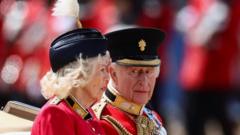
Rain in London does not merely fall. It seeps into the limestone of Whitehall, softens the bear-fur of six-foot-tall caps, and turns the gravel of Horse Guards Parade into a gray, shifting soup.
To the casual observer watching on a screen from three thousand miles away, Trooping the Colour is a masterpiece of clockwork precision. It looks like a living oil painting. Emerald tunics, rhythmic thuds of polished leather boot heels, and the gleam of brass under a stubborn British sky. It is the King’s official birthday, a tradition stretching back through generations of monarchs, designed to display the ultimate manifestation of state order. Meanwhile, you can read other stories here: Why Words Matter More Than Weapons in Africa's Peace Mission.
But look closer. Zoom past the sweeping television lenses and focus on the individual human beings standing on that gravel.
There is a private in the Welsh Guards. Let us call him Thomas. He is twenty-two years old. He has spent the last four hours upright, his spine locked into a posture that defies human anatomy. Underneath his thick woolen tunic, sweat is pooling despite the chill June air. His feet lost feeling forty-five minutes ago. A swarm of gnats is hovering around his eyes, but he cannot blink. To scratch an itch is to break a spell. To faint—a very real hazard when blood pools in the legs during prolonged standing—is to fail publicly, falling face-first onto the stones while the world watches. To understand the bigger picture, check out the excellent article by Al Jazeera.
This is the hidden friction of monarchy. We treat these pageants as automated spectacles, but they are entirely powered by fragile, aching human machinery.
The Weight of the Bear Fur
The event centers on a deceptively simple ritual. A regiment flags—their "Colour"—is marched, or trooped, down the ranks of soldiers so every man knows exactly what banner to follow into the chaos of combat. Historically, it was a matter of life and death on smoke-blinded battlefields. Today, it is a theater of continuity.
But continuity is exhausting.
Consider the physical reality of the uniform. A standard bearskin cap weighs roughly one and a half pounds. When dry. If the London drizzle turns into a downpour, that skin absorbs water like a sponge, doubling in weight and pulling down on the neck muscles with every sudden turn of the head. The chin strap cuts into the skin, a constant, sharp reminder of the posture required.
Then there is the music. The massed bands strike up a march, a wall of sound that vibrates through the ribs of everyone present. It is designed to stir the soul, but for the men and women keeping time, it is a strict metronome of survival. Step. Step. Step. A single fraction of a second off-beat, a single boot hitting the mud out of unison, and the entire illusion of the monolithic state cracks.
We live in an era that values the casual, the frictionless, the immediate. We communicate in emojis and work in sweatpants. Yet, once a year, thousands of human beings gather in the center of London to do something deliberately difficult, absurdly uncomfortable, and agonizingly slow. Why?
Because difficulty creates reverence.
When you see a line of soldiers moving as a single organism, your brain registers the immense human effort required to achieve that perfection. It is a display of collective discipline that feels almost alien to modern life. It whispers that some things are still worth a great deal of trouble.
The Sovereign’s Stride
At the center of this orbit stands a man who knows a different kind of weight.
King Charles III rides into the parade ground. In previous decades, the monarch would remain on horseback for the duration of the ceremony, a display of martial vigor. But time and health alter all scripts. The transition to a covered carriage in recent years was not just a logistical choice; it was a public concession to the reality of aging and recovery.
Imagine the internal calculation of a man facing his seventy-sixth year, navigating the aftermath of a cancer diagnosis, stepping out under the glare of global scrutiny. The public demands a symbol of unshakeable permanence. The body, however, remains stubbornly mortal.
When the King steps out of the carriage to take the salute, there is a collective, unspoken intake of breath from the crowd packed along the Mall. It is a brief moment. A five-foot walk from the carriage step to the dais. But in that short distance lies the entire gamble of modern constitutional royalty. Can the individual sustain the myth?
Every movement is measured. The raise of the hand to the peak of the cap. The steady set of the shoulders. It is a performance of duty, executed by someone who knows that any sign of frailty will be dissected by commentators across the globe within minutes. The crown is not just an object in the Tower of London; it is a permanent atmospheric pressure pressing down on a single pair of shoulders.
The View from the Balcony
The ceremony eventually migrates away from the muddy parade grounds, moving up the Mall toward the stone facade of Buckingham Palace. This is where the public ritual shifts from military discipline to family drama.
The balcony appearance is the grand finale, accompanied by the roar of the Royal Air Force flypast cutting through the low clouds. Red, white, and blue smoke trails paint the gray sky, a temporary roof over the capital.
But look away from the airplanes. Look at the faces on the balcony.
You see three generations of a family standing shoulder to shoulder. There is Prince George, Princess Charlotte, and Prince Louis. To the world, they are symbols of the future, the unbroken chain of succession. To anyone who has ever managed young children in a formal setting, however, the scene is instantly recognizable. It is a high-wire act of parental anxiety.
Princess Catherine stands beside them, her presence carrying its own profound narrative weight given her own recent health battles. The smiles are fixed, the waves are practiced, but the eyes tell a story of intense concentration. The children must be kept still. Louis’s famous, irrepressible animated reactions must be gently managed. The family is fully aware that a single stray grimace or a restless squirm will become a meme before the flypast has even cleared the airspace over Heathrow.
They are a family living inside a glass clock. Every tick, every gear turn, is public property.
The Echo in the Mud
As the aircraft fade into the distance, leaving only the smell of aviation fuel and the damp tang of wet wool in the air, the crowds begin to disperse. The flags are furled and returned to their secure cases. The horses are led back to their stables, their flanks steaming in the cool air.
Thomas, our hypothetical private, finally receives the order to dismiss. He marches off the gravel, his legs burning, his shoulders aching with a deep, bruised fatigue. He will return to the barracks, peel off the damp wool tunic, and spend the next hour cleaning his kit for the next duty. There are no medals for standing still. There is only the quiet satisfaction of having held the line.
We often mistake these events for simple nostalgia, a quaint leftover from an empire that no longer exists. But that misses the point entirely.
Trooping the Colour survives because it is a grand, secular liturgy. It is an annual rehearsal of an old promise: that despite the chaos of politics, the volatility of the economy, and the relentless march of time, there is a structure that holds. It is a promise kept not by institutions or computers, but by the aching muscles of young soldiers, the forced smiles of children, and an old man standing straight in the rain.
The red smoke dissolves into the gray London sky, leaving behind nothing but the quiet thud of a single drum beating a retreat.


