The fluorescent lights in a county budget hearing room always hum at a pitch just low enough to give you a headache by hour three. You sit on a folding chair that squeaks every time you shift your weight, staring at spreadsheets projected onto a pull-down screen. Line items blur together. Road maintenance. Library hours. Clinic funding. Legal defense reserves.
Most people never visit these rooms. They trust that the people wearing stars on their chests and suits behind the dais are keeping the machinery of civic life running without turning the gears into weapons.
Then you look closer at the ledger, and you realize the bill for someone else’s political performance has just been handed to you.
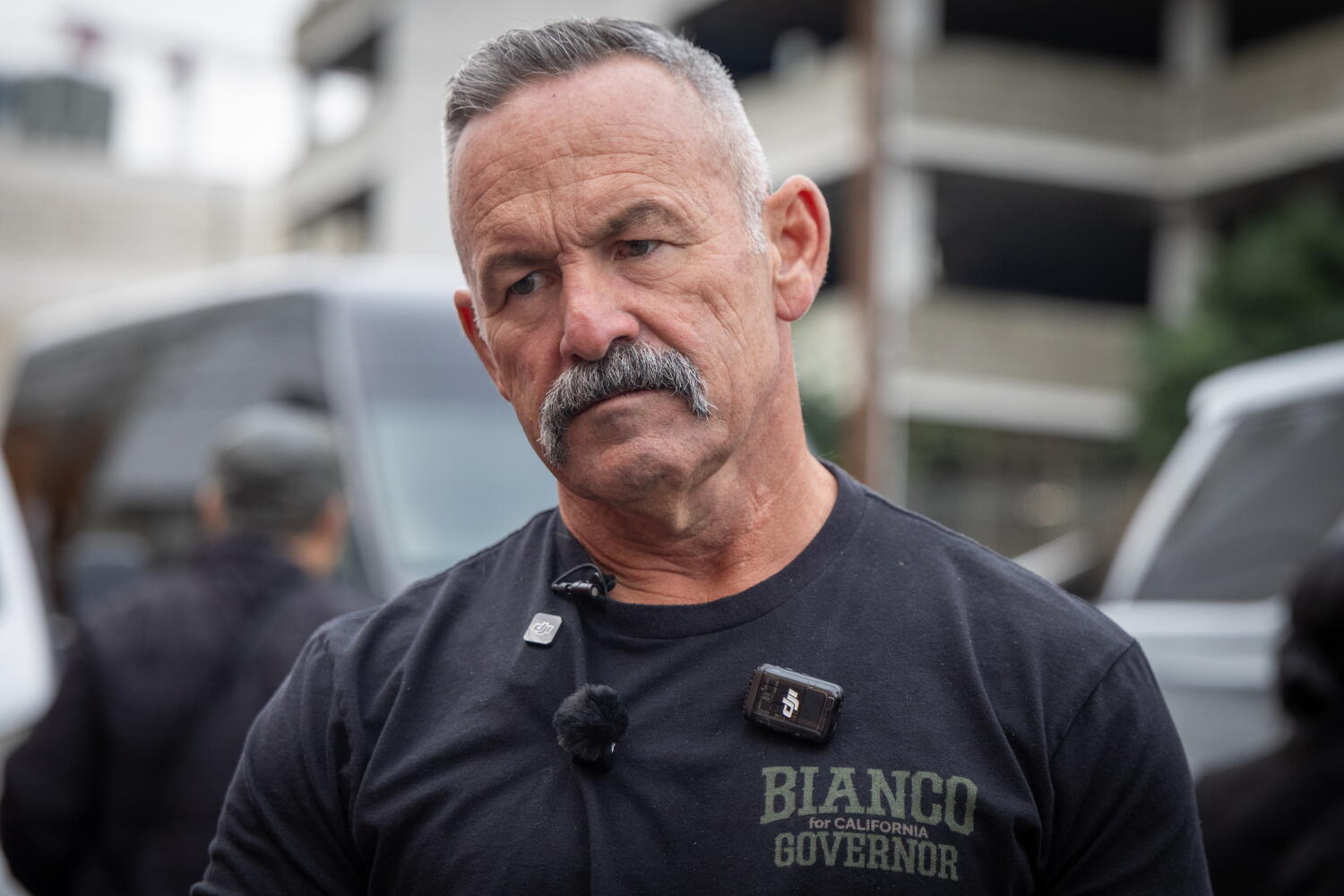
That is the quiet, infuriating reality unfolding in Riverside County, California, where Sheriff Chad Bianco decided that the machinery of his office belonged not to the taxpayers who fund it, but to the political theater of a presidential campaign. When a top law enforcement officer steps out of the patrol car and onto the partisan stage—using the weight, symbols, and resources of his badge to flatter a political figure—he does more than breach etiquette. He cracks the foundation of public trust. And when that breach invites legal blowback or Ethics Commission scrutiny, the most insulting part isn't the posturing itself. It is the expectation that the residents of his county should pick up the tab.
The Weight of the Brass
To understand why a single speech or a uniformed endorsement carries so much voltage, you have to strip away the noise of modern cable news and look at what a sheriff actually is.
Think of the badge not as a piece of jewelry, but as a borrowed key. A community hands that key to one person, granting them the extraordinary authority to detain, to arrest, to use force, and to decide where limited public protection goes. In exchange, the holder of that key agrees to an unspoken covenant: the power will be exercised without fear, without favor, and strictly outside the partisan arena.
When Sheriff Chad Bianco stood before cameras, decked out in the full regalia of his office, to declare his allegiance to Donald Trump—going so far as to lament that it was "time to put a felon in the White House"—he didn't just express an opinion. Every American has the right to a political opinion. Bianco has every right to stand at a podium in a button-down shirt and khakis on a Saturday afternoon and say whatever he wants about presidential politics.
He chose not to take off the uniform.
That distinction is everything. In uniform, flanked by the seals and symbols of Riverside County, Bianco wasn't speaking as a private citizen named Chad. He was speaking as the state. He was using the institutional authority paid for by every Democrat, Republican, and independent in his jurisdiction to score points in a national partisan brawl.
Consider a hypothetical scenario to see how quickly that line blurs on the street. Imagine you are a small business owner in Palm Springs or Corona. You have a dispute over a local permit, or your shop gets broken into, and you need the sheriff’s department to respond objectively. Now imagine you had a yard sign in front of your house supporting the opponent of the candidate your sheriff just enthusiastically endorsed while wearing his gun and badge. Even if the responding deputy is a consummate professional, a seed of doubt has been planted. Am I getting full protection, or am I on the wrong team?
Once that question enters a community's bloodstream, policing stops being a public service and starts looking like a protection racket.
Following the Paper Trail
Political theater is rarely free. In California, the rules governing how public officials use public resources are written in plain, unambiguous ink—precisely because history has shown how easily incumbents turn taxpayer-funded offices into campaign headquarters.
Under California’s Government Code and the regulations enforced by the Fair Political Practices Commission, public officials are strictly barred from using public resources—whether that means patrol cars, staff time, official social media accounts, or even the taxpayer-funded uniform worn during official duties—for campaign activity. The law doesn't care which party benefits. It cares about theft. Using public assets for political gain is, at its core, an unauthorized transfer of wealth from the public treasury to a political cause.
Bianco’s foray into Trump-world politics wasn't a slip of the tongue at a backyard barbecue. It was a calculated, high-production moment. Videos were filmed, distributed, and amplified across social media platforms—including channels tied to his official capacity. When critics, watchdog groups, and everyday residents pushed back, pointing out the obvious collision between state law and partisan grandstanding, the defensive crouch began.
And here is where the story shifts from an ethics violation to a pocketbook insult.
When an elected official steps outside the boundaries of their job description and lands in legal or regulatory trouble, a question immediately arises: Who pays the lawyers? Who pays the fines?
In almost every county across America, public officials are indemnified for actions taken within the scope of their employment. If a sheriff gets sued over a department policy or an operational decision made in good faith, the county covers the defense. That makes sense. Otherwise, no sane person would ever take the job.
But campaigning is not the job. Pandering to a presidential candidate is not the job. Mocking the justice system you are sworn to uphold while wearing a county-issued uniform is the exact opposite of the job.
If an investigation is launched, if an ethics complaint sticks, or if a lawsuit challenges the misuse of public property, every dollar spent defending that conduct out of the county’s general fund is a dollar stolen from somewhere else. It is a dollar taken away from cold-case detectives. It is a dollar shaved off mental health crisis teams. It is a dollar that isn't fixing a pothole on a rural highway.
The Architecture of Impunity
Why do officials keep doing this? Why risk the credibility of the badge for a thirty-second clip on a national news broadcast?
The answer lies in the warped incentives of modern political ambition. Local office used to be a destination; increasingly, it is treated as an audition stage. A county sheriff in Southern California has a massive platform, a built-in media apparatus, and an aura of tough-guy authority that national political consultants salivate over. By leaning into national partisan grievances, a local official can bypass the slow, unglamorous work of reducing jail deaths or improving response times and rocket straight into the national spotlight.
It is a shortcut. And like most shortcuts in public life, it leaves wreckage behind.
Look at the broader pattern across the country over the last decade. We have watched a steady erosion of the wall separating law enforcement from political activism. From "constitutional sheriffs" who claim the authority to decide which federal laws they feel like enforcing, to county officials appearing as warm-up acts at national rallies, the uniform is being weaponized for personal branding.
I remember talking to a retired deputy in a diner outside San Bernardino a few years ago—a man who spent thirty years working night shifts, breaking up domestic disputes, and notifying families when their kids didn't make it home from a highway crash. He stared into his coffee cup and shook his head when the topic of political sheriffs came up. "When I put that shirt on," he told me, "I had to leave my politics in my locker. If I didn't, I couldn't walk into half the houses on my beat and expect people to talk to me. These guys today think the badge is a megaphone. It's supposed to be a shield."
That distinction—megaphone versus shield—cuts right to the bone of what is happening in Riverside County.
A shield protects everyone standing behind it, regardless of how they voted in November. A megaphone only amplifies the person holding it.
The Price of Accountability
When an official uses their office as a megaphone, accountability cannot be an abstract concept. Saying "he shouldn't have done that" in an editorial or shaking a finger during a board of supervisors meeting accomplishes nothing. In politics, if the penalty for breaking the rules is simply getting more media attention, then the penalty is actually a reward.
Real accountability requires hitting the one nerve that politicians actually feel: personal financial responsibility.
If Chad Bianco wanted to film a campaign pitch for Donald Trump, there was a simple, legal way to do it. He could have clocked out. He could have gone home, taken off the tan uniform, unclipped the badge, stepped away from the county seals, and stood in front of a neutral wall in his own clothes. Had he done that, nobody would have a legal leg to stand on. It would have been pure, protected political speech.
Instead, he chose to borrow the prestige and property of Riverside County to make his point. He wanted the authority of the office to validate his political stance.
Therefore, the consequences of that choice belong to him alone. Not to the schoolteacher in Temecula paying property taxes. Not to the nurse in Moreno Valley watching sales tax get deducted from every grocery run. Not to the county’s legal defense fund, which exists to protect the public, not to subsidize an elected official’s side hustle as a political surrogate.
If fines are levied by state ethics watchdogs, the check must come from Bianco’s personal bank account or his campaign committee—never from county coffers. If outside counsel is required to untangle the mess he created by blurring the line between sheriff and partisan operative, the invoice should be mailed directly to his house.
What Happens When No One Pays
It is easy to dismiss a single sheriff’s political grandstanding as just another drop in an ocean of daily political absurdity. We are exhausted by outrage. Our capacity to be shocked by officials coloring outside the lines has been worn down to a nub.
That exhaustion is precisely what boundary-pushers count on. They bet that you will shrug, scroll past the headline, and let the county quietly absorb the legal costs while they ride the wave of partisan applause toward their next campaign—perhaps even a run for governor, a path Bianco has openly flirted with.
Watch what happens if that bet pays off.
If a sheriff can wear his uniform to endorse a candidate, use county-linked platforms to broadcast it, and walk away without paying a dime out of his own pocket when the legal bills arrive, then the law isn't a guardrail anymore. It’s a suggestion. Every department head, every district attorney, every county clerk watching from the sidelines gets the message loud and clear: The taxpayers will underwrite your ambition.
Civic life doesn't collapse all at once. It erodes through a thousand small surrenders—moments where we decide it is too much trouble to enforce the rules on people who hold power.
Walk back into that county hearing room for a moment. Picture the spreadsheets on the wall again. Every line item represents a real person’s life, a real community need, a real promise made between citizens and their government.
Somewhere on those pages, buried beneath routine administrative expenses, is the cost of defending an official who forgot who he works for. Look at the numbers. Then look at the badge. Someone has to pay for the show, and it shouldn't be the people sitting in the folding chairs.