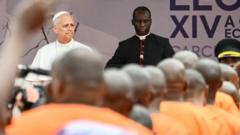
The humidity in Malabo does more than just make you sweat. It clings. It carries the scent of salt from the Atlantic and the heavy, metallic tang of an oil-rich nation that has forgotten its own people. When Pope Leo’s white robes touched the tarmac of Equatorial Guinea, the contrast was blinding. He arrived as a shepherd in a land where the sheep are often kept behind rusted bars, hidden from the sun-drenched boulevards that the ruling elite call progress.
The headlines will tell you that a religious leader completed a tour of Africa. They will mention diplomatic handshakes and the usual calls for peace. But to understand what actually happened during those final hours, you have to look past the photo ops. You have to look toward the walls of Black Beach prison. Read more on a connected issue: this related article.
The Geography of Silence
Equatorial Guinea is a place of staggering wealth and crushing obscurity. It is the only Spanish-speaking nation in Africa, a quirk of colonial history that has left it somewhat isolated from its neighbors. Thanks to vast offshore oil reserves, its per-capita GDP often rivals European nations. Yet, walk five minutes away from the gleaming government buildings and the reality shifts. The wealth doesn't trickle; it evaporates.
At the heart of this disparity lies the penal system. Black Beach is not just a name; it is a ghost story told to children to keep them quiet, and to adults to keep them compliant. For decades, it has been synonymous with the systemic disappearance of dissent. It is a place where time slows down, not because of peace, but because of the absence of hope. More journalism by The New York Times explores similar perspectives on this issue.
Consider a man like "Mateo"—a hypothetical name for a very real kind of prisoner in Malabo. Mateo isn't a hardened criminal. He might be a teacher who asked why the local school hasn't had new textbooks in a decade. One night, there is a knock. The next morning, he is a number. In a cell designed for two people, he sits with six others. The heat is an physical weight. The water is gray. The silence is the loudest thing in the room.
A Shepherd Among the Wolves
When the Pope stood before the authorities in the capital, he didn't stick to the script of polite platitudes. He spoke about the dignity of the incarcerated. This wasn't a casual suggestion. It was a direct challenge to a regime that has long used its prison walls as a rug under which to sweep the "inconvenient."
The Pope’s criticism focused on a simple, devastating truth: a civilization is measured by how it treats those who have no power to give anything back. In Equatorial Guinea, that measurement is currently a failing grade. The prisons are overcrowded, medical care is a myth, and the legal process is often a foregone conclusion.
He wasn't just talking about floor space or caloric intake. He was talking about the soul of a nation. When a government treats its prisoners as less than human, it begins to view its entire citizenry as a resource to be managed rather than a people to be served. The Pope’s presence was a temporary crack in the wall, letting a sliver of external light into a space that is usually pitch black.
The Invisible Stakes of Oil and Iron
Why does this matter to someone sitting thousands of miles away? Because the iron bars of Black Beach are forged with the currency of global trade. We see the statistics of oil production and the "robust" growth of the Equatoguinean economy, but we rarely see the human cost of that stability. The regime maintains order through a calculated theater of fear.
The Pope’s visit highlighted the friction between two worlds. On one side, the international community wants the oil to keep flowing. On the other, the fundamental rights of the individual are being ground into the dust. By calling out the prison conditions, Leo was essentially saying that no amount of economic success can justify the systematic stripping of human dignity.
It is a difficult thing to admit that our global comforts are often cushioned by the suffering of people in places we can't find on a map. We like to think that progress is a straight line, but in Malabo, it feels more like a circle. The same families stay in power. The same prisons stay full. The same promises are made to every visiting dignitary, only to be filed away as soon as the plane wheels leave the runway.
The Anatomy of an Outcry
Critics of the Papal visit might argue that words are cheap. They might say that once the Swiss Guard and the media entourage leave, the guards at Black Beach will simply go back to business as usual. And they might be right. But words in this context act as a permanent record. They strip away the excuse of ignorance.
Leo’s focus on the prisons was a masterclass in moral leverage. He didn't attack the government's economic policy or its foreign alliances. He went straight for the basement. He looked at the place where the country hides its shame and he pointed a finger.
This wasn't just about Malabo. It was a message sent to every leader across the continent and the world who thinks that "national security" is a valid excuse for torture. It was a reminder that the person in the cell—the teacher, the gardener, the political rival—still has a name. Still has a family waiting for them. Still has a right to breathe air that doesn't smell like decay.
The Weight of the Departure
As the Pope's tour concluded, the air in Equatorial Guinea didn't magically clear. The humidity stayed. The oil pumps kept bobbing in the bight. The guards at Black Beach still held their keys.
But something had shifted in the atmospheric pressure of the country. For a few days, the invisible people were the primary topic of conversation. The "dry facts" of human rights abuses were given a human voice. The Pope left behind a challenge that cannot be un-heard: a nation that builds its palaces on the backs of those it cages is not a nation that is moving forward. It is merely a nation that is very good at hiding its tracks.
The real test begins now. It begins when the cameras are gone and the world’s attention drifts to the next crisis. The iron doors are still shut. The men inside are still waiting. The echo of those criticisms still bounces off the concrete walls, a haunting reminder that while a man can be locked away, the truth of his condition is much harder to contain.
Somewhere in a cell in Malabo, a man might have heard the news of the visit. He might have felt, for a fleeting second, that the world remembered he existed. That hope is a dangerous thing in a place like Black Beach. It is also the only thing that keeps the walls from closing in entirely.
The white plane disappeared into the clouds over the Atlantic, leaving the island of Bioko to its own devices. Below, the jungle remained thick, the oil remained profitable, and the silence returned to the prison corridors—but it was a different kind of silence. It was the silence of a secret that had finally been told out loud.
The sun sets quickly in the tropics. One moment the sky is a bruised purple, and the next, it is total darkness. In that darkness, the lights of the luxury hotels glitter like diamonds, while just a few miles away, the heartbeat of the country remains trapped in a cage of rusted iron and broken promises.