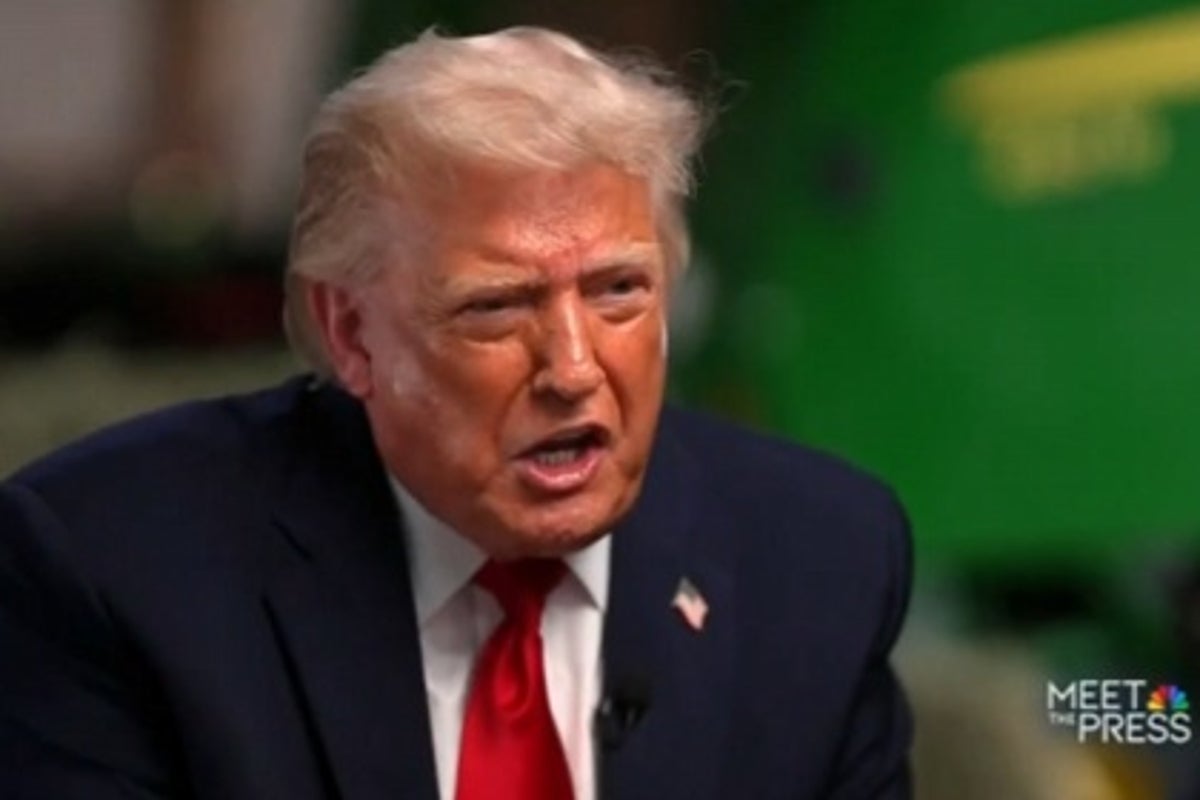
Donald Trump campaigned on a simple, seductive promise to an electorate exhausted by decades of foreign entanglements: "I'm not going to start a war. I'm going to stop wars." Yet, three months into a devastating military conflict with Iran, the commander-in-chief offered a striking revision of his own political brand during a contentious interview on NBC’s Meet the Press. Facing direct questions about whether Operation Epic Fury—the massive U.S. bombing campaign that began on February 28—shattered his non-interventionist doctrine, Trump flatly rejected the premise of his own campaign rhetoric.
"First of all, I didn’t guarantee no war. Why would I have built the strongest military in the world?" Trump stated, before adding an even more definitive dismissal: "I didn’t promise anything."
The sudden pivots from "no new wars" to "I didn't promise anything" exposes the transactional essence of modern populist foreign policy. For years, the political establishment treated Trump's isolationist rhetoric as a deeply held ideological shift away from traditional Republican hawkishness. It was not. Instead, Trump’s anti-war posturing was a highly effective rhetorical weapon used to bludgeon political opponents and appeal to a war-weary base, completely unmoored from the realities of execution or long-term strategic doctrine.
The Rhetoric vs Reality Gap
To understand how the administration reached this point, one must look at the gap between campaign messaging and operational reality. Throughout the 2024 campaign, Trump and his surrogates relentlessly marketed the "pro-peace ticket." Vice President JD Vance had previously argued that Trump's definitive achievement was his restraint in avoiding new conflicts during his first term. On election night, Trump leaned heavily into this identity, framing his return to power as a mandate to dismantle America's foreign commitments.
The reality of the second term has told an entirely different story.
U.S. Military Actions Under the Second Trump Administration
+-------------+----------------------------------------+
| Target Country| Nature of Military Action            |
+-------------+----------------------------------------+
| Iran        | Full-scale air and missile campaign    |
| Venezuela   | Regime change operation, naval strikes |
| Syria       | Targeted air strikes                   |
| Yemen       | Anti-insurgent bombing campaigns       |
| Nigeria     | Precision military operations          |
| Somalia     | Drone and tactical strikes            |
+-------------+----------------------------------------+
This rapid expansion of kinetic operations across seven nations caught parts of his loyal base off guard. High-profile conservative influencers and anti-interventionist lawmakers have openly revolted, accusing the White House of reviving the exact neoconservative interventionism it spent a decade trashing. The White House, meanwhile, has tried to rebrand these conflicts as swift, decisive actions rather than open-ended commitments.
Redefining Forever Wars
When challenged on the duration and scope of the conflict with Iran, Trump relied on semantic redefinition. "I don’t like these endless wars. This is not an endless war. We’ve been doing this for three months," he argued.
This defense relies on a deliberate misunderstanding of how modern conflicts develop. No administration sets out to launch a "forever war." The initial phases of the invasions of Afghanistan and Iraq were similarly sold to the American public as rapid, high-tech operations designed to eliminate specific threats and achieve swift victory. By defining an active war as "not endless" simply because it is only ninety days old, the administration ignores the structural realities of military engagement in the Middle East.
The justification for the current conflict centers on stopping Iran’s nuclear program. However, this rationale creates a logical contradiction within the administration’s own narrative. Trump frequently boasts that his previous strikes "completely and totally obliterated" Iran’s nuclear facilities. If those facilities were genuinely destroyed last year, the strategic necessity for a massive, regime-change-oriented bombing campaign today remains entirely unexplained. The administration cannot simultaneously claim to have solved the problem via past tactical strikes and use that same problem to justify an escalating war.
The Mirage of the Master Dealmaker
The deeper institutional failure lies in the collapse of the administration's stated diplomatic alternative to war: dealmaking. The core tenet of the "America First" foreign policy was that traditional diplomacy was weak, and that personal, transactional negotiations backed by the threat of tariff walls or military force would yield superior results.
When Trump withdrew from the Joint Comprehensive Plan of Action (JCPOA) during his first term, he promised to negotiate a "far better deal" that would permanently neutralize Tehran's regional ambitions. No such deal ever materialized. When pressed on why years of maximum pressure failed to produce a diplomatic breakthrough, Trump offered a rare acknowledgment of bureaucratic friction: "It takes years to do these things."
This admission cuts to the heart of the analytical flaw in populist foreign policy. Complex, multilateral international agreements cannot be forced through sheer force of personality or erratic social media declarations. When the theatrical element of negotiation fails, an administration that has gutted its diplomatic corps and alienated its traditional allies is left with only two choices: total retreat or raw military force.
The Base Splinters
The political consequences of this foreign policy shift are already manifesting at home. For nearly a decade, the Make America Great Again movement maintained a fragile coalition between traditional national security hawks and populist isolationists who felt betrayed by the cost of post-9/11 interventions. Trump’s ability to cater to both factions was a masterpiece of political marketing. He could praise the military and demand record defense budgets while simultaneously telling anti-war voters that those weapons would never be used.
The war with Iran has shattered that synthesis. Prominent conservative commentators have publicly broken with the administration, arguing that Operation Epic Fury serves foreign interests rather than American security. This internal dissent highlights a fundamental truth about populist movements: the rhetoric used to capture power is rarely compatible with the hard realities of governing a global empire.
By declaring "I didn’t promise anything," the president did not just walk away from a campaign pledge. He signaled to both allies and adversaries that American foreign policy remains entirely contingent on the immediate, transactional instincts of the executive branch. In this environment, long-term strategic planning becomes impossible, replaced instead by sudden escalations and tactical damage control. The administration did not end the era of foreign intervention; it simply stripped away the ideological justifications, leaving behind an unpredictable machine of state power that operates entirely in the moment.