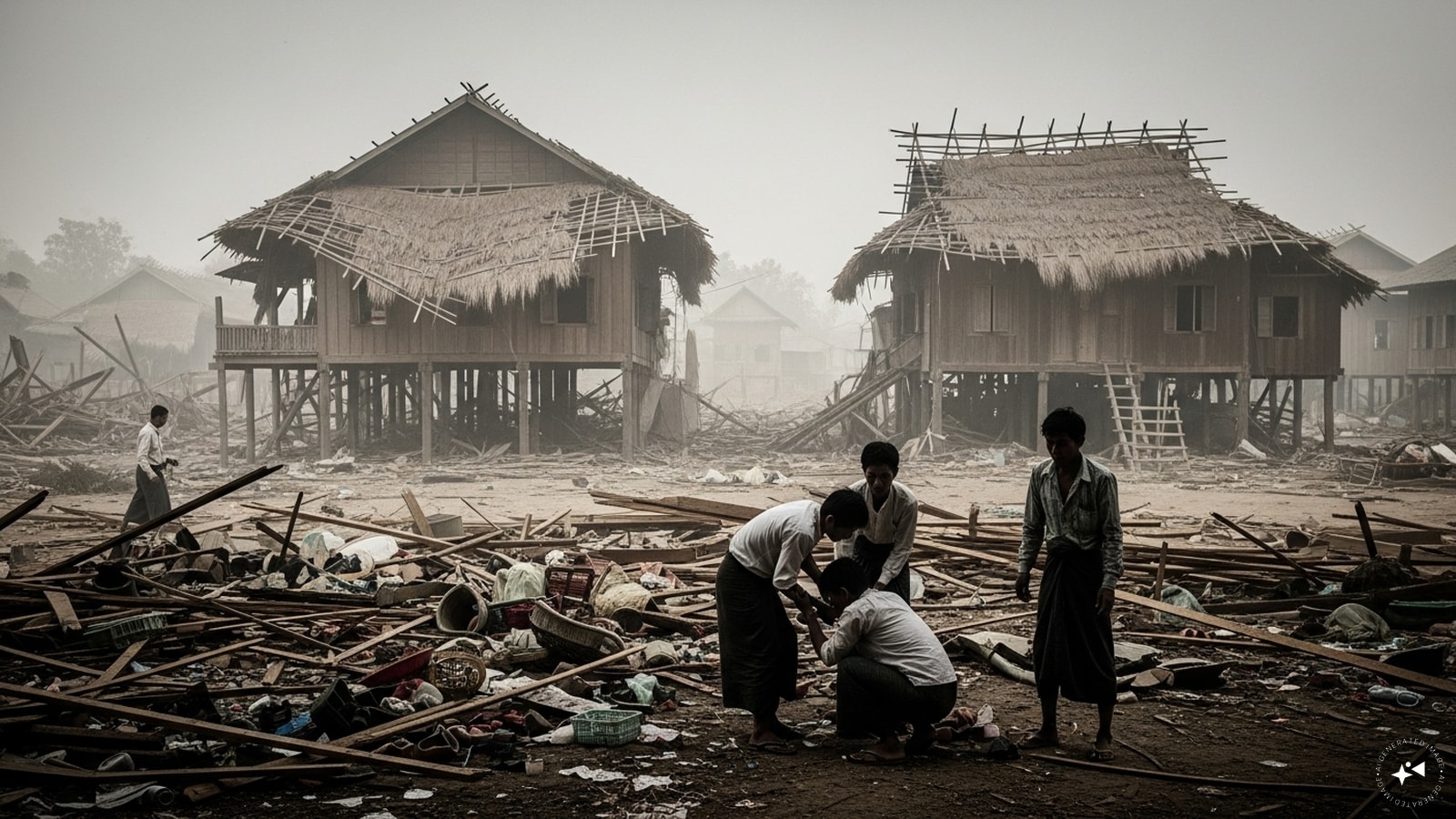
A massive explosion tore through Kaung Tat village in Myanmar’s northeastern Shan State on Sunday, leaving at least 55 people dead and dozens more severely injured. The blast entirely flattened a cluster of residential homes, sending a towering plume of smoke into the sky and triggering a series of secondary detonations that terrified local residents. While early state media and initial dispatches framed the incident as a sudden, isolated tragedy, the reality on the ground points to a much more systemic crisis of governance, war profiteering, and unregulated militarization.
The Ta'ang National Liberation Army (TNLA), an ethnic armed organization that holds administrative control over the region, quickly issued a statement attributing the disaster to the accidental detonation of commercial explosives stored for local mining operations. Shan State is a region rich in ruby, jade, and rare earth mines, where industrial-grade explosives are a staple of the local economy. However, local independent tracking groups and cross-border investigators argue that drawing a neat line between civilian mining and rebel munitions storage in active conflict zones is nearly impossible.
The catastrophic loss of life in Kaung Tat highlights the perilous reality for civilians living under the fragmented authority of ethnic armed organizations. In the rush to secure territory and fund ongoing resistance efforts against the central military junta, safety regulations and basic civil protections are routinely sacrificed.
The War Economy Under the Surface
To understand why 55 people died in a quiet village on a Sunday afternoon, one must look at the financial lifelines of Myanmar's rebel factions. The TNLA, alongside other members of the Three Brotherhood Alliance, has spent the last several years expanding its territorial footprint across northern Shan State. Securing territory is only half the battle. Sustaining a standing army requires an immense amount of capital, and in northeast Myanmar, that capital comes directly from the earth.
Mining operations in rebel-held territories operate entirely outside the jurisdiction of international safety watchdogs or standard environmental protocols. The trade of rubies and precious minerals fuels the purchase of black-market weaponry, creating a vicious cycle where civilian villages become dual-use hubs.
In these areas, the infrastructure of extraction and the infrastructure of insurgency are deeply intertwined. Commercial blasting powder, detonators, and military-grade ordnance are frequently stockpiled in identical conditions, often within arms reach of civilian dwellings to shield them from junta surveillance drones. When a storage facility is embedded in a residential community, the line between an industrial accident and a military disaster disappears entirely.
The Problem With Dual-Use Stockpiles
The TNLA maintains that the material in Kaung Tat was strictly intended for mining. Even if taken at face value, this claim ignores the sheer negligence of storing highly volatile, commercial-grade explosives in the heart of a populated settlement.
- Lack of specialized storage: Most localized stockpiles are kept in makeshift bamboo or concrete warehouses without proper climate control or ventilation, making materials highly unstable during hot seasons.
- Proximity to domestic life: For safety, industrial magazines require significant buffer zones. In Kaung Tat, residential kitchens and electrical lines sat directly adjacent to the blast site.
- Secondary detonation risks: The initial blast triggered a chain reaction among smaller, unmapped caches nearby, compounding the devastation and hindering immediate rescue operations.
Governance in the Shadow of Ceasefires
The explosion comes at a highly sensitive political moment. The TNLA is currently navigating a fragile, Beijing-brokered ceasefire with the Myanmar military junta. This paused active frontline combat, but it did not bring peace. Instead, it shifted the focus of these armed groups from active tactical maneuvers to consolidation and governance.
Administering a territory requires more than just checkpoint policing. It demands administrative oversight, infrastructure maintenance, and public safety enforcement—capabilities that many guerrilla forces simply do not possess. The tragedy in Shan State reveals the structural weakness of rebel governance. While these groups can successfully execute complex ambush strategies against junta forces, they routinely fail at basic civic administration, such as keeping hazardous materials out of family neighborhoods.
International aid networks operating along the Thai and Chinese borders have long warned about this exact scenario. When armed factions transition into civilian administrators, they frequently prioritize resource extraction and tax collection over civil defense. The citizens of Kaung Tat paid the ultimate price for this governance vacuum.
The Human Toll of Accountability Gaps
As rescue workers continue to dig through the pulverized remains of Kaung Tat, the issue of accountability looms large. The TNLA has promised a thorough investigation into the root cause of the blast, pledging to hold those responsible to account. Yet, in an unrecognised statelet governed by the barrel of a gun, true independent oversight is a fantasy.
There are no neutral courts in northern Shan State. There are no independent workplace safety inspectors to audit the findings, nor is there a free press on the ground to challenge the official narrative. The families of the 55 victims, including multiple children reported among the dead, have no legal recourse to seek damages or demand systemic changes.
This lack of transparency also complicates the international humanitarian response. Border-crossing medical teams and non-governmental organizations face immense hurdles when attempting to deliver emergency aid to rebel-controlled zones. The junta heavily restricts medical supplies traveling through government-held transit points, while the rebel factions tightly control who enters their territory to prevent operational intelligence leaks. Consequently, the wounded are left to rely on under-equipped local clinics that lack the specialized trauma units required to treat severe blast injuries and third-degree burns.
The disaster in Kaung Tat will likely be forgotten by the international community as just another chaotic statistic from Myanmar’s protracted civil war. To dismiss it as a mere industrial accident is a grave mistake. It was the direct result of a militarized war economy that treats civilian villages as logistics hubs, gambling with innocent lives under the fragile pretense of security. Until these governance structures prioritize civilian protection over resource exploitation, the ground beneath Myanmar's borderlands will remain a tinderbox.