The asphalt hums. It is a low, vibrating growl that travels from the tires, through the chassis, and directly into the marrow of a driver’s bones. For those who steer the great steel beasts across Malaysia’s winding arteries, this sound is the rhythm of life. It is the sound of a job done, of a schedule kept, and of a machine tamed. But there is a fragile boundary between the machine and the man, a thin line where the weight of responsibility meets the lightness of a momentary lapse.
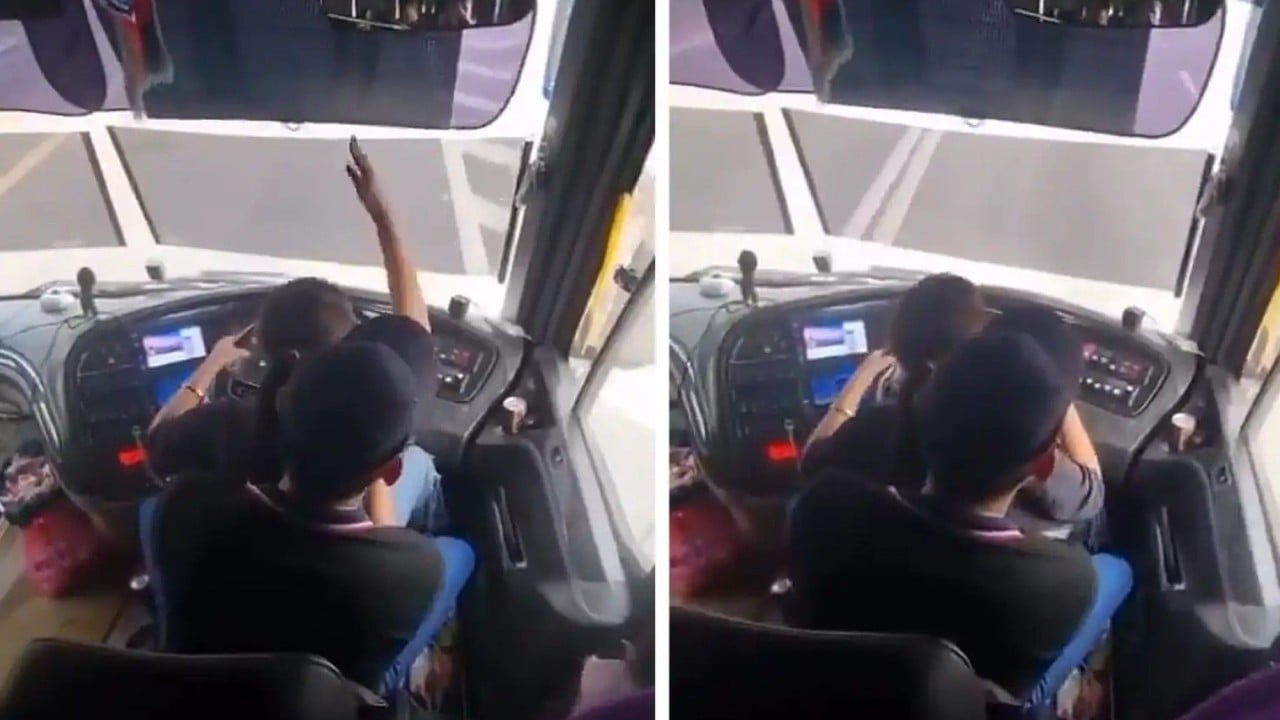
When a video surfaced recently showing a bus driver in Johor with a woman seated on his lap while navigating a public road, the internet reacted with a predictable storm of digital fury. The footage, captured by a passenger and distributed across social media like wildfire, depicted a scene that felt surreal. A heavy vehicle, dozens of lives in the back, and at the helm—a distraction that defies logic.
We often view safety as a series of boxes to be checked. We look at statistics, we read the fine print of transport regulations, and we assume that common sense is a universal constant. It isn’t. Common sense is often the first casualty of complacency.
The Weight of the Wheel
To understand why this matters, you have to feel the physics. A standard passenger bus weighs anywhere from twelve to fifteen tons when fully loaded. At sixty kilometers per hour, it possesses enough kinetic energy to flatten a sedan like a soda can. The driver is not just a worker; they are the sole arbiter of that energy. They are the filter through which every variable—weather, road conditions, the erratic behavior of other motorists—must pass.
Imagine the cabin of that bus. It is a cramped kingdom of levers and mirrors. The steering wheel is large, requiring deliberate, physical input. To operate it while another human being is perched on your lap is not just a breach of company policy. It is a physical impossibility to react to an emergency. If a child darts into the road, or a tire blows, or a motorcyclist swerves, the driver’s hands are shackled by the very presence of the person they are holding.
The Johor Bahru North Police, led by Assistant Commissioner Balveer Singh, didn't see a romantic gesture or a harmless quirk when they viewed that footage. They saw a Class A hazard. They saw a violation of Section 21 of the Public Service Vehicles (Conduct of Drivers, Conductors, and Passengers) Rules 1959. More importantly, they saw a betrayal of the public trust.
The Psychology of the Glass Cage
Why does a professional, knowing the stakes, allow such a scene to unfold?
There is a psychological phenomenon that occurs in long-haul driving often referred to as "highway hypnosis" or "velvet complacency." When you spend ten hours a day, six days a week, behind the same windshield, the world outside begins to look like a movie. It stops feeling real. The dangers become abstract. You begin to feel invincible in your glass cage.
In this state of mind, the bus is no longer a lethal instrument; it is an office. It is a living room. This blurring of boundaries is where the most horrific accidents are born. We see it in the driver who scrolls through TikTok while cruising at ninety kilometers per hour. We see it in the driver who thinks they can balance a person on their lap while navigating the suburban sprawl of Johor.
The woman in the video, whose identity remains a focus of the ongoing investigation, represents more than just a passenger. She represents the intrusion of the private world into a space that must remain strictly, unyieldingly professional. The moment that bus door closes and the engine turns over, the driver’s personal life must vanish. There is no room for "husband," "boyfriend," or "friend." There is only "operator."
The Invisible Passengers
Every time we board a bus, we make a silent, unconscious pact. We hand over our lives to a stranger. We trust that their training, their license, and their moral compass are all pointed in the same direction.
Consider the people sitting behind that driver.
Maybe there is a student on her way to an exam, clutching a backpack and mentally rehearsing chemical formulas. Perhaps an elderly man is traveling to see his grandchildren, his hands slightly trembling as he holds a gift. There are workers coming home from exhausting shifts, drifting in and out of sleep, vulnerable and unaware.
They are the invisible stakes.
When the driver in Johor allowed a woman to sit on his lap, he didn't just risk his job. He gambled with the futures of everyone on board. He gambled with the peace of mind of every family waiting for those passengers to arrive. This is why the police hunt was so swift. This is why the Land Public Transport Agency (APAD) and the Road Transport Department (JPJ) don't just issue fines—they dismantle careers.
The driver was eventually identified. The company, a local operator, faced the immediate heat of a public relations nightmare and the looming shadow of a suspended license. In the transport industry, reputation is the only currency that matters. Once you are known as the firm that lets its drivers treat a steering wheel like a park bench, the contract ends. The business dies.
The Ripple Effect of a Viral Moment
We live in an age of total surveillance. This is a truth many have yet to fully internalize. Every passenger is a potential whistleblower. Every smartphone is a body camera. The viral nature of the video served as a digital trial before the police even issued their first statement.
But the real story isn't the video itself. It’s the culture that allows such a moment to happen.
In the logistics and transport sectors across Southeast Asia, there is a constant tension between high demand and human fatigue. Drivers are often pushed to their limits. They spend weeks away from home. They live in a state of perpetual transit. While this doesn't excuse the behavior seen in Johor, it paints a picture of a lonely, grueling profession where the lines of propriety can become dangerously thin.
However, the law does not care about loneliness. The law cares about the "duty of care."
When Assistant Commissioner Balveer Singh urged the public not to speculate, he wasn't just being a cautious officer. He was trying to ensure that the legal process could proceed without the taint of a lynch-mob mentality. The goal of the police hunt was not just to punish one man, but to send a signal to the thousands of others who hold a vocational license. The signal is simple: You are being watched, not by big brother, but by the very people you are sworn to protect.
The Sound of Silence
Imagine the moment the engine stops. The police arrive. The driver is asked to step out. The woman, whoever she may be, has to stand up. The illusion of the "private office" shatters.
The silence that follows a bus engine being cut is heavy. It is the sound of reality crashing back in. In that silence, the driver has to face the fact that a few minutes of foolishness have likely ended a decade of work.
We often talk about road safety in terms of "accidents." But an accident implies something unavoidable—a patch of black ice, a sudden mechanical failure. What happened in that bus was not an accident waiting to happen; it was a choice.
Every morning, thousands of bus drivers across the peninsula climb into their seats. They check their mirrors. They test their brakes. They look at the faces of the people boarding and they feel the weight of those lives. They are the silent heroes of our economy, the ones who keep the blood of commerce and connection flowing.
Then there are the others. The ones who forget the weight. The ones who think the rules are for someone else.
The Johor bus driver is currently a footnote in a news cycle, a "viral sensation" for all the wrong reasons. But his story serves as a visceral reminder of a truth we often forget in our rush to get from point A to point B. Safety is not a static state. it is an active, exhausting, second-by-second commitment.
The road is a hungry thing. It demands total attention. It does not forgive distractions, and it certainly does not care for romance. When you sit in that seat, the world shrinks to the size of the windshield. Everything else—your desires, your boredom, your passengers’ lap—must stay on the curb.
The bus continues its journey, but for one driver, the road has ended. He is left standing on the shoulder, watching the tail lights of his own career disappear into the dark, finally understanding the true cost of letting go of the wheel.