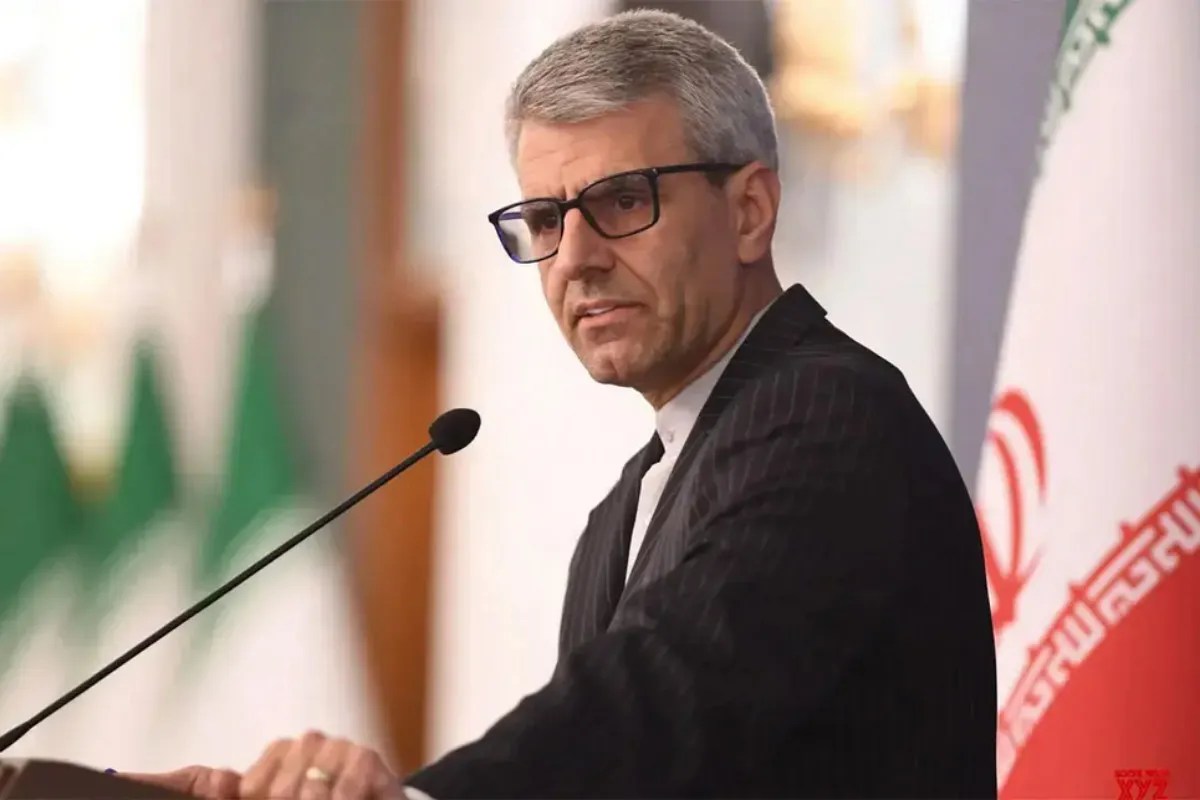
Mainstream foreign policy outlets love a polite diplomatic handshake. They look at National Security Advisor Ajit Doval sitting down with Vietnam’s Minister of Public Security Luong Tam Quang and Foreign Minister Bui Thanh Son, and they print the same tired press-release clichés. They call it "advancing a comprehensive strategic partnership" ahead of the 2027 milestone—the tenth anniversary of their elevated ties and fifty-five years of diplomatic relations.
They are completely missing the point.
If you read the standard wire reports, you would think this meeting was about trade corridors, cultural exchanges, and routine bureaucratic housekeeping. That is the lazy consensus of armchair analysts who take diplomatic communiqués at face value. When India’s top spymaster and security architect flies into Hanoi to sit across from the head of Vietnam’s internal security apparatus, they are not discussing visa waivers or tourism quotas. They are synchronizing intelligence grids, hardening cyber defenses, and building a quiet, asymmetric containment ring right on China’s southern doorstep.
The Illusion of the "Balanced" Indo-Pacific
Conventional wisdom argues that middle powers like India and Vietnam are merely "hedging" their bets between Washington and Beijing. Analysts love the word "hedging" because it sounds sophisticated and non-committal. It implies both New Delhi and Hanoi are terrified of provoking China, so they tiptoe around geopolitical tripwires while keeping economic doors open.
I have spent years tracking defense procurement and intelligence-sharing frameworks across the Indo-Pacific, and I can tell you firsthand: hedging is what countries do when they have no leverage. India and Vietnam are no longer hedging. They are actively constructing a reciprocal deterrence architecture—one designed specifically to complicate Beijing’s military calculus without firing a single shot or signing a formal mutual defense treaty.
Look at who was in the room. Ajit Doval is not a traditional diplomat. He is a former Intelligence Bureau chief who views statecraft through the prism of covert capability, hard power, and strategic disruption. His primary counterpart in these talks was not just the Foreign Minister, who handles the public-facing pleasantries, but General Luong Tam Quang, the Minister of Public Security. In Vietnam’s political hierarchy, the Ministry of Public Security (MPS) is the regime’s sharpest sword and thickest shield. It controls domestic intelligence, counter-espionage, cybersecurity, and internal regime stability.
When Doval meets the head of the MPS, the agenda is operational, not ceremonial. They are talking about how to neutralize Chinese grey-zone warfare, how to counter foreign influence operations, and how to secure critical telecommunications infrastructure from state-sponsored espionage.
Why the 2027 Milestone Is a Smoke Screen
Media coverage has fixated on the 2027 diplomatic anniversary as the driving force behind this sudden burst of high-level engagement. That gets the causality entirely backward. Diplomatic anniversaries do not drive security strategy; hard deadlines in military modernization do.
2027 is not just a nice round number on a diplomatic calendar. In defense circles across New Delhi, Hanoi, and Washington, 2027 is widely cited as the benchmark year for the People’s Liberation Army (PLA) to achieve full capability for major regional contingencies, particularly in the Taiwan Strait and the South China Sea. By framing their current intelligence and defense integration around a celebratory 2027 diplomatic milestone, India and Vietnam get convenient political cover. They can accelerate joint naval exercises, expand defense lines of credit, and integrate maritime domain awareness systems under the benign banner of "celebrating fifty-five years of friendship."
Imagine a scenario where China escalates its blockade tactics around Second Thomas Shoal or pushes deeper into Vietnam’s Exclusive Economic Zone (EEZ) near Vanguard Bank. At the exact same moment, PLA troops probe a disputed sector along the Line of Actual Control in Ladakh or Arunachal Pradesh. If New Delhi and Hanoi operate in silos, Beijing can apply overwhelming pressure on one front while keeping the other quiet.
By linking their intelligence apparatus and naval logistics now, India and Vietnam force Beijing to plan for a two-front dilemma. India gains a forward listening post and maritime foothold right in China’s maritime backyard—the South China Sea—while Vietnam gains a heavyweight strategic partner with space-based surveillance, missile technology, and deep-water naval capabilities that Hanoi could never build on its own.
What Everyone Gets Wrong About India-Vietnam Defense Ties
If you search for details on the India-Vietnam security partnership, you will immediately run into two mainstream narratives that are fundamentally flawed.
Misconception 1: It is all about selling BrahMos missiles.
For nearly a decade, defense commentators have obsessed over whether India will finalize the sale of the BrahMos supersonic cruise missile to Vietnam. Every diplomatic visit gets graded on whether a BrahMos contract gets signed. When no announcement drops, pundits declare the trip a failure.
This obsession with big-ticket hardware misses how modern deterrence actually works. You do not need to park supersonic missiles on a coastline to paralyze an adversary's naval planning. Real power lies in Maritime Domain Awareness (MDA)—the real-time tracking of every submarine, coast guard cutter, and maritime militia vessel moving through contested waters. India’s Information Fusion Centre for the Indian Ocean Region (IFC-IOR) and its expanding network of coastal radar stations and satellite telemetry give Vietnam something far more valuable than a few dozen missiles: persistent eyes over the horizon. Knowing exactly where an adversary’s assets are hiding degrades their tactical advantage before a conflict even begins.
Misconception 2: Vietnam will never truly align with India because of its economic dependence on China.
Critics constantly point out that China is Vietnam’s largest trading partner, supplying the raw materials and components that keep Vietnam’s manufacturing boom alive. Therefore, the argument goes, Hanoi will always fold when Beijing applies economic pressure.
This ignores the core operating principle of Vietnamese foreign policy, often referred to as "Bamboo Diplomacy"—bending with the wind without ever breaking at the root. Vietnam’s leadership understands better than anyone that economic integration with China is a survival necessity, while security cooperation with powers like India is an existential necessity. The Vietnamese Communist Party does not view trade with China and security alignment with India as contradictory. They view the latter as the exact insurance policy required to survive the former.
The Mechanics of Asymmetric Deterrence
To understand what Doval and his Vietnamese counterparts are actually building, look at the three concrete pillars replacing traditional alliance structures:
- Counter-Intelligence and Regime Security: Both New Delhi and Hanoi face relentless cyber intrusions and information warfare campaigns originating from state-backed actors. By linking India’s National Security Council Secretariat directly with Vietnam’s Ministry of Public Security, both nations create a shared early-warning system for cyber threats, transnational crime, and covert interference.
- Logistics and Naval Sustenance: A navy is only as powerful as its supply chain. Through reciprocal logistics agreements, Indian naval vessels operating in the South China Sea can access Vietnamese ports like Cam Ranh Bay for refueling, repairs, and replenishment. This extends the operational reach of the Indian Navy thousands of miles beyond the Malacca Strait without requiring India to build politically sensitive overseas military bases.
- Defense Industrial Co-Production: Handing out lines of credit—like India’s $500 million defense credit line to Vietnam—is only the first step. The real shift is moving from a buyer-seller relationship to joint maintenance, overhaul, and localized production of naval patrol boats and communications gear. When Vietnam can maintain and repair its own defense assets using Indian technical blueprints, Beijing cannot simply choke off supply lines during a crisis.
The Uncomfortable Reality Nobody Wants to Admit
Before anyone crowns the India-Vietnam axis as an unstoppable geopolitical juggernaut, we have to confront the glaring vulnerabilities that official readouts conveniently ignore.
First, India’s defense bureaucracy is notoriously slow. New Delhi has a long, frustrating track record of announcing ambitious defense lines of credit and strategic initiatives, only to watch them stall for years in labyrinthine procurement committees and inter-ministerial turf wars. Vietnam moves with centralized, decisive speed; India moves at the pace of a democratic coalition navigating endless red tape. If New Delhi cannot deliver hardware and technical upgrades on time, Hanoi will quietly look elsewhere—specifically toward South Korea, Japan, or Israel—to fill the gaps.
Second, there is an asymmetry of commitment. If Vietnam finds itself in a direct kinetic clash with China in the Spratly Islands, India is not going to send an aircraft carrier strike group to rescue Hanoi. New Delhi’s primary security obsession will always remain its northern land border with China and its dominance in the Indian Ocean. Conversely, if a border war erupts in the Himalayas, Vietnam will not open a second front in Guangxi. Both nations know this. Their partnership is built on mutual friction-generation against a common rival, not mutual suicide pacts.
Stop Reading the Press Releases
If you want to understand where the Indo-Pacific power balance is actually shifting, stop reading the sanitized summaries from foreign ministries. Watch the travel schedules of intelligence chiefs. Watch which ministries sign memorandums of understanding behind closed doors.
Ajit Doval did not go to Hanoi to celebrate an anniversary that is still over a year away. He went to wire together the nervous systems of two nations that share a border—and a profound strategic anxiety—with the same superpower. While the rest of the world argues over tariffs and trade deficits, India and Vietnam are quietly locking the back doors of the South China Sea.