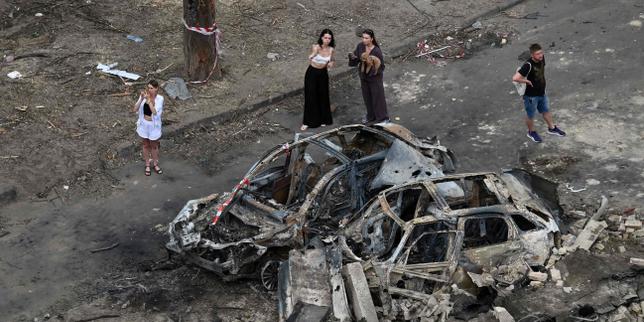
The standard Western media apparatus follows a predictable script every time Russia launches an Iskander missile at Kyiv or Ukraine sends a wave of drones into a Sevastopol substation. The headlines scream of immediate operational crises, collapsing civilian morale, and imminent tactical shifts. They treat these asymmetric infrastructure strikes as decisive, war-altering maneuvers.
They are wrong.
The breathless coverage of the recent blackouts in occupied Crimea and the ballistic missile sirens in Kyiv obscures a brutal, historical reality: strategic infrastructure bombing against a resilient adversary almost never achieves its intended political or military objectives. I have spent years analyzing asymmetric attrition dynamics and military logistics. If the history of modern warfare teaches us anything, it is that modern industrial and state systems are far more plastic and adaptable than headline writers realize. Treating the exchange of grid destruction as a leading indicator of military victory is a fundamental misreading of the conflict.
The Resilience Myth: Why Grids Don’t Bleed
When Ukrainian drones successfully knocked out power in portions of Sevastopol, the immediate analytical consensus painted it as a crippling blow to Russian logistics in the Black Sea. This narrative confuses a localized operational headache with a strategic paralysis.
Military infrastructure does not run on the same civilian grid that powers residential apartments. High-value military assets—naval command centers, air defense radars, and electronic warfare suites—are supported by layered, redundant generation systems. They rely on heavy-duty diesel generators, localized microgrids, and independent fuel supplies designed specifically to withstand first-strike degradation.
Knocking out a civilian substation forces a city into darkness and creates a PR victory, but it rarely freezes the tanks or silences the batteries.
The same logic applies to the Russian strikes on Kyiv’s energy network. For over two years, Moscow has attempted to freeze Ukraine into submission by target-packaging transformer stations and thermal power plants. The result? Ukraine’s repair crews, heavily backed by Western components and modular grid engineering, have turned infrastructure restoration into a high-speed art form.
To understand why this strategy fails, look at the classic United States Strategic Bombing Survey from World War II, or the outcomes of Operation Rolling Thunder in Vietnam. The data shows that unless an attacking force can completely deny the enemy the ability to substitute materials or reroute supply lines, the target nation adapts. The civilian population hardens its resolve, and the military apparatus simply centralizes its resource allocation, stripping the civilian economy to keep the war machine lubricated.
Dismantling the Flawed Logic of Asymmetric Costs
A common defense of Ukraine’s drone strikes on Russian-controlled infrastructure is the cost-to-damage ratio. Proponents argue that a $20,000 Ukrainian long-range drone causing tens of millions of dollars in damage to a Russian energy hub is an undeniable economic victory.
This calculation misses the broader macroeconomic reality of a total war of attrition.
[Economic Attrition Calculation]
Traditional View: Drone Cost ($20k) vs. Infrastructure Damage ($20M) = Win
Macro Reality: Repair Time + Substitutability vs. Total State GDP & Resource Allocation
Russia is a command economy operating under wartime mobilization. It does not measure the cost of repairing a substation in Sevastopol through the lens of corporate profit margins or insurance liabilities. It measures it in state-directed labor and raw steel. Russia possesses massive domestic reserves of oil, gas, and heavy manufacturing capacity. An asymmetric strike that inflicts financial pain on a balance sheet does not stop a train carrying artillery shells if the state can simply mandate the diversion of resources from consumer sectors to military ones.
Conversely, Ukraine’s reliance on Western financial and material aid means its infrastructure repairs are bound by foreign political consensus and complex transnational supply chains. When Russia hits a Ukrainian power plant, the replacement equipment often requires specialized, large-scale transformers that take months to manufacture in Europe or North America and transport across a bottlenecked rail network.
By celebrating superficial tactical successes in Sevastopol, observers overlook the asymmetrical vulnerability of the two economic systems. Ukraine is fighting a defensive war with a heavily disrupted domestic economy; Russia is running a crude but massive resource-extraction engine that can absorb localized infrastructural friction indefinitely.
The Real Bottleneck Is Not Power, It Is Throughput
If turning off the lights does not win the war, what does? The fix is not to hunt for more spectacular drone footage of burning fuel depots. The focus must shift entirely to institutional throughput and logistical density.
Wars of attrition are won by the side that can consistently generate, train, and equip fresh combat formations while maintaining a superior volume of fires. A temporary blackout in Crimea does nothing to alter the daily artillery disparity along the Donbas line. It does not solve the acute infantry shortages faced by Ukrainian brigades, nor does it halt the steady, incremental Russian advance through sheer mass.
The hard, unpopular truth is that both sides are burning precious, limited strike assets on symbolic targets. Russia uses million-dollar precision ballistic missiles to smash Ukrainian substations that can be bypassed or patched within days. Ukraine risks scarce, high-tech long-range drone assets to strike Russian energy nodes that look dramatic on social media but fail to degrade Russia's front-line combat power.
The Actionable Pivot
For Ukraine and its Western backers to break the current deadlock, the strategy must pivot away from high-visibility, low-impact infrastructure harassment.
- Cease the pursuit of PR victories: Stop allocating long-range strike capacity to targets chosen primarily for their media impact or their ability to cause temporary civilian discomfort in occupied territories.
- Target the logistical nodes that cannot be substituted: Focus exclusively on fixed transportation bottlenecks—such as critical rail junctions, bridges, and specific maintenance depots for heavy armor—where a single strike removes a capability that cannot be bypassed by a diesel generator.
- Accept the reality of a hardened adversary: Build military assumptions around the fact that Russia can and will absorb immense structural damage without its political leadership flinching or its front-line soldiers running out of ammunition.
The belief that air and drone campaigns against infrastructure can force a nuclear-armed state into a strategic retreat is a fantasy born of modern impatience. The lights will go out, the sirens will wail, and the repair crews will go to work. The war will continue to be decided by the brutal, unglamorous arithmetic of the trenches.