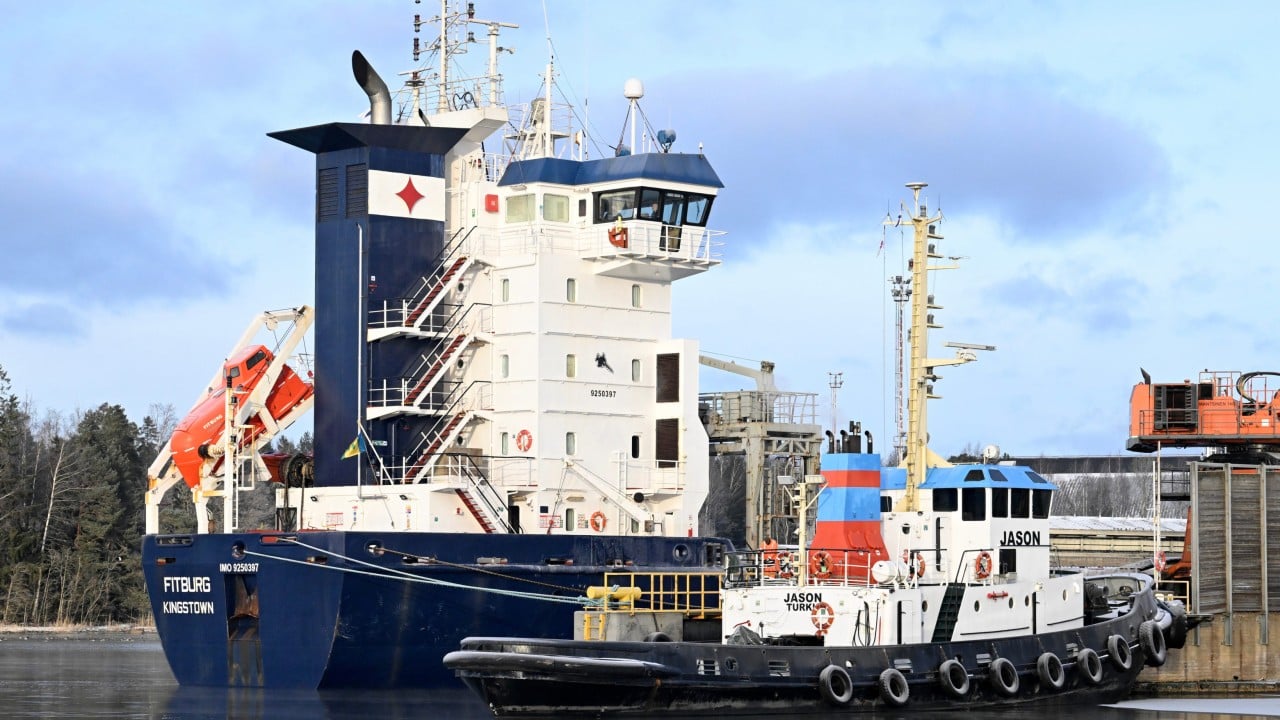
Finland has handed down a prison sentence to a Russian cargo ship captain for severing critical undersea cables in the Baltic Sea, a landmark ruling that shifts the legal battle over hybrid warfare from diplomatic hand-wringing to criminal accountability. By prosecuting the master of a commercial vessel for dragging an anchor across the seabed, Finnish authorities established a rare judicial precedent in maritime security. Yet the conviction itself barely scratches the surface of a much larger vulnerability. While one captain sits behind bars, hundreds of aging, poorly regulated vessels continue to crisscross Europe's shallow northern waters every single day, dragging thousands of tons of iron over the fiber-optic arteries and power lines that keep modern economies running.
To understand why this single prosecution matters so much, you have to look at the sheer mechanics of how undersea infrastructure gets destroyed—and why proving intent has historically been nearly impossible. Learn more on a connected issue: this related article.
The Anatomy of a Dragged Anchor
Ships drop anchors by accident. It happens in rough weather, during mechanical failures, or when an exhausted crew forgets to secure a windlass brake. For decades, maritime law treated severed subsea cables almost exclusively as civil negligence cases, settled quietly between shipping insurers and telecom operators out of court.
The Baltic Sea incidents changed that calculation entirely. Additional reporting by Al Jazeera explores related perspectives on the subject.
When a multi-ton stockless anchor drops to the seafloor while a cargo vessel steams ahead at ten or twelve knots, the physics are brutal. The anchor does not simply bounce along the mud. It digs in, plowing a trench several feet deep across the seabed. Modern subsea fiber-optic cables—despite carrying the bulk of international financial transactions, military communications, and cloud data—are roughly the width of a garden hose. Even armored power interconnectors, designed to balance electricity grids between Nordic and Baltic states, cannot withstand the kinetic energy of a twenty-thousand-ton ship hauling an iron hook through their protective steel casing.
What turned the Finnish case from a routine maritime insurance claim into a criminal prosecution was the telemetry. Investigators do not rely on a captain's logbook anymore. They pull Automatic Identification System (AIS) transponders, satellite synthetic aperture radar imagery, and seabed sonar scans. In the Baltic, where water depths average a mere fifty-five meters, a ship dragging an anchor leaves a signature that screams across every sensor in the region. Fuel consumption spikes as the engine fights the drag. Speed drops noticeably without a corresponding drop in engine revolutions. The vessel's heading slews slightly off-course as the anchor pulls from the bow.
A seasoned master feels that vibration through the deck plates. The engineering officer sees the load surge on the engine gauges. When a ship continues steaming for dozens of nautical miles across a charted cable corridor while ignoring those unmistakable physical warnings, the defense of "unfortunate accident" collapses under its own weight.
Why the Baltic Sea Is a Chokepoint Waiting to Break
Geography makes the Baltic Sea uniquely vulnerable to subsea disruption. Unlike the Atlantic Ocean, where cables drop into abyssal plains thousands of meters below the reach of commercial shipping, the Baltic is essentially a shallow, crowded shipping lane. Every vessel entering or leaving Russian ports in the Gulf of Finland—including Primorsk, Ust-Luga, and St. Petersburg—must thread a narrow maritime needle past Finland, Estonia, Sweden, and Denmark.
At the same time, the region has spent the last twenty years aggressively wiring itself together. Following Russia's invasion of Ukraine and the subsequent cutoff of Russian gas and electricity, the Baltic states accelerated their decoupling from the Moscow-controlled BRELL power grid, linking instead into Nordic and Central European networks via subsea high-voltage direct current cables. Simultaneously, new data cables were laid to turn the Nordics into a hub for European data centers.
The result is a dense, overlapping web of critical infrastructure sitting on a shallow seabed directly beneath one of the busiest—and most geopolitically contested—shipping corridors on earth.
The Shadow Fleet Complication
Compounding the geography is the rise of the so-called shadow fleet. Following Western price caps and sanctions on Russian crude oil, a parallel maritime ecosystem emerged overnight. Hundreds of aging tankers and general cargo vessels were bought up through shell companies registered in jurisdictions from Dubai to the Marshall Islands. Many operate without reputable Western P&I (Protection and Indemnity) insurance, rely on questionable flag-of-convenience registries, and employ crews rotated rapidly to obscure chains of command.
When a vessel belongs to a legitimate global shipping line, the company has billions of dollars in assets at risk and every incentive to cooperate with port state control inspections. When a vessel is a twenty-year-old rustbucket owned by a single-ship shell company with no attachable assets, traditional maritime deterrence evaporates.
This is where the Finnish prosecution hits a hard wall. Jailing the captain sends a sharp warning to individual mariners—the men actually standing on the bridge who have to decide whether to follow ambiguous orders or protect their own freedom. A master mariner holding an international certificate of competency stands to lose his livelihood, his pension, and years of his life in a Nordic prison. That personal liability creates friction inside the chain of command. It forces captains to think twice before turning a blind eye to a "malfunctioning" windlass.
Yet the owners, charterers, and state actors who profit from gray-zone disruption remain largely untouched, insulated by layers of corporate opacity and maritime jurisdiction rules that favor the flag state over the coastal state.
The Legal Trap of the High Seas
To appreciate how aggressive Finland's legal maneuver actually was, you have to understand the straightjacket of the United Nations Convention on the Law of the Sea (UNCLOS). Drafted in an era before subsea fiber-optic cables formed the nervous system of global finance, UNCLOS heavily prioritizes freedom of navigation.
Outside a nation's twelve-nautical-mile territorial sea—in the Exclusive Economic Zone (EEZ) where most subsea cables lie—coastal states have remarkably limited enforcement powers. Under standard interpretations of UNCLOS, if a foreign-flagged ship damages a cable in the EEZ, criminal jurisdiction generally belongs to the ship's flag state or the state of which the offender is a national. If a vessel is flagged in a compliant jurisdiction that ignores prosecution requests, the coastal nation is legally handcuffed.
Furthermore, UNCLOS obligates states to criminalize the willful or culpably negligent breaking of submarine cables, yet the treaty dates back to 1982 and lacks modern enforcement teeth. Boarding a foreign vessel in international waters without flag-state consent risks escalating a localized incident into an international naval confrontation.
Finland bypassed this trap through decisive operational action combined with rigorous domestic criminal statutes. When cables were severed, Finnish border guards and naval units moved quickly while the suspect vessel was still within reach, compelling it into Finnish territorial waters under safety-of-navigation and investigative authorities before it could slip into international lanes or Russian waters. Once inside Finnish jurisdiction, prosecutors did not need to prove an espionage conspiracy directed by the Kremlin—a nearly impossible evidentiary bar in a criminal courtroom. Instead, they relied on charges of aggravated criminal mischief and aggravated interference with communications, proving beyond a reasonable doubt that the captain's actions were either intentional or constituted extreme, reckless disregard for charted critical infrastructure.
That distinction is crucial. By decoupling criminal accountability from geopolitical attribution, prosecutors avoided getting bogged down in intelligence classification battles. They treated the destruction of a subsea cable with the exact same legal gravity as someone driving a bulldozer through an electrical substation on land.
The Gray Zone Problem Nobody Wants to Admit
Here is the uncomfortable truth that defense ministries in Brussels and Washington rarely state plainly: you cannot guard every kilometer of seabed.
Even with NATO launching enhanced maritime patrol missions in the Baltic—deploying frigates, maritime patrol aircraft, and unmanned surface drones—the sheer scale of the infrastructure makes continuous physical protection impossible. A naval warship cannot shadow every bulk carrier transiting the Gulf of Finland.
Consider a hypothetical scenario that keeps European grid operators awake at night. Suppose three separate commercial vessels, operating under different flags of convenience and owned by unrelated shell entities, suffer "simultaneous mechanical failures" during a winter storm, dragging their anchors across three major power interconnectors between Finland, Sweden, and Estonia within a six-hour window.
Even if patrol vessels intercept all three ships immediately, the physical damage is already done. Repairing a high-voltage subsea power cable does not happen overnight. There are only a handful of specialized cable-laying and repair vessels operating in Northern Europe. Mobilizing a repair ship, locating the fault, hauling the damaged section to the surface in freezing winter swells, splicing new armored cable, and re-laying it on the seabed can take weeks or even months. During peak winter demand, losing multiple interconnectors simultaneously would trigger severe electricity price spikes, industrial rationing, and rolling blackouts across the Baltic region.
And the perpetrators would still claim it was bad weather and poor maintenance.
Why Deterrence Remains Incomplete
This asymmetry is the entire point of hybrid warfare. The cost of mounting a subsea disruption operation using a commercial vessel is negligible—a few hundred thousand dollars in charter fees and fuel, plus the potential sacrifice of a disposable ship and an expendable crew. The cost to the target nations runs into the hundreds of millions of euros in repair bills, lost transmission capacity, naval deployment expenses, and market anxiety.
Critics of the Finnish judicial approach argue that imprisoning a single merchant captain does nothing to alter the strategic calculus in Moscow. From their perspective, a captain is merely a pawn; if Russia wants to test NATO's infrastructure resilience, it will simply recruit another master willing to take the risk for sufficient financial compensation—or coerce one whose family lives inside Russian borders.
There is undeniable truth to that critique. Criminal law is built to punish individual culpability, not to deter hostile state intelligence services. Expecting a Helsinki courtroom to solve a geopolitical confrontation is naive.
At the same time, doing nothing—continuing to treat severed cables as mere insurance write-offs—invites escalation. When gray-zone provocations carry zero personal or financial consequences, they rapidly become standard operating procedure. By arresting the crew, impounding the vessel, and securing a custodial prison sentence, Finland raised the operational friction for anyone attempting future sabotage. Every merchant captain transiting the Baltic now knows that Nordic authorities will board their ship, seize their electronic navigation records, and put them in a prison cell if their anchor touches the bottom near a cable corridor.
What Actually Fixes the Vulnerability
If Europe wants to move beyond reactive prosecutions after the lights go out, the fix has to happen at three distinct layers: engineering, regulatory enforcement, and redundancy.
First, hardening and burial. Many older cables in the Baltic were laid directly on the seabed surface because the soft mud made trenching seem unnecessary against normal fishing trawlers. New cables—and repaired sections of existing ones—must be buried deeper beneath the seabed floor using high-pressure water-jetting plows, putting them below the penetration depth of standard commercial anchors. Simultaneously, operators are increasingly integrating Distributed Acoustic Sensing (DAS) technology directly into fiber-optic lines. DAS turns the glass fiber itself into thousands of continuous acoustic sensors, detecting the vibrations of a ship slowing down or an anchor scraping the seabed miles before physical contact occurs, giving coastal authorities precious minutes to radio the vessel or scramble interceptors.
Second, ruthless port state control and insurance verification. Coastal states bordering the Baltic and North Seas cannot continue allowing unverified, under-insured shadow fleet vessels to transit narrow chokepoints unchecked. European maritime authorities have begun demanding proof of valid, internationally recognized insurance from vessels passing through key straits. Vessels that refuse to provide documentation or exhibit suspicious AIS dark periods must be blacklisted from European ports, denied pilotage services, and flagged for immediate boarding whenever they enter territorial waters.
Third, aggressive network redundancy. The single best deterrent against cable sabotage is making any single cable irrelevant. When a telecom network has five diverse routing paths—combining subsea cables, terrestrial overland routes, and low-Earth-orbit satellite backups—cutting one line produces zero service interruption. Power grids require the exact same philosophy: more interconnectors, localized battery storage, and decentralized generation so that severing a single seabed link becomes an expensive nuisance rather than a national emergency.
Finland proved that the law can reach out across the water and hold a ship's master accountable for what happens beneath the waves. Now Europe has to decide whether it will use that breathing room to actually armor its seabed, or simply wait around to prosecute the next captain who drags an anchor through the dark.


