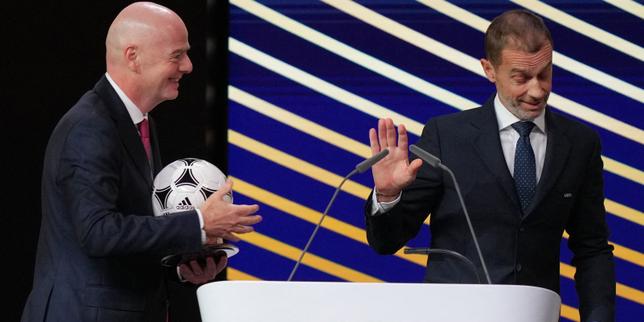
The quiet corridors of Zurich headquarters have given way to open jurisdictional warfare. Global football finds itself caught in the crosshairs of an escalating civil war as FIFA formally accuses European governing body UEFA of orchestrating a malicious smear campaign. At the center of this brawl is a dead-on-arrival multi-billion-dollar private equity plan that nearly rewrote the financial architecture of the sport.
FIFA’s recent legal filings in United States federal courts expose deep operational fractures between the two most powerful entities in international sport. What started as a controversial business proposal has devolved into cross-border litigation, threats of Swiss criminal complaints, and a high-stakes power struggle over the presidency of world football.
The Anatomy of a Failed Billion-Dollar Bet
The crisis traces back to a secretive proposal spearheaded by FIFA President Gianni Infantino. Known as FIFA Forward Enterprise, the initiative aimed to pool commercial revenues tied to the World Cup and other premier tournaments into a standalone commercial entity. To fund and scale this vehicle, Infantino courted high-profile American capital, striking an agreement to sell a significant stake worth roughly four billion dollars to Thrive Capital, the investment firm run by Josh Kushner.
The pitch was simple on paper. Proponents argued that modernizing football operations required outside private equity to unlock untapped commercial streams. Critics saw something entirely different. Opponents inside European football viewed the maneuver as a structural attempt to monetize the crown jewel of international sport, stripping long-term authority away from member associations and placing it into a centralized corporate wrapper.
The backlash was swift and unforgiving. UEFA threatened an immediate boycott of FIFA competitions, while regional confederations across Asia and the Americas mobilized in opposition. Facing an existential revolt and crumbling political alliances ahead of upcoming electoral cycles, FIFA abruptly scrapped the investment scheme.
Crossing Borders for Legal Ammunition
Scrapping the deal did not end the conflict. Instead, it shifted the battleground from administrative boardrooms to American courtrooms.
Determined to hold leadership accountable, UEFA initiated legal maneuvers across multiple United States jurisdictions—filing requests in New York, Florida, and Colorado. The European body sought discovery orders to compel private entities, including Thrive Capital and former corporate executives, to surrender internal correspondence and documents related to the collapsed investment plan. UEFA’s stated objective was clear: gather evidence to support a potential criminal complaint in Switzerland for alleged financial mismanagement against top FIFA officials.
FIFA’s response was characteristically aggressive. In motions filed to intervene and block the discovery requests, FIFA’s legal representation did not mince words. They characterized the American filings not as legitimate legal actions, but as public relations stunts designed to damage leadership.
The global governing body argued that UEFA’s requests suffered from a fatal flaw. According to FIFA's legal team, UEFA was attempting a fishing expedition in aid of a foreign criminal proceeding that does not actually exist, managed by an organization that lacks the legal authority to initiate one under Swiss law. Furthermore, FIFA asserted that UEFA suffered no direct financial injury from the aborted commercial arrangement, rendering their legal standing toothless.
The Underlying Economics of Control
To understand why this feud turned toxic so quickly, one must look beyond legal technicalities and examine the underlying distribution of power and money.
European football has historically commanded the financial high ground. The wealth generated by European club competitions and elite domestic leagues creates a massive resource gap between UEFA member states and the rest of the global football ecosystem. Initiatives that centralize World Cup revenues under direct presidential control threaten to alter that balance, potentially giving developing confederations alternative funding channels independent of European dominance.
At the same time, internal governance standards within international sports bodies face heightened scrutiny. Detractors argue that executive overreach has marginalized the 211 national member associations who form the backbone of the sport. When multi-billion-dollar equity sales are drafted behind closed doors without exhaustive consultation, trust evaporates.
The fallout has fractured political coalitions that once guaranteed smooth electoral paths. Regional power brokers who previously aligned with Zurich have recalibrated their loyalties. The pressure on Infantino ahead of upcoming electoral milestones is tangible, with various national federations openly questioning the current trajectory of institutional governance.
The Broader Fallout for the Global Game
This institutional cold war carries immediate operational consequences for international sport. When regulatory bodies spend millions of dollars litigating against each other in foreign courts, the credibility of the sport takes a direct hit. Fans and commercial partners watch as governance descends into factional warfare.
Private equity firms are also taking note. The willingness of political stakeholders to torpedo multi-billion-dollar structural investments creates a chilling effect on future financial innovation within sports administration. Institutional capital demands stability and clear regulatory consensus, neither of which currently characterizes the relationship between Zurich and Nyon.
The immediate legal skirmishes in New York and Colorado will set vital precedents for how international sports organizations utilize cross-border discovery laws. Yet the underlying tension remains completely unresolved. As political alignments harden and the race for future administrative control intensifies, the structural friction between global expansion and traditional European power shows no sign of cooling down.