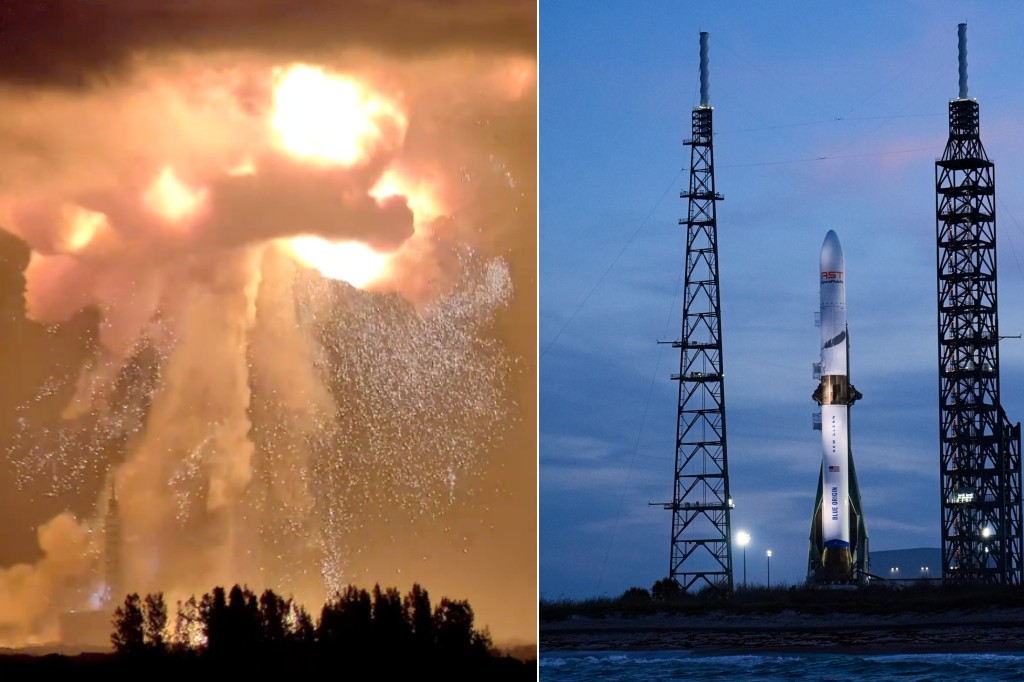
The catastrophic explosion of Blue Origin’s New Glenn rocket during a static fire test at Cape Canaveral does not just ground Jeff Bezos’s orbital ambitions. It fractures the brittle, dual-lander architecture anchoring NASA’s multi-billion-dollar Artemis program and its projected return to the Moon.
When the massive heavy-lift vehicle erupted into a fireball at Launch Complex 36, the immediate fallout was commercial—a lost vehicle, a severely damaged pad, and another delay for Amazon’s Project Kuiper satellite deployment. But the true crisis lies in Washington. By relying on a strategy that treats Blue Origin as a vital hedge against SpaceX, NASA has tied its deep-space timeline to an unproven rocket that has now suffered two severe hardware failures within a matter of weeks. The incident proves that duplicating contracts does not automatically guarantee redundancy. Instead, it exposes a fundamental reality: America’s contemporary lunar timeline is entirely dependent on two massive, highly experimental commercial launch systems, both of which are currently grounded.
The Cape Canaveral Anomaly and the Illusion of Redundancy
For years, the space agency operated under a clear philosophy. Do not put all your engineering eggs in one basket. This logic drove the selection of both SpaceX’s Starship and Blue Origin’s Blue Moon Mark 2 lander for the Human Landing System contracts. If one provider stumbled, the other would ensure the United States maintained its march toward a permanent presence on the lunar surface.
The events at Launch Complex 36 shattered that comfort zone. The explosion occurred during a "hotfire" test, a routine pre-flight procedure where the rocket is fully fueled and its engines are ignited while the vehicle remains clamped to the pad. The resulting blast did far more than incinerate the booster. It tore through critical infrastructure, heavily damaging the sole transporter-erector and a lightning protection tower.
This ground-level disaster follows an upper-stage failure during New Glenn’s third flight, which left an AST SpaceMobile satellite stranded in an unusable orbit. While the Federal Aviation Administration had briefly cleared the rocket to return to operations, this latest hardware failure happened during a ground test outside the scope of active flight licensing. Regulators may not immediately mandate a federal mishap investigation, but the sheer physical destruction of Blue Origin’s only functional orbital pad means the vehicle is effectively sidelined for the foreseeable future.
The operational math for NASA is now deeply problematic. The agency’s strategy assumes that Blue Origin can rapidly mature New Glenn to launch the massive Blue Moon lander. Without a functional rocket, the lander remains an expensive piece of high-tech cargo with nowhere to go.
The Engine Problem Nobody Wants to Discuss
To understand why this explosion is a structural threat to the Artemis timeline, one must look at the underlying propulsion mechanics. New Glenn relies on seven BE-4 engines burning liquid oxygen and liquefied natural gas on its first stage. It is a highly complex, oxygen-rich staged combustion design. While United Launch Alliance utilizes the same engines for its Vulcan vehicle, Blue Origin’s internal manufacturing and integration pipelines have been plagued by years of developmental delays.
More concerning, however, is the rocket’s upper stage, powered by two liquid-hydrogen-fueled BE-3U engines. The previous flight failure was explicitly linked to a cryogenic leak that froze a hydraulic line, causing a severe thrust anomaly. When a heavy-lift rocket experiences an in-flight engine failure followed a month later by a catastrophic pad explosion during a static fire, it points to a systemic issue in fluid management, telemetry, or structural integration.
Spaceflight hardware is unforgiving. A single microscopic fracture in a fuel line or a millisecond error in valve sequencing translates into a multi-million-dollar shockwave. Blue Origin’s corporate culture has historically favored a slow, methodical approach—captured by their motto, Gradatim Ferociter (Step by Step, Ferociously). Yet, under immense pressure to compete with the rapid flight cadence of SpaceX, the company shifted toward a more aggressive operational posture. The current hardware state suggests the engineering team is struggling to balance that newly demanded speed with the extreme precision required for heavy-lift rocketry.
How the Calendar Favors Beijing
The physical rebuilding of Launch Complex 36 will take months. Replacing custom-engineered steel structures, liquid gas plumbing, and digital control lines cannot be rushed. Consequently, the downstream effects on NASA's lunar infrastructure are immediate.
NASA recently awarded Blue Origin hundreds of millions of dollars to launch uncrewed prototype landers and robotic lunar terrain vehicles. These missions were designed to validate landing software, automated hazard avoidance, and cryogenic fuel transfer technologies in deep space before putting human lives on the line. Every week New Glenn spends grounded is a week where these critical operational data points are not being collected.
This systemic delay plays directly into a broader geopolitical race. The China National Space Administration is moving forward with its own Long March 10 heavy-lift rocket and the Mengzhou crewed spacecraft, targeting a landing before the end of the decade. Beijing's program relies on a state-directed, highly standardized aerospace infrastructure that does not answer to commercial shareholders or public corporate rivalries.
NASA's commercial paradigm offers unparalleled innovation when it works. When it fails, the government has very little recourse. The agency cannot step in and fix Blue Origin's production lines, nor can it build a alternative heavy-lift rocket on its own. The Space Launch System remains a legacy option, but its astronomical cost and slow production rate make it entirely incapable of flying the frequent infrastructure missions required to build a sustained lunar outpost.
The Limits of Public-Private Partnerships
The core premise of modern aerospace procurement is that competition drives down costs while accelerating innovation. By acting as a customer rather than an operator, NASA shifted the financial risk of vehicle development onto billionaire-backed private entities.
This model is facing its first structural crisis. When a private partner suffers a catastrophic setback, the public timeline suffers anyway. NASA Administrator Jared Isaacman acknowledged the difficulty of the task, noting that developing heavy-lift capability is a brutal engineering challenge. But diplomatic language cannot obscure the vulnerability of the current architecture.
Consider the baseline requirements for a single lunar landing under the current plan. Both SpaceX's Starship and Blue Origin's Blue Moon require multiple "tanker" flights just to orbitally refuel the landers before they can depart for the Moon. This demands an unprecedented launch cadence. If a company struggles to execute a basic static fire test without destroying its own pad infrastructure, the prospect of managing dozens of rapid-succession cryogenic refueling launches becomes a distant engineering fantasy.
The industry is left with a sobering realization. The dual-source strategy was intended to create safety through redundancy. Instead, it has created a system where a failure at a single launchpad in Florida can ripple through the entire deep-space pipeline, halting progress on payloads, landers, and scientific instruments thousands of miles away. Jeff Bezos has committed to rebuilding whatever is necessary. The hardware can be replaced, but the one commodity NASA cannot manufacture or buy back is time.
The explosion at Cape Canaveral forces a brutal re-evaluation of the American lunar roadmap, demonstrating that the road to the Moon cannot be paved solely with commercial promises and venture capital.
The engineering hurdles of heavy-lift rocketry are laid bare in this breakdown of Blue Origin's New Glenn Pad Explosion, which highlights the intense physical forces and risks involved in static fire testing.