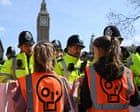
The traditional image of a British prisoner is undergoing a quiet, structural transformation. In cells across England and Wales, alongside habitual offenders and violent criminals, sits a growing demographic of retirees, university students, and former professionals serving sentences measured in years. They have not committed acts of physical violence, nor have they engaged in financial fraud. Their offense was participation in highly disruptive, non-violent civil disobedience, primarily tied to climate change and anti-war movements. A deep-dive academic study from Queen Mary University of London and the campaign group Defend Our Juries reveals the scale of this shift. Researchers tracked 286 activists who collectively received 136 years of jail time, exposing a fundamental re-engineering of the British legal architecture designed to shut down public disruption by treating political dissenters as serious criminals.
This is not a sudden accident of judicial overreach. It is the logical culmination of a coordinated legislative strategy. Over successive administrations, the British state has systematically lowered the threshold for what constitutes criminal disruption while simultaneously raising the penalties. The primary mechanisms driving this surge are the Police, Crime, Sentencing and Courts Act 2022 and the Public Order Act 2023. These statutes took common law offenses and turned them into sweeping statutory traps, giving the judiciary explicit mandates to hand down severe custodial sentences.
The Engineering of a Legal Trap
To understand how a citizen ends up serving four years for organizing a peaceful motorway blockade, one must look at the mechanics of the Public Order Act 2023. Parliament did not merely increase fines; it invented entirely new criminal categories.
The act introduced specific offenses for locking on, a historic tactic where protesters attach themselves to buildings, railings, or each other. Under the new rules, simply carrying an item intended to facilitate this act—such as a bicycle lock or a roll of heavy tape—can result in criminal charges under the banner of being equipped for locking on. Furthermore, the legislation explicitly criminalizes the disruption of key national infrastructure. This definition is intentionally broad, encompassing airports, railways, oil refineries, and even newspaper printing presses.
The state also resurrected and codified the statutory offense of public nuisance. Previously a vague common law concept used sparingly, it now carries a maximum sentence of ten years. The legal definition of serious disruption was recalibrated to mean anything that hinders day-to-day activities to more than a minor degree. By lowering this benchmark, routine acts of political expression are instantly transformed into high-level offenses.
The real teeth of the strategy, however, lie in the deployment of civil law mechanisms for criminal outcomes. Public bodies and private corporations now routinely secure high court injunctions against protest groups at specific sites, such as fuel depots or transport hubs. When an activist steps onto that land, they are not initially charged with a criminal offense. Instead, they are found in contempt of court. This allows judges to bypass the standard protections of a criminal trial and issue immediate prison sentences of up to two years. The Queen Mary University report notes that contempt of court charges accounted for 40% of the total cases of activist imprisonment, effectively allowing private corporate interests to trigger the incarceration of citizens.
The Suppression of the Courtroom Defence
The battlefield has shifted from the streets into the crown courts, where an even more controversial legal doctrine is being enforced. Judges are systematically preventing defendants from explaining why they committed their actions to the jury.
In multiple trials involving groups like Just Stop Oil and Palestine Action, trial judges have issued pre-trial rulings that strip defendants of their core legal defenses. Concepts like necessity, proportionality, or the defense of reasonable excuse under human rights law have been ruled inadmissible. Protesters have been explicitly ordered not to mention climate change, fuel poverty, or geopolitical conflicts in their testimonies.
When activists have defied these orders to explain their conscientious motivations to the jury, judges have held them in immediate contempt of court, placing them in cells beneath the courthouse. This creates an artificial environment for the jury. The jurors are asked to decide whether a defendant blocked a road, but they are denied the context of why the road was blocked.
This tension reached a critical point in the landmark case of R v Hallam in the summer of 2024. Five climate activists were sentenced to up to five years in prison for organizing a non-violent blockade of the M25 motorway via a planning call. The sentences were longer than those given to many individuals convicted of violent assaults.
Activists Sentenced: 286 tracked cases
Total Jail Time: 136 years
Average Detention: 28 weeks
Contempt of Court: 40% of imprisonments
The Court of Appeal eventually intervened in March 2025. A panel of senior judges reduced the sentences for the activists, declaring the original terms manifestly excessive. Crucially, the appellate court ruled that a defendant's conscientious motivation is directly relevant to sentencing and must be factored into any assessment of their culpability. While this provided a minor course correction, it did not dismantle the underlying statutory framework. The laws remain on the books, and the prison sentences continue to accumulate.
The Strategy of Pre Trial Remand
A particularly harsh reality exposed by recent legal data is the aggressive use of pre-trial remand. Activists who have not yet been convicted of any crime are being held in high-security prisons for months on end while awaiting trial.
The standard legal limit for pre-trial detention in England and Wales is six months. However, in complex protest cases involving multiple defendants, this limit is frequently extended. The case of the Filton 24—a group of Palestine Action activists accused of targeting an aerospace facility near Bristol—saw defendants held in custody for up to 18 months before their cases were resolved.
The systemic distortion becomes clear upon sentencing. The Queen Mary University researchers discovered that in 60% of tracked cases, the final sentence handed down by the court was more lenient than the time the individual had already spent locked away on remand. This suggests that pre-trial detention is functioning as a form of de facto punishment before a jury has even heard the evidence. It serves as a powerful chilling mechanism, removing individuals from the activist ecosystem without the state needing to secure a swift conviction.
The State Case for Deterrence
There is a counter-argument to this narrative, one that is fiercely maintained by the police, the crown prosecution service, and a significant portion of the public. The state maintains that its primary duty is to protect the rights of the majority to go about their daily lives without unlawful interference.
When a major orbital motorway like the M25 is brought to a standstill, the consequences ripple far beyond political irritation. The prosecution in the Hallam trial presented evidence showing that the four-day blockade caused over 50,000 hours of vehicle delays, directly affecting at least 700,000 drivers. The economic damage was calculated at £765,000, while the policing operation cost taxpayers more than £1.1 million.
Emergency services are delayed. Deliveries of critical goods are missed. People miss hospital appointments, job interviews, and family events. From the perspective of the Home Office, the economic and social cost of total disruption is an unacceptable toll levied by a small, self-selecting minority on the wider populace.
The state argues that the severity of the sentencing reflects the scale of the harm intended. If traditional fines and community service orders fail to deter activists from shutting down national infrastructure, then custodial sentences become the only remaining lever to maintain public order. The laws were explicitly designed to raise the stakes, making the cost of direct action too high for ordinary citizens to bear.
The Long Term Costs to the Justice System
The current strategy is achieving its goal of clearing the streets, but it is doing so by creating structural vulnerabilities within an already collapsing criminal justice system. British prisons are currently facing a historic capacity crisis, with overcrowding reaching emergency levels.
By funneling hundreds of non-violent political protesters into a system that cannot cope with its existing violent population, the state is making a deliberate resource allocation. It costs tens of thousands of pounds per year to house a single prisoner. Taxpayer funds are being expended to incarcerate retired teachers and young climate scientists, while traditional rehabilitation programs are stripped of funding.
Upon release, these individuals are not returning to routine civilian life. Many are placed under stringent licensing conditions normally reserved for serious criminal offenses or extremist threats, including electronic tagging, strict travel restrictions, and curfews. This level of state surveillance requires continuous monitoring by an overworked probation service.
The long-term danger is the erosion of public trust in the neutrality of the law. When the legal system is perceived to be acting as an enforcement arm for private corporate injunctions, or when juries are denied the right to hear a defendant's full testimony, the moral authority of the judiciary is compromised. The British state has successfully constructed a legal machine capable of delivering lengthy prison terms to its critics, but it has yet to calculate the true cost of running it.