Four soldiers died immediately and dozens more were hospitalized when a wind-driven grassfire tore through a live-fire training exercise at Canadian Forces Base Wainwright in Alberta on October 17, 2026. A fifth soldier later died from his injuries in mid-November, turning what early headlines framed as a sudden weather disaster into a wrenching test of military range governance, risk tolerance, and peacetime readiness.
Early accounts leaned heavily on the wind. Officials described uncommonly strong gusts pushing flames across roughly a kilometer in seconds, overtaking soldiers from the 3rd Battalion, Princess Patricia's Canadian Light Infantry and Army reservists taking part in Exercise Apollo Shooter. Yet as military police and a board of inquiry began peeling back the sequence of events, a sharper question emerged beneath the smoke. Why was live-fire training continuing at four o'clock in the afternoon during a high-risk autumn month when a fire had already been detected on the base?
Having covered military training mishaps and defense safety audits for decades, I have seen how quickly complex operational failures get flattened into a single villain. Weather makes a convenient scapegoat. It arrives without warning, shifts direction without permission, and spares commanders the immediate discomfort of examining their own assumptions. Still, wind alone does not ignite munitions, nor does wind alone decide whether troops remain on a range while smoke is already rising nearby.
A Fire Known Before the Wind Turned
The timeline offered in the earliest briefings raises uncomfortable questions that no press release has fully settled. Senior leadership stated that the fatal incident occurred around four in the afternoon local time as high winds drove flames rapidly across the training area. At the same time, commanders acknowledged that officials had been aware of a fire earlier and believed it was contained, allowing training to proceed.
Investigators have pointed to an automatic grenade launcher range—reportedly involving training with a C-16 grenade launcher—as the likely origin point of the blaze. When flames start inside a danger area or impact zone, firefighters face a brutal operational bind. Entering an active range or an area suspected of holding unexploded ordnance puts emergency crews directly in harm's way. Letting an impact-area fire burn out under observation is common practice on ranges worldwide.
What is far harder to defend is treating containment as certainty in dry fall conditions. Dry prairie grass and brush do not care about neat administrative boundaries on a map. Once dry fuel cures in late summer and autumn, even a modest spark can build a heat column strong enough to influence local airflow. Waiting for a dramatic wind shift before re-evaluating nearby troops turns a manageable hazard into a trap.
A fire inside an impact zone is never truly benign when dry fuel stretches all the way to the next training lane.
Why Standing Orders Read Like Suggestions
CFB Wainwright already had written rules designed to reduce fire risk during hazardous months. Base range standing orders advise units firing between August and October to schedule shoots in the early morning, when cooler temperatures and higher humidity typically keep fire danger lower before roughly ten in the morning. Those same orders call for immediate reporting of grass and brush fires to Range Control, continuous monitoring of fire spread, ongoing weather checks, and halting training when soldiers face danger.
On paper, those safeguards look thorough. In practice, they collide with the realities of modern force preparation.
Soldiers deployed to Wainwright were working toward operational readiness ahead of a planned spring deployment reinforcing Canadian forces with NATO in Latvia. Live-fire drills—including pairs exercises where soldiers bound forward while covering one another—build muscle memory and tactical cohesion that blank rounds or dry rehearsals cannot replicate. Commanders face relentless pressure to fit complex progression drills into tight training windows before overseas rotations.
When a standing order is framed as a guideline rather than a hard stop, operational tempo almost always wins. Leaders weigh the probability of a bad outcome against the certainty of lost training time. That calculus works nine times out of ten. The tenth time costs lives.
Consider a hypothetical example of how risk normalization creeps into a routine afternoon shoot. Suppose a range officer sees light smoke a kilometer away at midday, checks the current wind reading, notes that the range is downwind or separated by a track, and decides to run one more iteration before calling it a day. Nothing goes wrong during the first twenty minutes. By the time a sudden gust bends the flames across the dry grass, the margin for evacuation has already vanished. That kind of drift rarely stems from malice; it grows out of habit and optimism.
The Myth of Peacetime Safety
Prime Minister Mark Carney called the tragedy one of the worst peacetime losses for Canada's military on domestic soil. That phrase captures the emotional shock across the country, yet it can also lull civilians into forgetting what live-fire training actually involves.
Training with explosives, launchers, and high-velocity ammunition is inherently hazardous. Under the Canadian Armed Forces' range safety framework, commanders are tasked with managing occupational health and safety risks "to the extent practicable in a military context". That qualifier—"in a military context"—is where the tension lives. Civilian workplaces aim to eliminate hazards whenever possible. Military training intentionally introduces controlled danger so troops can survive real combat.
| Risk Factor | Civilian Workplace Standard | Live-Fire Military Range Reality | Where Wainwright Strained |
|---|---|---|---|
| Fire Suppression | Immediate crew entry with water or foam | Delayed or restricted due to unexploded ordnance risk | Fire burned on range before surging into training area |
| Work Timing | Shifted or halted during extreme heat or wind | Driven by training schedules and deployment timelines | Afternoon live-fire occurred during high-risk autumn month |
| Hazard Boundaries | Physical barriers and strict exclusion zones | Buffer distances vulnerable to rapid wind-driven fire spread | Flames crossed roughly a kilometer to reach troops |
| Medical Surge | Distributed across large urban trauma networks | Concentrated near rural or regional facilities first | Local clinic overwhelmed within minutes; mass airlifts required |
Pretending live-fire exercises are routine industrial shifts misses the point. At the same time, treating severe burn and smoke casualties as an unavoidable cost of doing business is equally dangerous. A credible safety system has to define hard triggers—wind speeds, fuel moisture levels, proximity of active fires, and time-of-day thresholds—that automatically suspend live munitions regardless of how badly a unit needs another iteration on the range.
Rural Hospitals and the Hidden Casualty Toll
A major base fire does not end at the perimeter fence. Dozens of soldiers were injured, with nineteen initially reported in critical condition and dozens requiring hospital care across Alberta. Even after the flames were brought under control, the medical toll stretched across weeks and multiple provinces, including transfers so injured soldiers could be closer to home communities in British Columbia and Ontario.
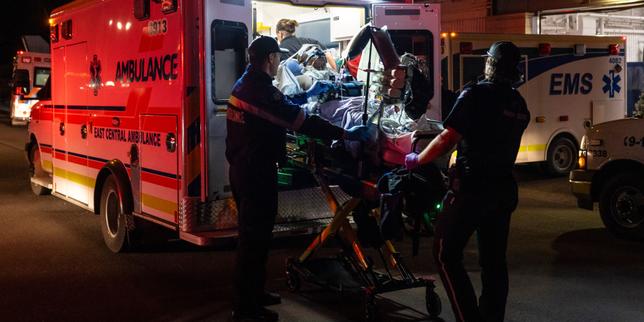
The local emergency department at Wainwright Health Centre received warning of a mass-casualty event and saw the first wounded arrive within minutes. Small rural and regional hospitals are built for steady community care, not dozens of simultaneous blast, thermal, and inhalation injuries. Rapid airlifts and province-wide coordination kept the system from buckling completely, yet acute care leaders noted how quickly patient volume strained regional capacity.
There is another cost that rarely makes the headlines after the initial press conferences fade. Frontline nurses, paramedics, base firefighters, and surviving soldiers carry the weight of what they saw and did during those hours. Alberta Premier Danielle Smith rightly pointed to the psychological strain on first responders, and military officials highlighted support lines and family liaisons. Support hotlines matter, though long-term recovery for burn survivors and witnesses demands sustained clinical care long after public attention moves on.
What Real Accountability Requires Now
Three parallel tracks—military police investigation, a board of inquiry, and internal safety reviews—have been tasked with determining what happened and what must change. Military leaders have promised transparency and stated that new safety measures will be adopted immediately if investigators find gaps.
Promises are easy in the wake of grief. Real reform is harder because it forces institutions to confront uncomfortable trade-offs.
- Audit range fire triggers objectively. Replace vague discretion around "monitored" fires with strict wind, dryness, and proximity thresholds that halt live fire automatically.
- Separate training schedules from weather windows. When autumn conditions turn dry and gusty, shift live munitions to early hours or reschedule rather than stretching afternoon blocks.
- Publish the inquiry's operational findings plainly. Families, soldiers, and taxpayers deserve a clear accounting of the timeline between initial smoke detection, range control decisions, and evacuation orders—not sanitized generalities.
No board of inquiry can bring back Sgt. Morgan Wong, Pvt. Shaun Farrell, Pvt. Aidan Goulding, Pvt. Hayden Lykkemark, or Pvt. William Douglas Dal Bianco. What the Canadian Armed Forces owes them—and the dozens of wounded still healing—is a candid reckoning with how a known fire on a training range was allowed to become lethal.