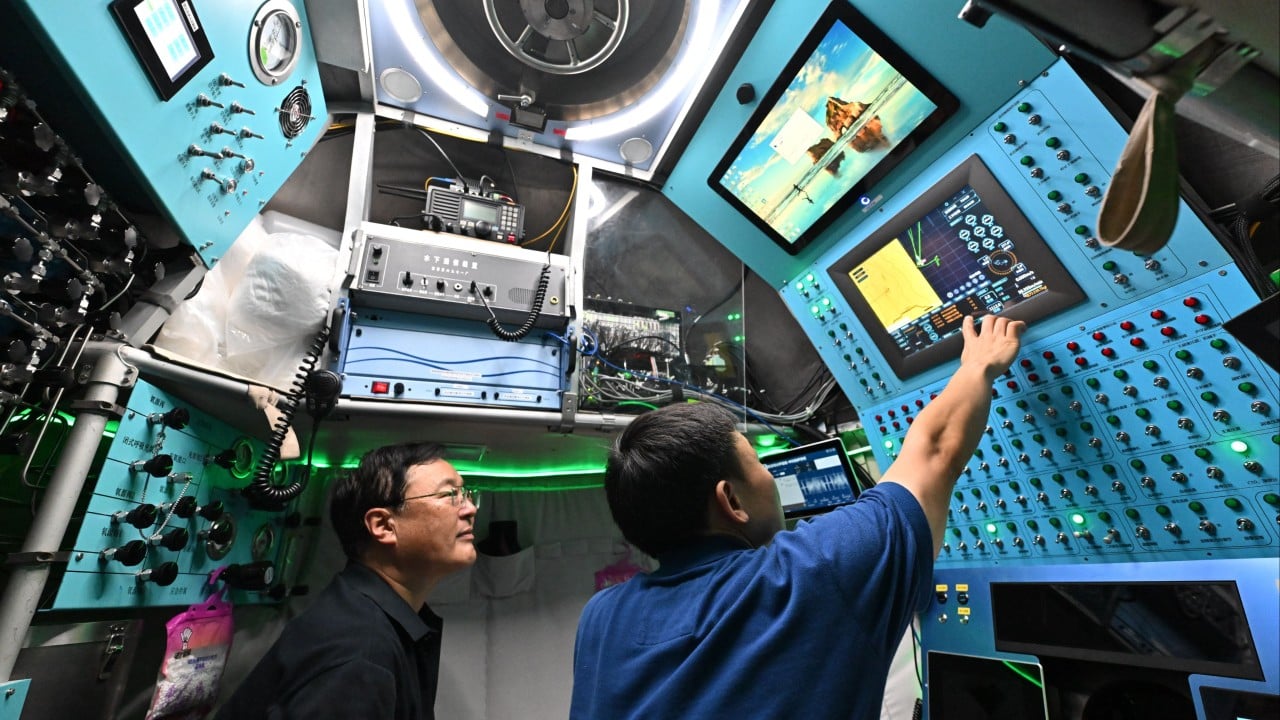
Beijing is testing advanced artificial intelligence systems designed to assist submarine commanders with high-stakes tactical decisions, acoustic tracking, and silent navigation in contested waters. By training machine learning models on simulated naval engagements and complex oceanographic data, Chinese defense researchers aim to compensate for the historical acoustic disadvantages of the People’s Liberation Army Navy (PLAN) undersea fleet. While the technology promises faster threat identification and reduced human error during prolonged submerged patrols, deploying autonomous decision-making software beneath the waves introduces severe operational risks, including algorithmic blind spots, brittle edge-case performance, and the terrifying prospect of automated escalation in the South China Sea.
For decades, undersea warfare has been defined by a simple, brutal equation. Whoever hears the other first wins.
Submarines operate in a sensory vacuum where radar is useless, radio waves barely penetrate the surface, and global positioning satellites cannot reach. Crews rely almost entirely on passive sonar—listening to the ambient noise of the ocean and picking out the faint mechanical hum of a distant propeller, the cavitation of water bubbles, or the subtle shift in thermal currents caused by a massive steel hull moving through the deep. Historically, this has been China’s greatest vulnerability. While the United States and its allies spent half a century perfecting ultra-quiet nuclear propulsion and acoustic dampening, early Chinese submarines were notoriously noisy, easily tracked from hundreds of miles away by American acoustic arrays and hunter-killer subs.
To close that gap, Beijing has poured billions into hull design, pump-jet propulsors, and battery technology. Now, it is turning to code.
The Acoustic Bottleneck and the Algorithmic Fix
Modern naval combat generates far more data than a human sonar operator can process in real time. A single patrol in the Western Pacific involves filtering out thousands of overlapping sound profiles: container ships, fishing trawlers, seismic shifts, biological marine life, and shifting thermoclines—layers of water with different temperatures and salinities that bend sound waves in unpredictable ways.
In traditional submarine operations, interpreting this acoustic soup requires years of intuition. A seasoned sonar technician can tell the difference between a merchant vessel and a Virginia-class attack submarine by listening to subtle rhythmic anomalies on a waterfall display.
Human ears get tired. Algorithms do not.
According to publicly available research papers from Chinese defense institutions—including the China Shipbuilding Industry Corporation (CSIC) and Harbin Engineering University—engineers have been developing deep-learning architectures specifically tailored for underwater acoustic target recognition. These systems ingest raw hydrophone data, strip away environmental background noise, and classify targets within milliseconds.
The ambition goes well beyond passive listening. Researchers are testing decision-support AI capable of acting as a digital executive officer. During simulated war games, these models evaluate incoming sensor feeds, predict an adversary's likely evasion maneuvers, calculate firing solutions for torpedoes or anti-ship missiles, and recommend optimal depth changes to hide beneath thermal layers. In theory, an AI co-pilot allows a smaller, less experienced crew to execute maneuvers that would otherwise require a veteran captain at the peak of cognitive alertness.
Why Beijing Needs AI Underwater More Than Washington Does
To understand the urgency behind this push, look at the demographics and operational tempo of the Chinese navy. China has built warships and submarines at a pace unseen since the Second World War. Hulls are sliding down slipways faster than the PLAN can train experienced commanding officers to fill them.
Submarine command is not a skill you can mass-produce in a classroom. The U.S. Navy puts prospective submarine captains through a grueling, multi-year pipeline of nuclear power school, sea tours, and rigorous command qualification exams. Even then, the psychological toll of spending months sealed inside a steel tube without sunlight or external communication breaks many capable officers.
China faces an acute command bottleneck. Expanding the fleet means promoting younger officers faster, resulting in a shallower pool of institutional muscle memory during high-stress scenarios.
Artificial intelligence is Beijing’s attempted shortcut. By encoding the tactical playbook of top naval strategists into a neural network, the PLAN hopes to standardize tactical competence across its entire submarine force. If a junior commander in the Taiwan Strait encounters an unexpected U.S. carrier strike group, the onboard AI can instantly run thousands of probabilistic simulations, flagging the highest-probability escape route or ambush vector before the human crew has finished plotting the contacts on a paper chart.
There is also the matter of electronic silence. In a peer-to-peer conflict, a submarine that transmits data back to shore headquarters reveals its location and invites an immediate anti-submarine warfare (ASW) response. Submarines must fight alone, cut off from cloud computing and satellite uplinks. Running large, capable AI models locally on ruggedized, low-power servers inside the hull allows a submarine to maintain high-level analytical capability without ever breaking radio silence.
Inside the Machine How Naval AI Actually Trains
Training an AI to drive a car requires millions of miles of street footage. Training an AI to fight a submarine war is infinitely harder because real-world combat data barely exists.
Nobody has fought a major submarine battle since the Falklands War in 1982, and modern nuclear submarines have never engaged one another in open combat. Consequently, Chinese defense researchers rely heavily on synthetic data and reinforcement learning.
Consider a hypothetical training scenario inside a classified simulator in Wuhan or Qingdao. Two virtual submarines—one representing a Chinese Type 093B nuclear attack submarine, the other modeled on the acoustic and kinematic profile of an American Los Angeles-class boat—are dropped into a digital recreation of the Bashi Channel. The virtual environment models real bathymetry, underwater canyons, shifting salinity levels, and seasonal current patterns.
The AI plays millions of iterations of this cat-and-mouse game. In early rounds, it makes catastrophic mistakes: running too fast and cavitatating its propellers, silhouetting itself against surface noise, or firing torpedoes prematurely from out of range. Through trial and error, the neural network discovers non-intuitive tactics. It learns to hug specific underwater ridges to mask its acoustic signature, or to time its speed bursts to coincide with the passage of noisy surface tankers overhead.
Once the model demonstrates consistent tactical superiority in simulation, engineers distill the neural network into a compressed format capable of running on marine-grade hardware. These pruned models are then tested aboard manned testbeds and unmanned underwater vehicles (UUVs) in controlled littoral waters before ever approaching a frontline combat vessel.
The Illusion of Control in the Deep
On paper, an AI-assisted submarine sounds unstoppable. In practice, veteran submariners and defense analysts see glaring vulnerabilities that promotional research papers conveniently gloss over.
The ocean is not a static chessboard. It is a chaotic, dynamic environment where acoustic conditions change by the hour. A sudden rainstorm on the surface alters ambient noise profiles. A massive school of snapping shrimp can blind passive sonar arrays. Freshwater runoff from major rivers shifts water density and refracts sound waves in ways that defy neat mathematical modeling.
Overfitting to simulation data is the silent killer of military AI. If a neural network is trained primarily on idealized oceanographic models, it may hallucinate targets or completely miss a real threat when confronted with messy, real-world acoustic anomalies. Worse, because deep learning models operate largely as black boxes, a submarine captain may not understand why the system is recommending a sharp turn to port or flagging a phantom contact as an enemy destroyer.
Under extreme stress, human operators fall victim to automation bias—the tendency to trust a computer's output over their own training and instincts. Imagine a patrol in contested waters where tensions are already at a boiling point. The AI flags a faint acoustic transient as an incoming torpedo launch from a nearby patrol aircraft, recommending immediate evasive maneuvers and counter-fire. In reality, the sound was an iceberg calving miles away or an unusual mechanical rattle from a nearby commercial vessel. If the human crew defers to the machine, a false positive triggers a shooting war.
The Vulnerability to Acoustic Spoofing
There is another problem that rarely makes headlines: adversarial attacks.
Just as image-recognition AI can be tricked into seeing a toaster as a banana by altering a few pixels, underwater acoustic AI can be spoofed. If an adversary understands the frequency bands and feature-extraction methods a rival AI relies on, they can deploy inexpensive expendable decoys or unmanned underwater drones programmed to emit specific acoustic signatures.
By flooding a contested chokepoint with tailored noise profiles, an opposing force could theoretically induce cognitive paralysis in a submarine's AI, forcing it to classify harmless decoys as high-priority threats or masking the approach of an actual hunter-killer submarine behind a wall of algorithmic confusion.
The Escalation Trap Nobody Wants to Discuss
The integration of AI into submarine warfare crosses a dangerous threshold when those vessels carry nuclear weapons.
China’s Jin-class (Type 094) ballistic missile submarines form the sea-based leg of its nuclear triad. These boats patrol deep waters to ensure a survivable second-strike capability—the guarantee that even if land-based missile silos are destroyed, China can still retaliate. Because the Type 094 is relatively noisy compared to American Ohio-class boomers, keeping these boats hidden is a top strategic priority for Beijing.
Using AI to help a ballistic missile submarine evade detection seems defensive on the surface. Yet the line between defensive navigation and offensive fire control is razor-thin.
When an AI system is deeply woven into a submarine’s combat management system, decision timelines compress dramatically. Actions that used to require deliberation across a chain of human officers—verifying a contact, assessing intent, plotting a firing solution, requesting authorization—collapse into seconds. In an environment where communications with mainland command are unreliable or severed entirely during a conflict, a cornered submarine crew relying on automated threat assessments faces immense pressure to shoot first before they are sunk.
Washington and Moscow spent decades building cold war guardrails, hotlines, and tacit rules of engagement to prevent accidental naval clashes from spiraling into nuclear exchanges. No comparable framework exists for algorithmic warfare beneath the Pacific.
Beyond the Manned Hull The Rise of the Ghost Fleet
While headlines focus on AI assisting human captains, the real transformation happening in Chinese shipyards is the elimination of the crew altogether.
Everything Beijing is learning from putting AI aboard manned submarines feeds directly into its aggressive development of extra-large unmanned underwater vehicles (XLUUVs), such as the HSU-001 and larger autonomous prototypes spotted via satellite imagery at naval bases in recent years.
A human crew is the single biggest limitation on submarine design. People require oxygen scrubbers, freshwater distillers, food storage, bunks, radiation shielding, and rescue hatches. Strip out the human element, and naval architects can build sleeker, cheaper, longer-endurance vessels that can sit dormant on the seabed for months, waking up only when their onboard AI detects the acoustic signature of a high-value target passing overhead.
Manned submarines equipped with decision-support AI are effectively the bridge technology toward this autonomous future. The data collected by human-crewed boats running AI co-pilots during peacetime patrols provides the exact real-world training telemetry needed to refine fully autonomous underwater drones.
What Comes Next in the Undersea Arms Race
The United States is not sitting idle while Beijing wires neural networks into its fleet. Through programs run by DARPA and the Office of Naval Research, the U.S. Navy is actively deploying its own machine-learning acoustic processors, autonomous mine-hunting drones, and large unmanned undersea vehicles like Boeing’s Orca.
However, the strategic calculus differs sharply between the two powers. The U.S. military doctrine emphasizes human-in-the-loop accountability, maintaining strict legal and operational barriers against delegating lethal force to autonomous algorithms. Beijing’s military-civil fusion strategy treats artificial intelligence as an asymmetric equalizer—a way to leapfrog decades of Western maritime dominance without waiting generations to build institutional experience from scratch.
Testing an algorithm in a simulation lab or a calm coastal test range is one thing. Trusting it with nuclear-armed hulls in the dark, crushing depths of the Philippine Sea is another entirely. Until those systems face the unpredictable chaos of an actual crisis at sea, the world will not know whether China’s underwater AI is a decisive tactical advantage or a catastrophic single point of failure waiting to misfire.
/Palantir by Hiroshi-Mori-Stock via Shutterstock.jpg)