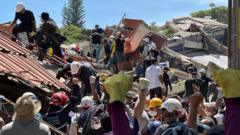
The dust settles slowly over the concrete debris. Beneath the pancaked slabs of what used to be a family home, a brother waits. He stares at the void where his sibling was last heard, listening for a sound against the deafening silence of an unfolding tragedy. This is the raw reality of the Colombian earthquake crisis, an event that does more than rattle tectonic plates; it cracks open decades of systemic neglect, municipal failures, and the brutal mathematics of seismic vulnerability in urban centers ill-equipped for disaster.
When the earth heaves in the Andes, the immediate narrative focuses on magnitude, epicenters, and the frantic hours of search and rescue operations. Yet, veteran reporters who have walked the cracked alleys of Andean cities know that the real story begins long before the first tremor. It begins in zoning offices, in skipped engineering reviews, and in the quiet compromises of informal construction.
The Anatomy of a Man-Made Disaster
Seismology is an exact science, but disaster is a choice. Colombia sits atop one of the most volatile geological junctions on the planet, pinned between the Nazca, South American, and Caribbean tectonic plates. Tremors are a constant, documented reality of life from Bogota to Medellin and down into the regional valleys.
Yet, when buildings collapse like stacks of wet cardboard, the root cause is rarely just the earth's fury. It is substandard rebar. It is unreinforced masonry built without professional oversight. It is the unchecked expansion of neighborhoods where housing demand completely outpaces municipal enforcement of building codes.
When a structure fails under moderate stress, engineers do not look exclusively at the Richter scale. They look at the mix of cement and aggregate. They look at the spacing of stirrups in concrete columns. They examine shortcuts taken by developers who maximized profit margins while gambling with human lives.
The human cost of these structural shortcuts is borne entirely by families standing behind police tape. While politicians issue statements of solidarity from air-conditioned offices in the capital, relatives of the missing spend days counting the hours in the dirt. They watch heavy machinery claw at rubble with a desperation that defies official timelines.
The Logistics of Despair
Rescue operations in high-density Latin American urban zones present a logistical nightmare. Heavy equipment cannot navigate narrow, hillside streets choked with parked vehicles and impromptu vendor stalls. Communication grids fail within minutes of a major shock. First responders are often cut off from centralized command, forced to improvise with inadequate gear, bare hands, and sheer adrenaline.
During the critical window—the golden seventy-two hours when survival rates plummet—efficiency is everything. But efficiency requires infrastructure. When local disaster response committees rely on volunteer brigades with outdated hydraulic jacks and broken radios, hours slip away.
Foreign aid takes time to clear customs, coordinate flight paths, and deploy to the field. By the time specialized canine units and thermal imaging gear arrive at a collapse site, the window has often closed. This systemic lag is rarely discussed in official press briefings. Instead, the focus remains on the heroism of the individuals on the ground, masking the institutional inertia that allowed the disaster to worsen in the first place.
The Economic Penalty of Ignoring the Fault Lines
Disaster recovery in developing nations follows a predictable, tragic loop. Relief funds arrive. Temporary tent cities sprout up in public parks. Rebuilding efforts begin with high-energy pronouncements about building back better. Then, attention shifts to the next global crisis, funding dries up, and vulnerable communities return to the exact same precarious conditions they occupied before the earth moved.
This cycle is economically unsustainable. Every peso spent on emergency body recovery and emergency shelters is a peso stolen from preventative retrofitting. Retrofitting older brick-and-mortar homes with external steel bracing or carbon-fiber wraps is expensive, disruptive, and politically unsexy. No mayor wins an election by spending municipal budgets on invisible structural reinforcements that might not be tested for a decade.
Instead, cities expand outward and upward without constraint. Informal settlements cling to unstable hillsides where soil liquefaction during a quake turns entire neighborhoods into cascading mudslides. When disaster strikes these zones, the rescue effort transitions almost immediately from a search for survivors to a recovery operation.
What Real Preparedness Demands
If Colombia and the broader Andean region are to break this cycle, the conversation must shift from post-disaster charity to aggressive accountability.
Building codes must be treated as life-safety laws, not optional guidelines. Municipal inspectors must be insulated from local political corruption and developer influence. Property owners who lease unreinforced spaces must face criminal liability when structural negligence turns a natural event into a manslaughter statistic.
Furthermore, civil defense must be decentralized. Communities need neighborhood-level response caches—stored locally, maintained by residents, and drilled regularly. When bridges drop and tunnels close, central government help is too far away. The first responders are always the neighbors.
Back at the rubble site, the brother continues to watch. The sun dips below the horizon, casting long, bruised shadows across the ruined street. Heavy lights flicker on, buzzing against the quiet hum of generators. Another shift of rescue workers steps up to the pile, swapping out tired colleagues. Beneath their boots, the earth is quiet for now, resting before its next inevitable strike, while above ground, a family waits for an answer that the system was never built to provide.