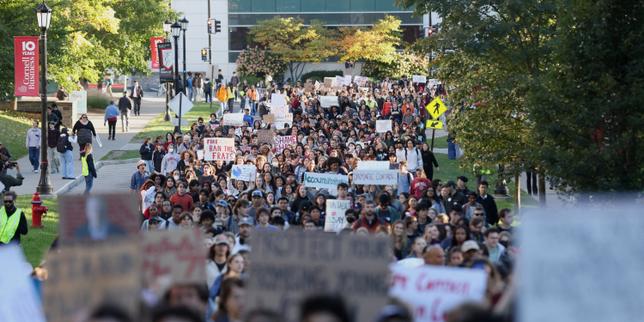
A fifteen-year-old high school student lost his hand during student demonstrations in France after a police-issued munition detonated. This catastrophic injury instantly transformed an ordinary dispute over underfunded classrooms into a national crisis regarding state violence. Thousands of teenagers had taken to the streets to protest crumbling infrastructure, overcrowded rooms, and staff shortages. Instead of administrative reform, they met tear gas, batons, and high-powered dispersal devices designed for military combat rather than municipal crowd control.
The incident occurred amid escalating demonstrations that paralyzed dozens of schools across France
When a High School Protest Turns to Shrapnel The True Cost of French Civil Unrest
news
cg
A teenager lost his hand after picking up an explosive device during high school demonstrations in France, turning a standard student mobilization into a grim security emergency. Civil disobedience in the European nation has long operated under a volatile set of rules. Tear gas, overturned bins, and burning barricades usually form the baseline of urban friction between youth groups and law enforcement. The presence of military-grade munitions in the middle of a civilian street demonstration shatters that baseline entirely.
How does a defensive grenade end up on a suburban pavement during a morning walkout? That question exposes a fractured pipeline of municipal security, protest management, and lingering munitions from past conflicts or training exercises. The incident occurred outside a lycée as students mobilized against educational reforms. What began as a routine demonstration over curriculum changes and funding cuts quickly devolved into chaos when unidentified objects detonated or were triggered on the asphalt.
The Anatomy of a Riot Zone
Street protests in major European urban centers rarely remain peaceful for long when institutional tension reaches a boiling point. Labor strikes, pension reforms, and educational disputes routinely draw thousands of students into the streets. These demonstrations function as pressure valves for a younger demographic feeling increasingly alienated from state policies.
Law enforcement agencies deploy specialized units to contain these crowds. Tear gas canisters and flash-bangs become standard atmospheric features. Yet, the introduction of a live military explosive into the hands of a minor points to a breakdown that goes beyond standard riot control protocols.
Munitions find their way into civilian zones through various channels. Collectors, illicit artifact hunting, or historical remnants buried near suburban training grounds sometimes resurface during civil unrest. When agitators infiltrate student movements, the dynamic shifts from political expression to opportunistic violence. The teenager who picked up the object did not recognize the lethal architecture hidden beneath layers of rust or dirt.
Security Failures and the Escalation Spiral
Public safety officials face an impossible balancing act during nationwide walkouts. Securing hundreds of educational institutions simultaneously stretches police resources to a breaking point. When thousands of adolescents flood the thoroughfares, containment strategies often rely on aggressive dispersal rather than preventive intelligence.
Critics argue that heavy-handed police tactics radicalize otherwise peaceful student populations. When teenagers face projectile tear gas and baton charges, defensive instincts take over. Conversely, authorities point to masked infiltrators who use student protests as cover for looting, property destruction, and direct assaults on officers.
The loss of a limb changes the political conversation instantly. It moves the debate from abstract discussions about school funding to immediate questions about physical survival and police accountability. Families send their children to school expecting basic custodial safety. They do not expect them to encounter unexploded ordnance on public streets.
The Broader European Protest Culture
France occupies a unique position in Western political traditions. Street protest is viewed not merely as a constitutional right, but as a core civic duty. Governments expect a certain level of disruption whenever a new piece of legislation encounters public resistance.
This cultural tolerance for chaos creates blind spots. When riots become ritualized, the warning signs of real danger get ignored. Smoke from burning tires blends with smoke from actual explosives until it is too late to tell the difference.
Municipal authorities now face intense pressure to audit how crowd control munitions are accounted for and how military-grade hardware ends up accessible to the public. The investigation into the incident continues, but the psychological damage to the student body is already permanent.
Every street corner holds a history. In this case, that history surfaced with devastating force.