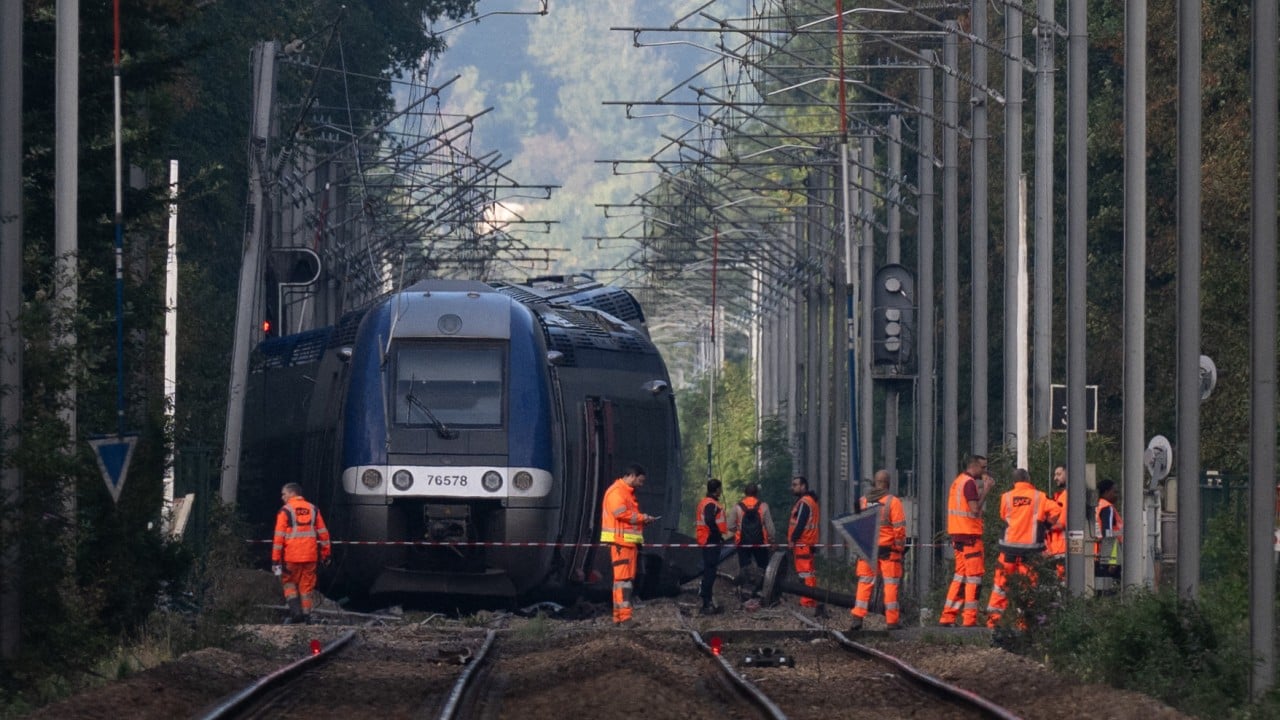
A regional passenger train carrying 186 people hurtled along the tracks between Rouen and Caen at roughly 140 kilometers per hour before violently meeting a foreign fragment of steel placed maliciously across the line. That singular piece of metal triggered a catastrophe near Cléon in northwestern France, leaving 44 people injured—including an 18-year-old woman initially rushed away in critical condition. While initial headlines quickly settled on the obvious mechanics of the crash, the primary line of inquiry pursued by Rouen prosecutor Sébastien Gallois points directly to deliberate human intervention.
Critical infrastructure across Western Europe remains intensely vulnerable to low-tech, high-impact disruption. When a multi-ton locomotive strikes an object intentionally bolted or wedged onto active rails, the physics involved dictate an immediate crisis. The regional TER train did not merely experience a mechanical failure; it was subjected to an external physical assault designed to defeat the passive safety margins engineered into modern rail networks.
The Anatomy of Vulnerability
Rail networks span thousands of kilometers of open countryside, making absolute physical security an impossible logistical luxury. Unlike commercial aviation, which funnels every movement through heavily monitored, fenced-in airport perimeters, national rail grids rely heavily on open access lines, automated signaling, and the sheer presumption of civic order.
A malicious actor requires very little to disrupt this ecosystem. Dropping, clamping, or wedging a heavy section of spare rail onto an active path introduces a catastrophic point of failure. When the train's lead bogie impacts the foreign object at high speed, the immense kinetic energy has nowhere to go. One carriage tipped completely onto its side while four others jumped the tracks near the local industrial zone, turning a routine Friday evening commute into a mass-casualty response zone involving 130 firefighters and multiple emergency medical units.
Investigators quickly cleared the human element in the cabin; routine toxicology screens administered to the train driver returned entirely negative for drugs and alcohol. The focus narrowed instantly onto the track itself, where photographic evidence and forensic recovery teams identified a detached segment of metal that had no operational business resting between the active rails.
A History of Fragile Lifelines
France is no stranger to catastrophic rail incidents, though intentional sabotage occupies a uniquely dark category compared to structural wear or human error. Decades ago, high-speed and regional networks expanded under the banner of national unity and efficient transit, prioritizing speed and accessibility over fortress-like security.
Major disasters of the past, such as the fatal high-speed testing derailment at Eckwersheim or the tragic commuter crash at Brétigny-sur-Orge, forced engineering teams to rewrite safety protocols regarding track maintenance and component fatigue. Yet those historical tragedies stemmed from mechanical breakdowns or procedural lapses. Deliberate sabotage shifts the paradigm entirely, transforming the rail network from a complex technical system into an asymmetric security puzzle.
Protecting thousands of miles of ribbon steel from bad actors requires an impossible balance between civil liberties, economic viability, and counter-surveillance. If every kilometer of track required physical patrols or continuous electronic monitoring to detect foreign objects, passenger fares would skyrocket and the fundamental convenience of rail transit would evaporate.
The Broader European Ripple Effect
Transport security analysts have watched consecutive incidents across the continent with mounting dread. Sabotage targeting rail infrastructure is rarely random; it often tests the resilience of state emergency apparatuses and exploits public anxiety. When vital economic and commuter corridors between Normandy urban centers are abruptly severed, the psychological shock outweighs the physical damage.
SNCF Réseau, the agency managing the French rail network, immediately suspended traffic along the affected corridor and cut electrical power to the lines to allow forensic teams and rescue personnel to operate without the threat of live-wire hazards. Thousands of daily commuters face cascading delays, freight movements grind to a halt, and regional supply chains absorb sudden friction.
The investigation unfolding in Normandy will inevitably lead to uncomfortable questions about how easily a piece of heavy steel can be positioned to derail a passenger transport. As forensic experts comb through digital footprints, local surveillance, and physical evidence left at the Cléon site, the illusion of effortless transit fades.
Open rail grids operate on trust, and repairing that trust demands answers that go far beyond a standard accident report.


