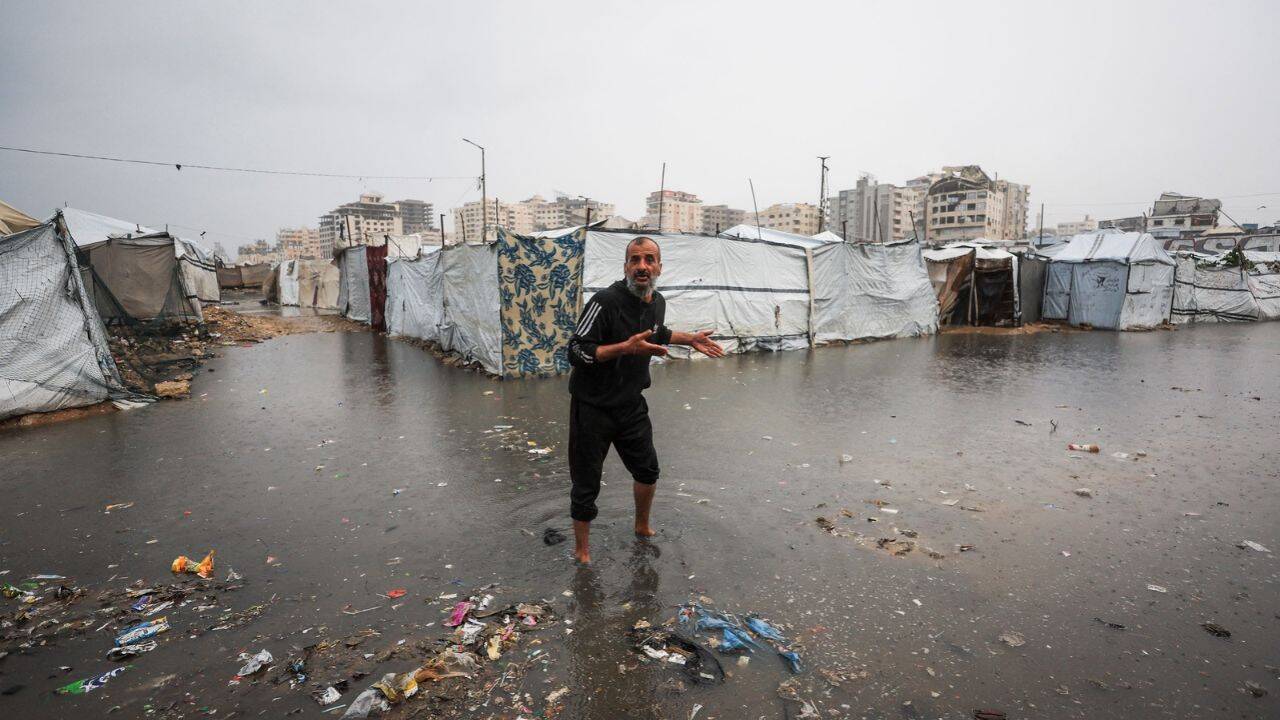
Torrential winter rains have inundated roughly 70,000 makeshift shelters across the Gaza Strip, turning displacement camps into waist-deep basins of mud and raw sewage while severe fuel shortages paralyze the trucks and pumps needed to rescue families.
It is a predictable disaster. Every autumn along the eastern Mediterranean coast, low-pressure weather systems sweep inland off the sea, dumping heavy rain onto a narrow strip of coastal plain. Under normal urban conditions, municipal storm drains, coastal outfalls, and pumping stations channel that runoff into the Mediterranean within hours. Today, those systems are largely gone. Over months of sustained bombardment, heavy tracked military vehicles, and widespread demolition, the subterranean arteries of Gaza have been crushed, severed, or choked with millions of tons of pulverized concrete. When the rain falls now, the water has nowhere to go.
The Anatomy of a Man-Made Floodplain
To understand why a seasonal storm becomes a mass-casualty hazard in Gaza, you have to look beneath the surface. Before the current conflict, Gaza's water and sanitation network already operated on thin margins, relying on aging pipes and stressed treatment plants to serve more than two million people in one of the most densely populated territories on earth.
Since late 2023, that fragile grid has suffered systemic collapse. Stormwater drainage networks require continuous gradient flow and unobstructed catch basins to function. When multi-story residential blocks collapse onto streets, fine concrete dust and jagged rebar wash directly into street-level grates during the first drizzle. Once those grates seal shut, rainwater pools on the asphalt and seeks the lowest elevation.
In Gaza, the lowest elevations are often the exact areas where displaced families have pitched their tents. Coastal dunes near Al-Mawasi, agricultural depressions in Khan Younis, and cleared lots in central Gaza act as natural catch basins. Hundreds of thousands of people moved to these sandy or low-lying zones because intact urban neighborhoods had become uninhabitable or inaccessible.
The physics are unforgiving. Sand and compacted dirt can absorb only a finite volume of water before reaching saturation. Once the water table rises to the surface, any additional rainfall creates standing sheets of water. Because municipal wastewater networks are simultaneously broken, untreated sewage overflows from damaged manholes and mixes directly with the rainwater.
Families are not merely getting wet. They are wading through a contaminated slurry that destroys bedding, ruins dry food rations, and transforms minor scrapes into severe skin infections.
Why Tents Fail in Coastal Winter Storms
Most reporting on the flooding treats a tent as a basic unit of shelter, assuming that once an agency distributes canvas or plastic sheeting, a family is housed. In the humanitarian sector, we know better. Emergency tents are designed for rapid deployment and short-term dry-season staging, not multi-month winter survival against gale-force coastal winds.
Consider the anatomy of the shelters currently housing over a million people in Gaza. Many are not standardized humanitarian-grade ridge tents at all. Due to prolonged supply bottlenecks and commercial restrictions, thousands of families rely on ad-hoc structures cobbled together from salvaged wooden pallets, thin polyethylene tarpaulins, torn advertising banners, and bedsheets.
Even standard-issue emergency tents deteriorate rapidly under prolonged UV exposure. After six to nine months under the intense Mediterranean sun, woven polypropylene fibers become brittle. When winter gusts hit 30 or 40 knots off the sea, seams split and grommets tear out.
The Ground-Level Failure Point
The fatal flaw of almost every shelter in these camps is the floor. Standard emergency tents lack integrated, heavy-duty bathtub groundsheets capable of holding back rising surface water. Without raised wooden pallets, gravel beds, or perimeter trenching, water seeps underneath the tent walls within minutes of a downpour.
Digging drainage trenches around tents—the standard field engineering fix in displacement camps—requires two things largely absent in Gaza's overcrowded zones: space and tools. When tents are pitched guy-rope to guy-rope with barely a foot of clearance between families, digging a trench around one shelter simply diverts runoff directly into a neighbor's sleeping area. Shovels, pickaxes, and sandbags remain scarce, often restricted at border crossings under broad dual-use classifications that treat basic construction materials and metal tools as potential military assets.
Hypothetically, if an aid agency wanted to winterize a single camp holding 10,000 people using basic gravel elevation and heavy-duty timber framing, it would require hundreds of flatbed truckloads of aggregate and lumber. Across Gaza, almost none of those raw materials are entering the strip.
The Fuel Chokehold on Emergency Response
When floodwaters rise in a functioning city, two machines save lives: diesel-powered dewatering pumps and heavy earthmoving equipment. In Gaza, both sit idle because of an acute, chronic deficit in diesel fuel.
Fuel is the singular bloodstream of humanitarian operations in a war zone. Without electricity from the grid—cut off at the outset of the conflict—every critical municipal and relief function runs on generators and internal combustion engines. When fuel deliveries drop below minimum operational thresholds, agencies face brutal triage decisions.
- Hospital generators take absolute priority to keep intensive care units, neonatal incubators, and operating theaters alive.
- Desalination plants and water wells come next, because without potable water, dehydration and cholera follow within days.
- Sewage pumping stations compete directly with hospitals and water plants for the remaining liters of diesel.
- Aid distribution trucks sit at the back of the queue when tanks run dry.
This cascading shortage explains why the flooding of 70,000 shelters coincides with a near-total paralysis of relief delivery. Even when warehouses inside Gaza hold blankets, mattresses, or replacement tarpaulins, logistics teams cannot move them if their flatbed trucks lack diesel.
The Mechanics of Sewage Backflow
The fuel shortage also actively worsens the flooding itself. Modern sanitation systems rely on lift stations—subterranean pumps that push wastewater uphill toward treatment facilities or coastal outfalls. In low-lying areas of Gaza City, Deir al-Balah, and Khan Younis, those lift stations depend entirely on backup diesel generators.
When a lift station runs out of fuel during a rainstorm, incoming rainwater overwhelms the gravity-fed pipes. Pressure builds inside the underground mains until sewage erupts backward through street drains and household plumbing. A storm that might have caused six inches of clear rainwater pooling suddenly generates two feet of toxic, pathogen-laden floodwater.
Municipal crews know exactly how to stop it. They know which valves to close and which mobile pumps to deploy. They simply lack the fuel to run the engines and the safe passage required to reach flooded intersections under active military conditions.
The Logistics Bottleneck at the Borders
To an outside observer, solving a shelter and fuel crisis in a territory less than 25 miles long seems like a straightforward logistics exercise. Drive trucks in, offload supplies, pump out the water. On the ground, the border crossings function like a clogged funnel where administrative friction, security inspections, and active combat zones intersect.
Every pallet entering Gaza must pass through multi-layered inspection regimes. If a single item on a manifest triggers a security flag—a metal tent pole deemed too thick, a solar battery bank classified as dual-use, a batch of waterproof sealant—the entire truckload can be rejected, forced to turn back, offload, and re-enter the inspection queue from the beginning.
This zero-tolerance inspection model creates a devastating mismatch between what agencies request and what actually crosses the fence. Aid workers routinely report receiving shipments of food parcels while winterization kits—thermal blankets, heavy-duty plastic sheeting, waterproof boots, and drainage pumps—remain stranded in warehouses in Egypt or Jordan for months.
The Last-Mile Collapse
Crossing the border is only half the battle. Once supplies enter Gaza, convoys must navigate devastated road networks cratered by airstrikes and churned into deep mud by tanks. Standard commercial cargo trucks, built for paved highways, routinely bog down in flooded dirt tracks.
Security breakdown compounds the physical obstacles. Desperate crowds, armed gangs looting unguarded convoys, and unpredictable military checkpoints force humanitarian drivers to halt operations for days at a time. International aid agencies cannot insure commercial drivers to operate in active fire zones, and armored vehicles remain severely limited in number. As a result, thousands of tons of aid sit on the Gaza side of the border crossings, less than ten miles from flooded camps, completely unreachable.
Public Health Fallout in Saturated Camps
The immediate misery of freezing in wet clothes quickly gives way to predictable epidemiological spikes. Cold stress weakens the immune system, particularly among infants, the elderly, and people already weakened by months of caloric deficits and malnutrition.
Hypothermia does not require sub-zero temperatures. When coastal winds blow across soaked clothing at 45 or 50 degrees Fahrenheit, human body temperature drops rapidly. Inside unheated plastic tents, wet mattresses conduct heat away from the body all night long.
Simultaneously, floodwaters serve as an efficient delivery mechanism for waterborne pathogens. Acute watery diarrhea, hepatitis A, and typhoid thrive when fecal matter contaminates living spaces. In overcrowded camps where dozens of families share a single working latrine—or rely on open pits—flooding erases any remaining barrier between human waste and daily life.
Respiratory infections surge alongside gastrointestinal illnesses. To stay warm inside damp tents, families burn whatever they can scavenge: scrap plastic, treated wood, cardboard, and trash. Thick, toxic smoke fills unventilated shelters, triggering severe asthma attacks, bronchitis, and pneumonia in children who have nowhere else to breathe.
The Structural Trap of Temporary Relief
There is an uncomfortable truth that humanitarian organizations rarely state plainly in their press releases. You cannot tarpaulin your way out of an infrastructure collapse.
Distributing 70,000 new plastic sheets after a storm is a necessary emergency reflex, yet it is functionally identical to mopping a floor while the roof is missing. As long as heavy engineering machinery, concrete, piping, spare parts for pumps, and unrestricted diesel fuel remain blocked or severely rationed, every subsequent winter storm will produce the exact same catastrophe.
True flood mitigation in Gaza requires industrial-scale intervention. It requires excavators to clear millions of tons of rubble from blocked drainage corridors. It requires replacement submersible pumps, high-density polyethylene piping, and thousands of tons of gravel to elevate camp foundations above the floodplain. Above all, it requires reliable daily fuel allocations specifically ring-fenced for municipal water and sanitation crews, backed by guaranteed deconfliction corridors so engineers can work without being targeted.
Without those structural inputs, the cycle is locked in place. The rain falls off the Mediterranean, the broken drains back up, the diesel tanks run dry, and tens of thousands of families stand ankle-deep in freezing sewage waiting for trucks that have no fuel to start their engines.