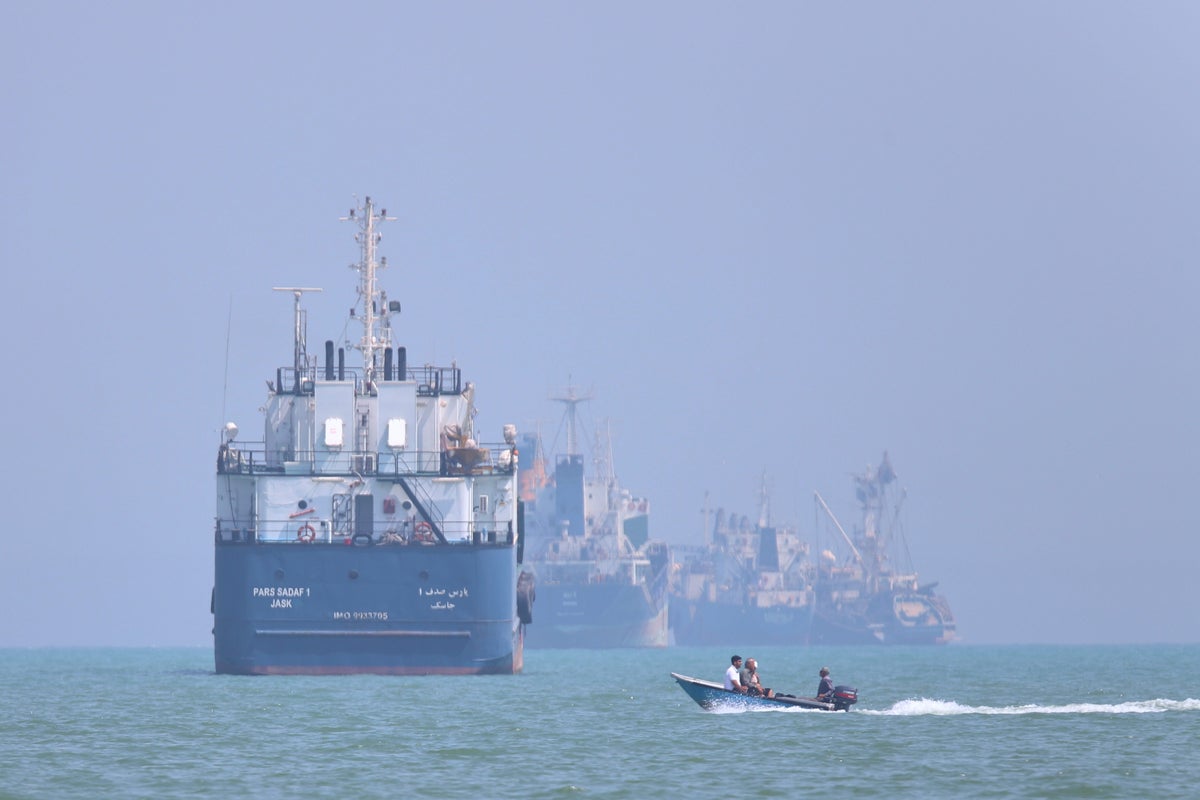
The collapse of the interim Persian Gulf ceasefire was entirely predictable. When Iran shuttered the Strait of Hormuz on Sunday and initiated missile and drone strikes against five regional neighbors, mainstream outlets rushed to label it a sudden, unprovoked escalation. The reality is far more calculated. By launching salvos at Bahrain, Kuwait, Qatar, Oman, and Jordan following intense American bombardment, Tehran is executing a deliberate strategy designed to weaponize regional dependency. This is not a erratic regime lashing out in blind fury. It is a calculated gambit to enforce an entirely new maritime order in the world's most critical energy transit artery.
The immediate trigger for this weekend’s catastrophic breakdown occurred when the Islamic Revolutionary Guard Corps (IRGC) targeted the M/V GFS Galaxy, a Cyprus-flagged container ship transiting the strait. The vessel suffered catastrophic engine room damage, leaving an Indian crew member missing and forcing the remaining mariners to abandon ship. Washington countered immediately. US Central Command directed a punishing series of airstrikes, hitting more than 140 targets across Iran on Saturday night alone, bringing the three-day American total to over 300 destroyed military assets. Tehran’s subsequent response—raining ordnance down on neighboring Arab states while declaring Hormuz closed until the complete cessation of American intervention—has pushed the global energy market toward a terrifying precipice. For another look, read: this related article.
The Secret Financial Leverage Driving Tehran’s Maritime Siege
To understand why Iran chose this exact moment to shatter the fragile truce, one must look beyond the immediate exchange of cruise missiles. The core issue lies in a fundamental disagreement over how international shipping operates within the Persian Gulf. For decades, global commerce has treated the Strait of Hormuz as an international waterway, a legal status protected by international maritime conventions. Tehran wants to destroy that status quo completely.
The Iranian government, now operating under newly installed Supreme Leader Mojtaba Khamenei, is attempting to establish a permanent regulatory regime over the strait. Iranian negotiators, led by parliamentary speaker Mohammad Bagher Qalibaf, are pushing a framework where Tehran would directly audit, approve, and heavily tax every single commercial vessel entering the Persian Gulf. It is a protection racket on a geopolitical scale. Further reporting regarding this has been provided by NBC News.
Washington recently revoked crucial sanctions waivers that had previously allowed Iran to trade crude oil in US dollars. The decision was made in response to initial Iranian harassment of shipping lanes. This financial strangulation completely drained Tehran’s foreign reserves, prompting the IRGC to pivot toward direct physical control of the waterway as an alternate economic lifeline. By forcing ships to navigate arbitrary, Iranian-mandated corridors or face anti-ship ballistic missiles, Tehran is trying to extort billions in transit fees from international shipping cartels.
The strategy depends entirely on exploiting the geographic vulnerability of the southern Gulf states. Iran is attempting to convince its neighbors that hosting American forces brings absolute destruction, while compliance with Iranian hegemony guarantees safety.
The Illusion of Gulf Air Defense and the Five Nation Target List
The choice of targets in Sunday morning’s multi-directional bombardment exposes the soft underbelly of regional defense coordination. While Western defense contractors have spent years selling sophisticated air defense batteries to the Arab monarchies, the actual performance of these systems during a coordinated, multi-layered saturation attack remains deeply troubling.
- Bahrain: Home to the US Navy’s Fifth Fleet, the island kingdom found itself under immediate duress as air raid sirens sounded multiple times. Targeting Bahrain is a direct attempt to hold American command infrastructure hostage, signaling that the headquarters coordinating the maritime coalition is fully within range of Iranian precision-guided munitions.
- Kuwait: Positioned at the northern tip of the Gulf, Kuwait's military confirmed it actively engaged incoming aerial threats. By targeting Kuwait, Iran demonstrates its capability to choke off the northern logistics nodes that support Western land-based assets.
- Qatar: Despite its historically nuanced diplomatic relationship with Tehran, Qatar’s Al Udeid Air Base—which hosts thousands of US troops—was an explicit target. Qatar's military successfully intercepted incoming fire, but falling shrapnel wounded three civilians in Doha, illustrating that even successful defenses carry severe localized risks.
- Oman: For decades, Muscat acted as the premier diplomatic bridge between Washington and Tehran. Yet, Omani state media reported drone strikes in its northeastern territory, forcing residents to shelter in place. This strike is particularly sinister because Oman controls the southern territorial waters that the US military has urged commercial shipping to use to avoid Iranian territory.
- Jordan: Situated further inland, Jordan intercepted three Iranian missiles crossing its airspace. The kingdom remains a critical Western security partner, and by pulling Amman into the crossfire, Tehran is showing that its operational envelope extends far beyond the immediate littoral zone of the Gulf.
The sheer geographic dispersion of these strikes proves that Iran has mapped out a comprehensive theater of war. They are not merely aiming at the ships in the water. They are striking the entire logistical and political network that enables the American presence in the Middle East.
Why the White House Red Line Failed to Deter the IRGC
President Donald Trump’s administration has consistently maintained that unrestricted freedom of navigation through the Strait of Hormuz is an absolute red line for American national security. Following the initial strikes, the White House issued severe warnings, stating that thousands of missiles were locked and loaded to respond to further provocations. Defense Secretary Pete Hegseth echoed this stance, bluntly posting that Iran had made a poor choice and would pay the price.
Yet, the deterrence failed. The reason for this failure stems from a fundamental miscalculation by Western intelligence regarding the internal dynamics of the Iranian leadership.
Following the death of Ayatollah Ali Khamenei in the opening salvos of this war on February 28, Western analysts gambled that a succession crisis would paralyze the Iranian state. They expected factional infighting to prevent a coordinated military response. Instead, Mojtaba Khamenei used the external threat of American bombardment to consolidate power rapidly, aligning himself entirely with the most radical elements of the IRGC command structure.
To the new leadership in Tehran, an extended conflict is not a crisis to be avoided. It is an existential necessity for domestic survival. A prolonged state of war allows the regime to crush domestic dissent under the guise of national security while presenting themselves as the sole defenders of Islamic sovereignty against Western imperialism. When the Pentagon struck 140 targets to degrade Iran's conventional military capabilities, it inadvertently played into the regime’s political hands, giving Mojtaba Khamenei the exact narrative justification he required to order the regional missile assault.
The Dangerous Fallacy of the Southern Maritime Route
In the days leading up to the ceasefire collapse, international maritime agencies and the US military advised commercial mariners to alter their routes significantly. Ships were instructed to hug the coastlines of Oman and the United Arab Emirates, traversing exclusively through non-Iranian territorial waters to maintain safety.
This advice has proven to be an absolute fallacy. The Strait of Hormuz is incredibly narrow, with the shipping lanes proper measuring only a few miles wide in certain choke points. The idea that a massive container ship or a supertanker can achieve safety simply by shifting a few miles to the south is a geographical absurdity when dealing with modern warfare.
When the IRGC attacked the M/V GFS Galaxy, the vessel was operating precisely along the recommended southern route near the Omani coast. The Iranian military did not hesitate to project power into what is technically Omani jurisdiction. They justified the action by claiming the ship was utilizing an unauthorized corridor.
By physically striking a vessel outside its own territorial waters, Tehran has effectively declared that it views the entire mouth of the Persian Gulf as its sovereign domain. This completely invalidates the safety assurances provided by Western navies. Commercial shipping companies are fully aware of this reality. Insurance underwriters are already moving to classify the entire Persian Gulf as a zero-transit zone, a move that will effectively formalize the blockade Iran is seeking to impose, regardless of whether the US Navy physically keeps the lanes open.
The Broken Mechanics of the Global Energy Markets
When Iran first threatened to close the Strait of Hormuz at the onset of hostilities in early 2026, global crude prices spiked to historic highs of $120 a barrel. In the months since, prices have unexpectedly cooled, misleading many economic analysts into believing that the global economy has successfully decoupled from its dependence on Middle Eastern energy.
This stability is incredibly fragile and largely artificial. The drop in oil prices was driven by emergency releases from strategic reserves and a temporary reduction in industrial demand from Asian markets. It was not caused by a permanent structural fix. Approximately one-fifth of the world’s liquefied natural gas (LNG) and petroleum products must pass through that narrow body of water. There are simply no pipelines or alternative overland routes capable of absorbing that volume of transport.
Furthermore, the nature of modern containerized shipping means that a crisis in Hormuz immediately triggers a compounding logistical nightmare across the globe. The M/V GFS Galaxy was not an oil tanker. It was a container ship carrying consumer goods and industrial components. By expanding their targeting profile to include standard merchant shipping, the IRGC is attacking the global supply chain at its foundational level.
Ports in Asia, Europe, and North America will begin feeling the secondary effects of this shutdown within a fortnight. The insurance premiums for any vessel entering the Indian Ocean are set to skyrocket, creating an inflationary pressure wave that central banks will be completely powerless to combat through monetary policy alone.
The Grim Operational Reality of Clearing the Waterway
The Pentagon's current strategy relies heavily on a conventional war of attrition. By launching waves of precision strikes from carrier strike groups and regional airbases, the military aims to systematically destroy Iran’s coastal radar installations, anti-ship missile sites, and drone manufacturing facilities.
This approach looks highly effective on a battle map, but it completely ignores the asymmetric realities of modern coastal defense. The IRGC has spent nearly three decades preparing for this exact scenario. They have constructed an extensive network of underground missile silos, hidden submarine pens, and mobile launchers carved directly into the rugged, mountainous terrain of Iran’s southern coastline.
Every time a US cruise missile destroys a known radar array, a mobile, low-signature unit is rolled out of a reinforced bunker elsewhere to take its place. Furthermore, the extensive use of cheap, mass-produced loitering munitions means that Iran can maintain a persistent threat over the shipping lanes at a fraction of the cost it takes for the US military to intercept them. Striking 140 targets in a night is an impressive logistical feat for Central Command, but if Iran retains even ten percent of its mobile anti-ship capability, the strait remains functionally impassable for commercial traffic.
A single well-placed drone strike can disable a multi-million-dollar merchant vessel, and no commercial captain will risk their crew and cargo when the probability of incoming fire remains high. The United States and its allies are facing the uncomfortable truth that conventional military dominance does not automatically translate into the effective preservation of maritime security in a confined geographic theater.
The conflict has evolved far beyond a localized border dispute or a temporary diplomatic impasse. By striking five distinct regional nations simultaneously, Iran has effectively forced the entire Middle East into a high-stakes game of economic chicken. Washington is now faced with a stark operational choice. It must either significantly escalate its military intervention to include a prolonged, high-intensity campaign targeting the core infrastructure of the Iranian regime, or it must accept that Tehran now possesses a permanent veto over the flow of global commerce through the Persian Gulf.
The interim diplomatic agreements are dead, the regional airspace is heavily contested, and the illusion of a insulated global economy has been permanently shattered.
The international community must now prepare for a prolonged period where the world's most critical maritime chokepoint is governed not by international law, but by the raw exercise of ballistic leverage.