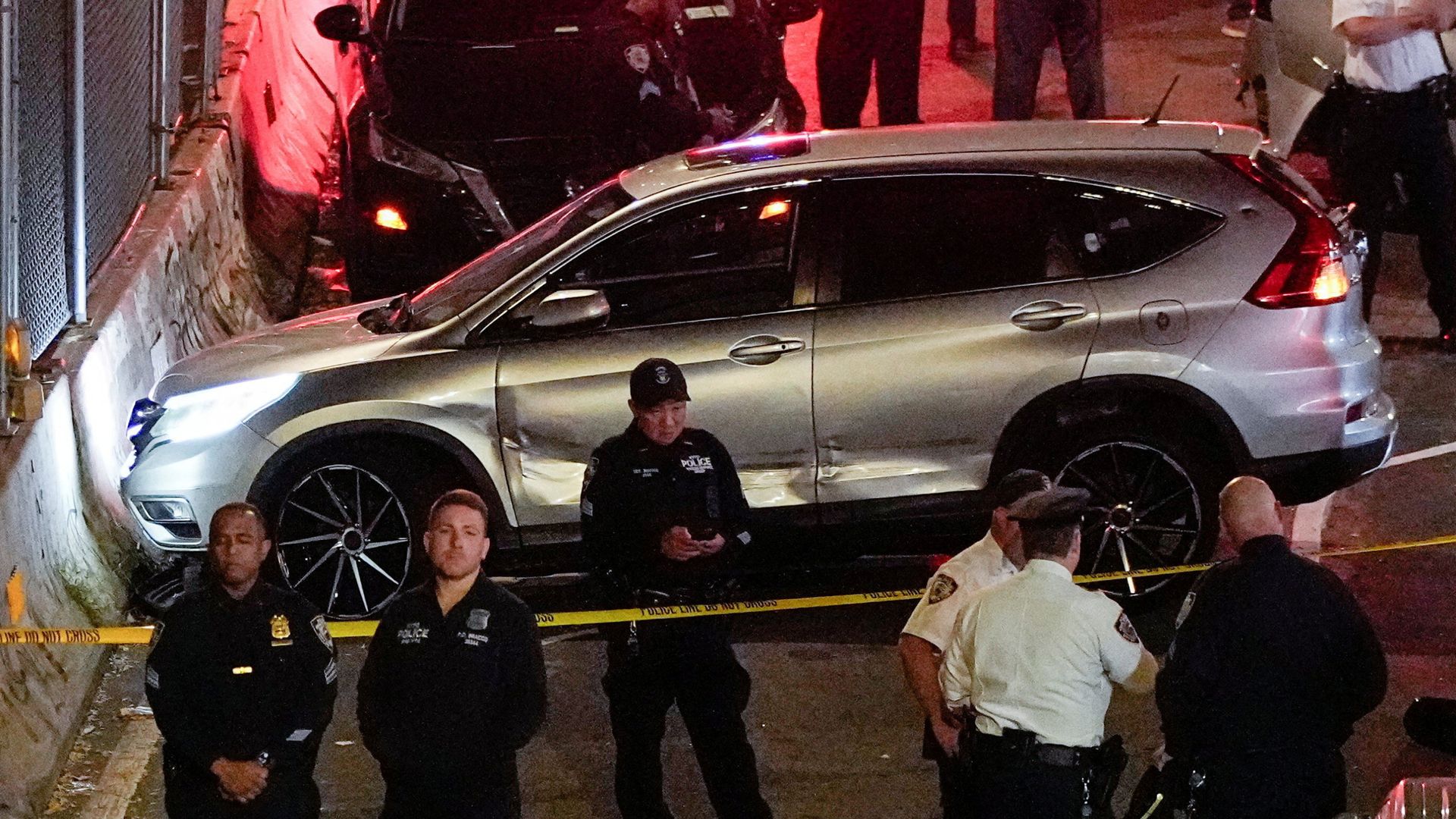
When federal immigration agents opened fire on a vehicle in the Marble Hill neighborhood of the Bronx, striking a 28-year-old man named Oscar Belgal as his five-year-old son sat inside the cabin, the fallout bypassed standard political friction and struck a raw, combustible nerve. The October afternoon operation transformed a residential street into a crime scene, a political flashpoint, and a glaring case study in the structural hazards of urban enforcement tactics.
The mechanics of the confrontation reveal an operation pushed to the margins of safe municipal policing. Federal immigration enforcement details, increasingly operating under intensified directives and higher quotas, have traded the quiet administrative targeted arrests of previous eras for dynamic, high-friction street encounters. When agents surrounded Belgal’s vehicle, the escalation happened with terrifying speed. According to law enforcement and municipal accounts, as the vehicle moved forward, officers discharged multiple rounds, riddling the windshield with bullet holes and lodging projectiles dangerously close to a child.
The Urban Safety Hazard of Dynamic Enforcement
Local leaders immediately pointed to the reckless calculus of executing armed arrests in densely populated residential sectors. New York City Mayor Zohran Mamdani did not mince words in the immediate aftermath, characterizing the operation as an unconscionable hazard that placed civilian lives directly in the crosshairs. When federal agencies deploy tactical units into crowded neighborhoods without deep synchronization with municipal police departments, the margin for catastrophic error widens exponentially.
Consider the operational reality on the ground. A residential block in Marble Hill features tight parking corridors, heavy pedestrian foot traffic, and children returning from school. Introducing drawn firearms and sudden vehicle-immersion tactics into this environment creates an immediate panic loop. Witnesses reported that agents failed to clearly identify themselves in the chaotic opening seconds—a claim frequently mirrored in violent federal-local friction points across the country. When subjects of enforcement are startled by unidentified or poorly identified operatives lunging at vehicles, their instinctual reaction is often to drive away. Treating that flight response as an immediate justification for lethal force transforms a standard administrative apprehension into a shooting scene.
The Collateral Impact on Families and Communities
The presence of the five-year-old child inside the target vehicle elevates this incident from a localized tactical failure to a profound institutional crisis. Department of Homeland Security justifications—claiming the child was taken into protective custody "out of an abundance of caution"—do little to mitigate the psychological trauma inflicted upon a minor forced to witness federal agents shooting their parent.
This is the hidden ledger of modern immigration enforcement. Policy debates in Washington frequently abstract numbers into ideological talking points, ignoring the raw physiological and emotional toll absorbed by communities. When federal officers operate with minimal local accountability, trust evaporates. The immediate protests that erupted outside local hospitals and across Bronx intersections demonstrated that residents no longer view these agencies as civil administrative bodies, but as an occupying force operating outside community norms.
Accountability and the Jurisdictional Tug-of-War
The aftermath exposed a fractured legal and political landscape. Following the shooting, local and state officials engaged in frantic, high-level calls to federal leadership, demanding answers and a withdrawal of aggressive enforcement footprints from municipal spaces. Yet, federal authorities moved swiftly to assert jurisdictional dominance, removing the injured man from hospital care even as local prosecutors and municipal leaders called for independent, transparent investigations.
This jurisdictional tug-of-war highlights a dangerous vacuum. When federal law enforcement personnel can discharge weapons in major metropolitan areas and swiftly insulate themselves within federal administrative channels, the traditional checks and balances designed to protect civilian populations break down entirely.
The bullets that shattered the glass of that vehicle in Marble Hill did more than wound a father; they pierced the fragile social contract governing federal operations within sanctuary and major urban centers. Until structural guardrails are imposed on how and where these high-risk apprehensions occur, neighborhoods will continue to reap the violent whirlwind of an unchecked enforcement apparatus.