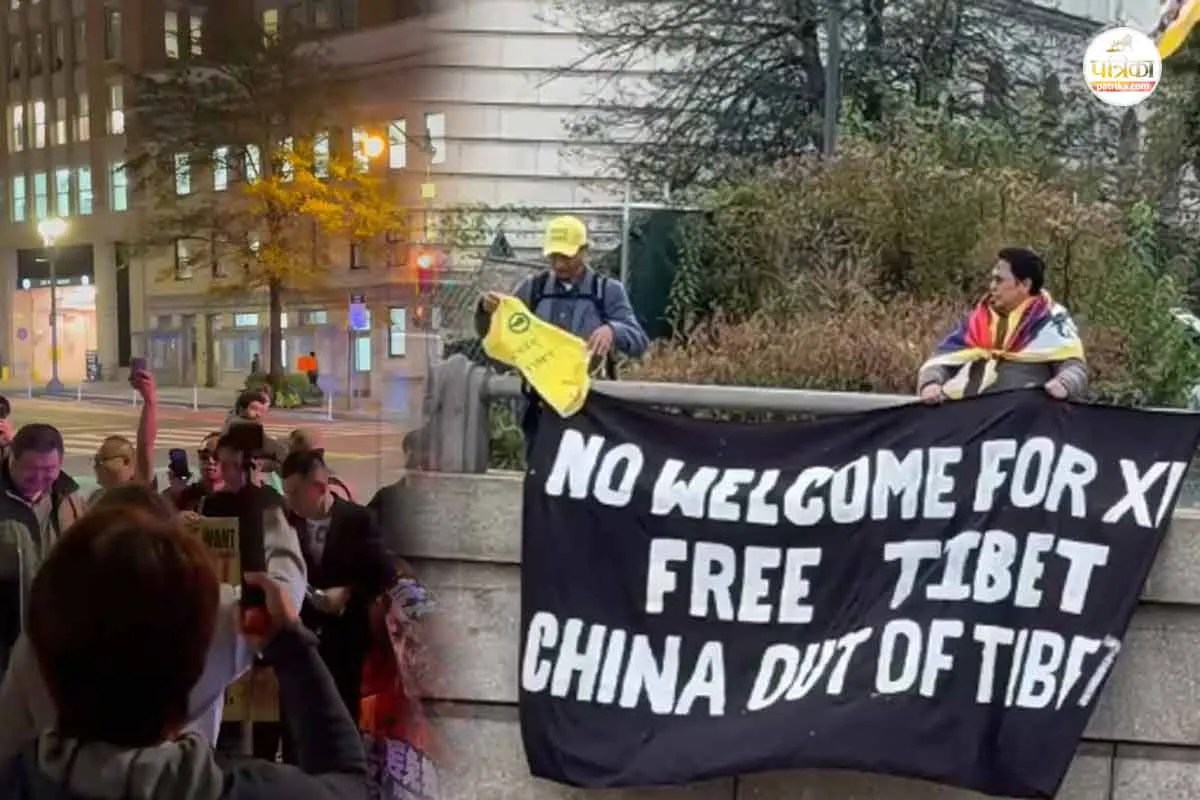
More than 2,000 Tibetan activists and diaspora members mobilize in Washington, D.C., whenever Chinese President Xi Jinping visits the United States to force human rights abuses in Tibet onto the bilateral diplomatic agenda. Organized primarily by the International Campaign for Tibet, Students for a Free Tibet, and the Regional Tibetan Youth Congress, these demonstrations serve a dual purpose. They counter Beijing's state-sponsored welcome committees while pressuring the White House to enforce existing American legislation—specifically the Tibetan Policy and Support Act and the Resolve Tibet Act—during high-stakes trade and security talks.
Street protests outside the White House or Blair House rarely change Beijing's domestic policies overnight. Veteran diplomatic observers know this well. Yet dismissing these gatherings as mere symbolic theater misses the mechanics of modern diaspora lobbying. When thousands of protesters fill Lafayette Square, they create an immediate visual contradiction to the tightly choreographed diplomacy taking place behind closed doors.
Media cameras follow conflict. If 2,000 demonstrators hold banners demanding religious freedom and environmental protection on the Tibetan Plateau, every major news network covering a presidential summit must split its screen between handshake photo-ops and the reality of dissent.
The Architecture of Diaspora Mobilization
Pulling thousands of people into the American capital on short notice requires more than spontaneous outrage. It relies on an institutional network built over six decades of exile.
The Tibetan diaspora in North America is concentrated in specific urban hubs—most notably New York City, Minneapolis-St. Paul, Toronto, and the San Francisco Bay Area. When a diplomatic summit is announced, community associations in Queens or Minnesota charter dozens of buses overnight. Families take unpaid leave from jobs in healthcare, hospitality, and small businesses to make the multi-hour drive to Washington.
Coordination falls to a coalition of advocacy groups with distinct tactical roles. The International Campaign for Tibet (ICT) handles the institutional heavy lifting, securing permits from the National Park Service, liaising with the Secret Service, and briefing congressional staffers on Capitol Hill. Meanwhile, grassroots organizations like Students for a Free Tibet (SFT) and the Tibetan Youth Congress (TYC) manage street-level energy, direct action, and visual messaging.
This division of labor is deliberate. Older generations often favor disciplined, non-violent vigils that align with the Dalai Lama's Middle Way Approach—seeking genuine autonomy within the framework of the Chinese constitution rather than outright independence. Younger activists frequently push for louder, more confrontational demonstrations that demand full sovereignty. Putting both groups on the same pavement in Washington creates a unified front without erasing their internal strategic debates.
Countering Beijing's Choreographed Welcome
A critical, often overlooked dynamic of any Xi Jinping visit to the United States is the battle for physical space along the motorcade route. The Chinese Embassy in Washington and its consulates across the country routinely mobilize counter-protesters to drown out Tibetan, Uyghur, and Hong Kong demonstrators.
These counter-demonstrations do not happen organically. Investigations by journalists and congressional committees have repeatedly documented how diplomatic missions coordinate with overseas Chinese student associations and hometown business groups to bus in supporters. Participants are often provided with standardized red banners, matching shirts, meals, and stipends.
The goal is visual erasure. If Chinese state media—such as CCTV or Xinhua—films Xi Jinping's motorcade passing through Washington, the footage must show cheering crowds waving Chinese flags, not Tibetan snow lion flags.
Consequently, Tibetan organizers treat permit applications like military intelligence operations. They file for prime locations along Pennsylvania Avenue and outside the hotels where the Chinese delegation is rumored to stay weeks in advance, sometimes submitting multiple applications under different coalition names to keep Beijing's planners guessing. When the motorcade finally rolls through, the two sides are frequently separated by double rows of steel barricades and lines of Metropolitan Police officers, turning a few blocks of downtown Washington into a proxy battlefield over historical memory and political legitimacy.
What the Protesters Actually Want From Washington
Western media coverage often reduces these rallies to a generalized plea for "human rights." That framing strips away the specific, actionable policy demands driving the organizers. Protesters in Washington are not just shouting at Xi Jinping; they are lobbying the U.S. executive branch.
Their primary objective is ensuring that Tibet is not traded away as a bargaining chip during negotiations over tariffs, fentanyl precursors, artificial intelligence export controls, or climate cooperation. In diplomatic practice, human rights issues are frequently relegated to private "frank exchanges" at the end of a summit—a polite euphemism for raising a topic without demanding concessions.
Activists point to specific American laws that the White House already has the authority to enforce:
- The Tibetan Policy and Support Act (TPSA) of 2020: This law makes it official U.S. policy that the succession of the Dalai Lama is strictly a religious matter for Tibetan Buddhists to decide. It mandates targeted sanctions—including visa bans and asset freezes—against any Chinese official who interferes in identifying a future reincarnation.
- The Promoting a Resolution to the Tibet-China Dispute Act (Resolve Tibet Act): Passed with overwhelming bipartisan support, this legislation rejects Beijing's claim that Tibet has been part of China since ancient times and empowers the State Department to actively counter Chinese disinformation about Tibetan history and culture.
- Colonial Boarding School Sanctions: Protesters demand the application of Global Magnitsky sanctions against officials overseeing the residential boarding school system in Tibet, where an estimated one million Tibetan children have been separated from their families to undergo Mandarin-language assimilation.
By putting 2,000 bodies on the streets outside the summit venue, advocates remind administration officials that ignoring these statutory mandates carries a domestic political cost. Congressional champions from both parties routinely step out of the Capitol to address the rallies, signaling to the White House that Capitol Hill is watching how firmly the president presses Xi on Tibet.
The Reality Inside Tibet Driving the Outcry
To understand why families from Toronto or Queens board a bus at midnight to stand in the cold in Washington, you have to look at the rapid tightening of control inside the Tibetan Plateau over the past decade. Under Xi Jinping, Beijing abandoned earlier, somewhat more flexible ethnic minority policies in favor of aggressive assimilation—officially termed "forging a strong sense of community for the Chinese nation."
The changes on the ground are structural and irreversible if left unchallenged. Traditional monastic education has been severely curtailed, with young monks forced out of monasteries and into state-run schools. The Tibetan language, once a primary medium of instruction in local schools, has been systematically downgraded to a secondary subject, replaced by Mandarin across core curricula.
Environmental extraction adds another layer of urgency. The Tibetan Plateau—often called the Third Pole because it holds the largest reserve of fresh water outside the Arctic and Antarctic—is the source of Asia's major river systems, including the Mekong, Yangtze, Yellow, and Brahmaputra rivers. Beijing has embarked on massive hydropower dam construction and lithium mining projects across the region. Local Tibetans who protest the displacement of nomadic communities or the destruction of sacred mountains face arbitrary detention, torture, and long prison sentences under broad "separatism" charges.
Surveillance technology tested in Xinjiang has been fully deployed across Lhasa and rural prefectures. Grid-style social management systems, mandatory DNA collection, biometric checkpoints, and the criminalization of possessing a photograph of the Dalai Lama have turned daily life into an open-air panopticon. For Tibetans living in exile, marching in Washington is one of the few remaining avenues to amplify voices that have been completely silenced inside their homeland.
The Limits and Gray Areas of Street Diplomacy
Seasoned analysts recognize the inherent limitations of diaspora protests. Does a rally of 2,000 people force Xi Jinping to halt dam construction on the Yarlung Tsangpo river or release political prisoners like Gedhun Choekyi Nyima, the Panchen Lama who disappeared in 1995? No. Beijing's leadership views absolute control over Tibet as a core national security interest—non-negotiable regardless of international embarrassment.
Furthermore, the Tibetan movement faces a looming demographic and political transition. The 14th Dalai Lama, Tenzin Gyatso, has been the singular moral and political anchor of the Tibetan struggle since 1959. His global stature guarantees meetings with world leaders and sustained media attention. As he ages, Beijing is openly preparing to install its own state-approved successor, aiming to fracture the Tibetan Buddhist world and hollow out the exile movement from within.
There is also the harsh reality of geopolitical fatigue. Washington's foreign policy bandwidth is stretched thin by active conflicts in Eastern Europe and the Middle East, alongside intense economic competition with Beijing. Keeping Tibet near the top of the American diplomatic agenda requires constant, exhausting effort against shifting global priorities.
Yet focusing solely on immediate policy reversals misunderstands how diplomatic leverage works over decades. Authoritarian governments invest billions of dollars into projecting inevitability—the idea that resistance is futile and historical disputes are settled. When 2,000 Tibetans shut down streets in the heart of the American capital, waving flags that carry a prison sentence back home, they shatter that illusion of finality. Every photograph of those demonstrations transmitted around the world proves that Beijing's decades-long campaign to erase Tibetan identity has failed to extinguish the political will of its people.