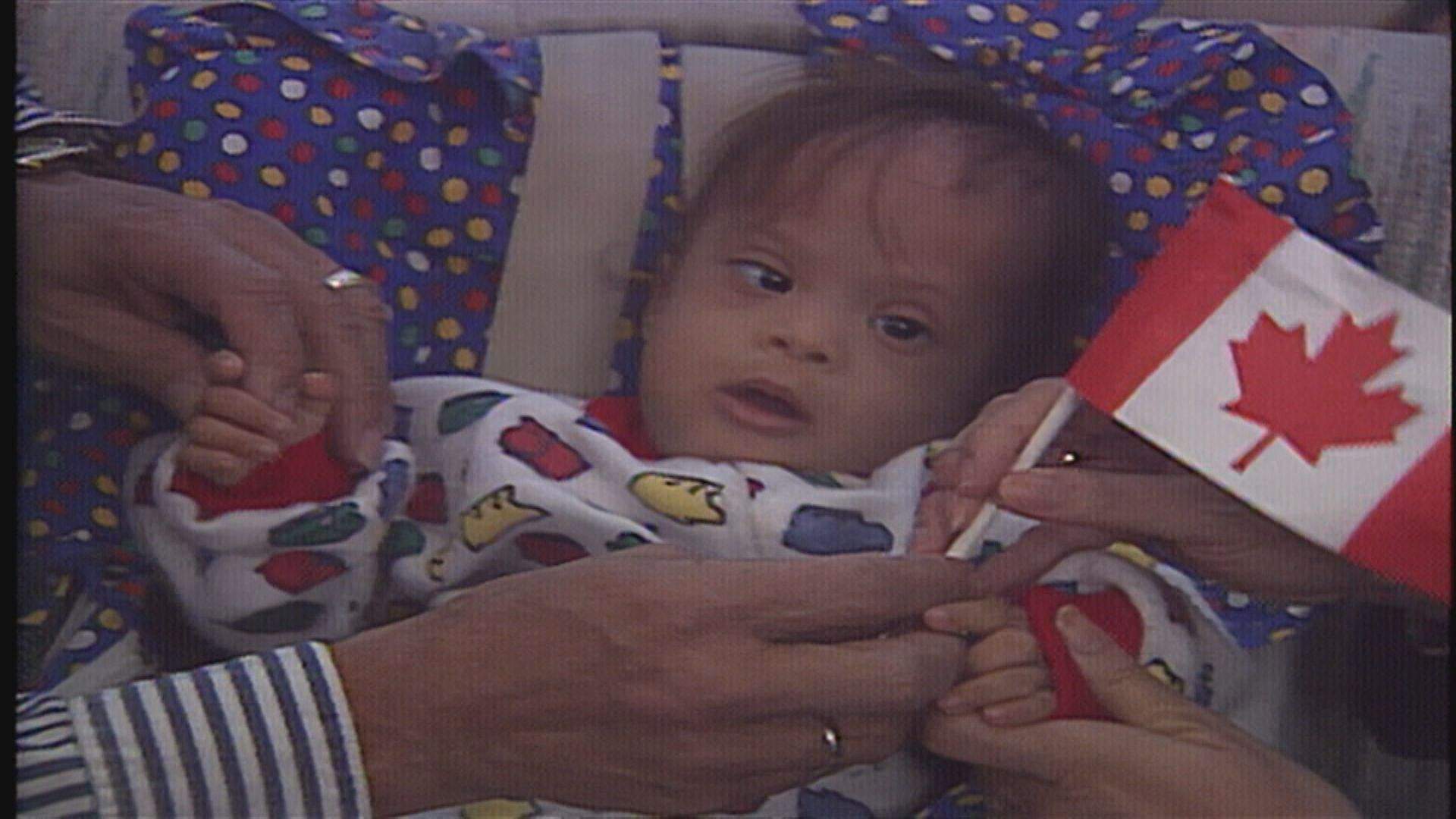
Nearly thirty years ago, a fourteen-month-old toddler named José Manuel Moran Robles arrived in Edmonton, Alberta, carrying a failing heart and a timeline measured in weeks. Born in Panama with Down syndrome and an advanced atrioventricular septal defect (AVSD), baby Jose faced a prognosis dictated by geographic inequality. His heart's central walls had failed to fuse properly, creating structural gaps that overloaded his pulmonary system and threatened rapid heart failure. In 1998, local pediatric cardiothoracic surgery was undergoing a quiet revolution, but advanced congenital correction for complex international cases remained a logistical frontier.
The story of how Jose returned to Alberta decades later is more than a heartwarming human interest reunion. It serves as an investigative lens into the mechanics of cross-border medical advocacy, the evolution of pediatric surgical milestones, and the quiet architecture of non-profit mobilization that operates entirely outside traditional geopolitical frameworks.
The Anatomy of an Improbable Medical Airlift
Medical miracles rarely occur in a vacuum. They are usually engineered by stubborn advocates who refuse to accept institutional borders. In the mid-1990s, organizations like Inclusion Alberta (then operating as the Alberta Association for Community Living) routinely crossed paths with families whose local healthcare infrastructure could not support complex pediatric interventions.
When the Robles family reached out for help, they were not knocking on an open door. They were staring down a wall of bureaucratic inertia, prohibitive international travel costs, and the complex challenge of securing emergency hospital admission in a foreign province. Family support advocate Bev Ray and her network did not blink. They activated a decentralized community response that mobilized Edmonton citizens to cover flights, local housing, and recovery expenses.
[Local Family Plea] ---> [Inclusion Alberta Coordination] ---> [Community Fundraising] ---> [Edmonton Surgical Intervention]
This pipeline relied on a simple premise: human vulnerability does not recognize passports. Yet, scaling such an effort required navigating medical visas, liability frameworks, and charitable allocations that could easily collapse under the weight of red tape. The success of the 1998 intervention proved that localized civil society networks could sometimes outmaneuver institutional sluggishness, filling critical voids in global pediatric healthcare equity.
Deconstructing Atrioventricular Septal Defect
To understand why Jose needed to travel thousands of kilometers from Panama to Alberta, one must examine the clinical weight of an atrioventricular septal defect. AVSD is a congenital anomaly where the tissue dividing the heart's upper chambers (atria) and lower chambers (ventricles) fails to form correctly. Instead of two separate valves managing blood flow between the left and right sides, a single, massive common valve sits in the middle, allowing blood to mix freely and flood the lungs with high-pressure blood.
Left uncorrected, AVSD triggers irreversible pulmonary vascular disease. Lead surgeon Dr. Ivan Rebeyka and his surgical team faced a high-stakes operational puzzle:
- Structural Repair: Splitting the single common valve into two distinct, competent valves.
- Septal Patching: Closing the holes in both the atrial and ventricular walls using synthetic or biological patch material.
- Hemodynamic Balancing: Ensuring the newly reconstructed heart could immediately handle systemic blood pressure without throwing lethal arrhythmias.
In the late 1990s, performing this delicate open-heart procedure on an infant with complex physiological needs demanded absolute surgical precision. The operating room functioned on razor-thin margins. When Jose's surgery succeeded, it was a testament not only to the skill of the Stollery Children's Hospital surgical teams but also to the rapid advancements in cardiopulmonary bypass technology that made deep pediatric repair viable.
The Evolution of Global Pediatric Care Inequality
Jose's return to Edmonton as a thirty-year-old adult—an independent athlete who has represented Panama in the Para Central American Games—forces a hard look at systemic progress. Why did a Panamanian infant have to travel to Western Canada for a procedure that should be accessible regionally?
For decades, specialized pediatric cardiac surgery remained hyper-concentrated in wealthy urban centers of North America and Western Europe. Developing nations suffered from a severe structural deficit: a lack of trained pediatric cardiovascular surgeons, inadequate intensive care infrastructure, and prohibitive equipment costs. Organizations like Inclusion Alberta acted as emergency stopgaps, rescuing individual children because systemic capacity back home was non-existent.
+------------------------+---------------------------------------------------+
| Era                    | Primary Mechanism of International Intervention   |
+------------------------+---------------------------------------------------+
| 1990s                  | Ad-hoc charity medical travel & individual flights|
| Modern Era             | Capacity building, regional training, local hubs  |
+------------------------+---------------------------------------------------+
Over the past thirty years, the landscape has shifted. While international medical missions and emergency patient transfers still occur, the primary focus of global health equity has moved toward capacity building. Training local medical teams in Latin America, Asia, and Africa to perform complex congenital repairs locally has largely replaced the logistical scramble of flying babies across oceans. Jose's story belongs to an era of medical pioneering that is thankfully giving way to sustainable, self-sufficient local healthcare infrastructure.
Beyond the Milestone: The Reality of Long-Term Outcomes
Public narratives surrounding medical triumphs often stop the moment the patient leaves the hospital. Real journalism demands tracking the trajectory long after the cameras turn off. Living with corrected AVSD and Down syndrome into adulthood involves lifelong cardiological surveillance. Patients remain at risk for late-onset mitral valve regurgitation, conduction system abnormalities, and secondary heart rhythms that require vigilant monitoring.
Jose's athletic achievements—competing internationally and living an active, autonomous life—shatter outdated societal assumptions about the capabilities of individuals with congenital anomalies and developmental disabilities. His trajectory illustrates that early medical intervention is not merely about extending biological survival; it is about unlocking human potential. When society invests in repairing a child's heart, it buys decades of lived experience, athletic competition, cultural contribution, and familial joy.
When the Robles family walked through the doors of the Ronald McDonald House in Edmonton during their recent homecoming, they were closing a circle that began with desperation and ended in profound accountability. They found the doctors, advocates, and community members who refused to let a baby from Panama become a casualty of geography.
The machinery of modern medicine is driven by cold technology, sterile operating suites, and complex physiological data. Yet, as Jose's journey proves, its ultimate engine remains raw, uncompromising human solidarity.
The system worked because individuals refused to let it fail, leaving a blueprint for how communities can mobilize when institutional safety nets fall short.


