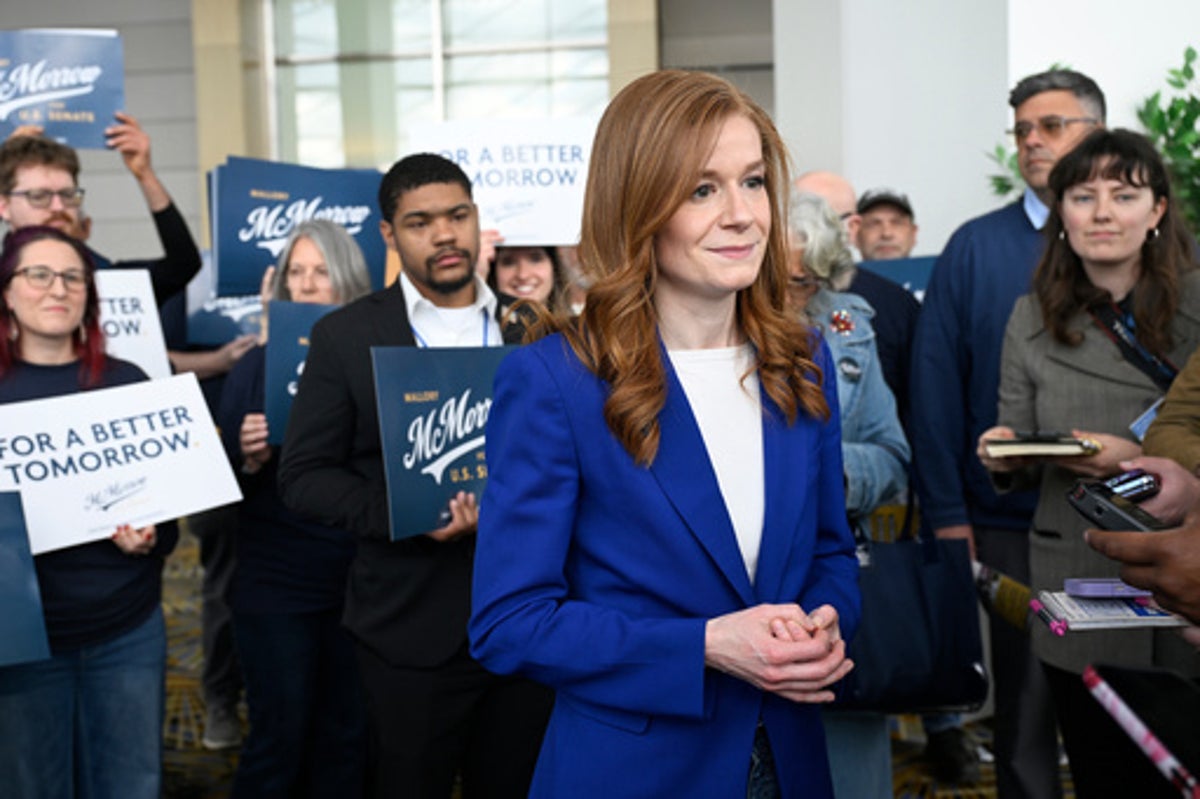
The sudden collapse of State Senator Mallory McMorrow’s campaign for the United States Senate has laid bare a brutal civil war within the Michigan Democratic Party. On Sunday, July 5, 2026, just thirty days before voters head to the primary polls on August 4, McMorrow released a polished video message announcing she was suspending her campaign. She offered no explicit reason for her departure. The exit of a politician once hailed as a national progressive star has transformed a crowded primary into a high-stakes, one-on-one proxy fight that could ultimately determine control of the Senate this November.
Her departure was not an act of political altruism. It was a calculated retreat forced by cratering poll numbers, heavy backroom pressure from party elites, and an avalanche of outside spending that left her completely squeezed out of the race. The remaining contest pits mainstream establishment favorite Representative Haley Stevens against surging progressive insurgent Abdul El-Sayed. For months, McMorrow tried to occupy a center-left lane that bridged these two factions. That middle ground turned out to be a political graveyard.
The Secret Pressure Campaign from Party Bosses
Money and structural panic dictated this exit. Behind the scenes, national and state Democratic leaders grew increasingly terrified that a fractured moderate vote would hand the nomination to El-Sayed, a left-wing former public health official whose platform includes Medicare for All and a fierce critique of American foreign policy. Party insiders worry that an El-Sayed victory in August would spell doom against the Republican nominee, former congressman Mike Rogers, in a state that remains an absolute must-win for Democrats.
The pressure reached a boiling point in late June. Retiring U.S. Senator Gary Peters, whose vacant seat everyone is fighting for, began privately telling associates that McMorrow needed to get out of the race. The goal was simple. Consolidate the moderate and center-left vote behind Haley Stevens before early mail-in ballots could lock in a fractured result.
Michigan Democratic Primary Independent Spending (Selected Groups)
+---------------------------+---------------------+-------------------+
| Organization              | Target Candidate    | Total Investment  |
+---------------------------+---------------------+-------------------+
| United Democracy Project  | Haley Stevens       | $20,000,000+      |
| Other Pro-Stevens PACs    | Haley Stevens       | $15,500,000       |
| McMorrow Campaign         | Mallory McMorrow    | $0 (Corp PACs)    |
+---------------------------+---------------------+-------------------+
McMorrow had attempted to run a pure campaign. She refused to accept any corporate PAC dollars, relying instead on a grassroots network built after her state senate floor speech against culture-war attacks went viral in 2022. That strategy works well for low-budget state legislative races. It fails miserably when up against tens of millions of dollars in national super PAC money.
The cash asymmetry was staggering. The United Democracy Project, a super PAC affiliated with the pro-Israel lobby group AIPAC, poured more than $20 million into television and digital advertisements designed to boost Stevens and destroy El-Sayed. Two other allied PACs dumped an additional $15.5 million into the state. McMorrow found herself completely drowned out on the airwaves, unable to match the multi-million-dollar ad buys in major media markets like Detroit and Grand Rapids.
The Internet Feud That Blew Up a Campaign
McMorrow’s standing did not just erode because of money. A sharp tactical miscalculation in the spring triggered a rapid defection of young voters and progressive activists who had once formed her base.
The trouble began in March when Abdul El-Sayed appeared at a campaign event with Hasan Piker, an enormously popular left-wing political streamer. Piker has a history of making highly controversial statements to generate online engagement. Sensing an opening to position herself as the responsible alternative to El-Sayed, McMorrow went on the offensive. She publicly slammed El-Sayed for sharing a stage with Piker, comparing the streamer to white nationalist figures and accusing him of spreading antisemitism and misogyny.
The blowback was immediate and severe. Instead of wounding El-Sayed, the attack alienated the exact online activists and young organizers McMorrow needed to fuel her cash-strapped campaign. To the party's left wing, her criticisms felt calculated and elite, mirroring the talking points of the party establishment she claimed to be challenging.
The math tells the story of her decline. In early April, public polling showed a tight three-way dead heat, with McMorrow, Stevens, and El-Sayed all hovering around 25 percent. By mid-May, after the Piker controversy and the first waves of AIPAC-backed television ads, McMorrow dropped to a distant third. By June, four separate independent polls showed her support cratering into the single digits. She was no longer a viable contender. She was a spoiler.
A Polarized Party with No Room for the Middle
The race now belongs to the extremes of the party coalition. With McMorrow out, the primary represents a pure ideological test that could redraw the map of Democratic politics in the Midwest.
Haley Stevens represents the traditional power structure. Backed by Senate Democratic Leader Chuck Schumer and bolstered by corporate and defense-oriented donors, her message focuses entirely on pragmatism, electability, and protecting the Biden-Harris legislative legacy. Shortly after McMorrow stepped aside, Michigan Attorney General Dana Nessel immediately endorsed Stevens, signaling that the state’s political establishment is moving rapidly to close ranks.
Abdul El-Sayed represents a populist insurgency. Endorsed by Representative Alexandria Ocasio-Cortez, El-Sayed has harnessed deep dissatisfaction among young voters, Arab-American communities in Wayne County, and progressive labor activists who feel betrayed by the national party’s stances on economic policy and Gaza. El-Sayed wasted no time capitalizing on McMorrow’s exit. He released a sharp statement targeting her supporters, arguing that the same party insiders who pressured her out are trying to rig the primary through outside spending.
Where do McMorrow's voters go now? Political strategists in Lansing caution that her supporters do not fit neatly into either remaining camp. Some are moderate suburbanites who will naturally migrate to Stevens. Others are anti-corporate idealists who view El-Sayed’s fight against super PACs as a reflection of McMorrow’s own platform.
The final weeks of this primary will be exceptionally ugly. Television screens across Michigan are already filled with negative advertisements, and the rhetoric on the campaign trail is growing increasingly hostile. Mallory McMorrow saw the writing on the wall and chose to protect her future political viability rather than suffer a embarrassing third-place finish in her home state. Her exit solves the party's spoiler problem, but it accelerates a deeper ideological fracture that money alone cannot fix.