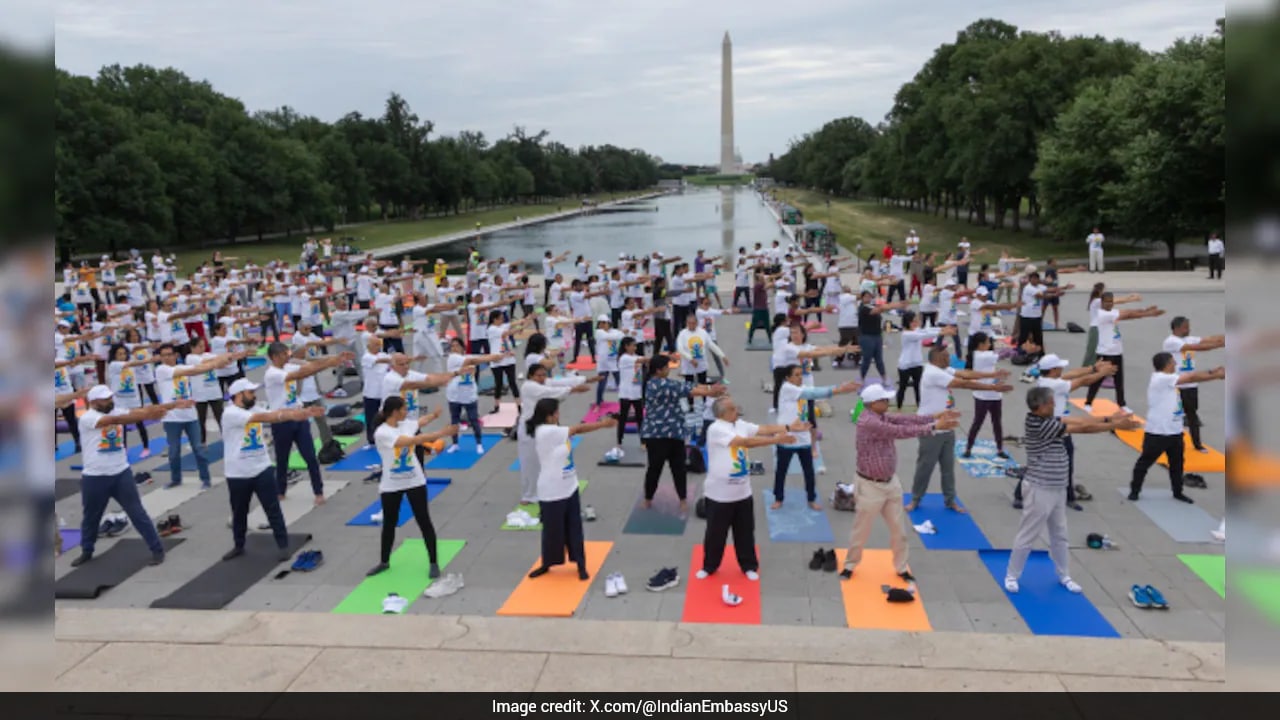
From the sweaty asphalt of Times Square to the manicured lawns of the Texas State Capitol in Austin, tens of thousands of Americans rolled out identical polyurethane mats this weekend. Ostensibly, they gathered to mark the annual International Day of Yoga. Local news broadcasts splashed colorful, sweeping aerial footage of rows of citizens breathing in unison. The media framed it as a wholesome grassroots explosion of public wellness.
That frame is incomplete. Behind the serene aerial photos of mass public gatherings lies a fiercely competitive, highly corporatized engine. The domestic wellness sector has successfully converted a 5,000-year-old spiritual discipline into a central column of consumer capitalism.
The standard media narrative treats these massive public gatherings as organic community events. In reality, the synchronized down-dogs from Manhattan to Houston function as massive, highly synchronized marketing activations for a global market valued at over $130 billion. North America alone commands more than 33% of this global economic footprint.
What went down across major US cities this weekend was not just an exercise in collective mindfulness. It was a clear demonstration of how modern corporate structure, digital platforms, and athleisure brands have institutionalized consumer behavior.
The Choreographed Capital of the Summer Solstice
In New York City, the 24th annual Mind Over Madness festival completely shut down the Broadway pedestrian plazas between 45th and 48th Streets. To the casual tourist, the sight of thousands of people finding stillness amid the flashing digital billboards of Times Square is a striking paradox. To an industry analyst, it is a masterclass in experiential corporate sponsorship.
The event was entirely free to the public, provided you registered in advance. That registration, of course, is the first point of value capture. It transforms thousands of participants into a highly targeted demographic database.
The physical space of the festival was divided into a carefully curated ecosystem. The Yoga Village, packed tightly between 47th and 48th Streets, was not a collection of local ashrams. It was a corporate promotional gauntlet. Brands like Clean Simple Eats, Gaiam, HEYTEA, Gatorade, and RYZE Superfoods handed out samples, captured social media handles, and distributed branded swag.
The mats that carpeted the asphalt were uniform, provided by major fitness partners. Participants did not just show up to practice; they stepped directly into a highly monetization-ready environment where every square inch of space was negotiated by event organizers and corporate sponsors.
A thousand miles southwest, the exact same commercial mechanics played out with a regional twist. The Consulate General of India in Houston orchestrated a massive statewide push across Texas. Major public gatherings took over Midtown Park and Discovery Green in Houston, the Civic Park at Hemisfair in San Antonio, and the South Lawn of the Texas State Capitol in Austin.
The Texas events showcased how public civic spaces are increasingly utilized to anchor commercial wellness brands. At Discovery Green, the scheduled practice was quickly followed by an organized sound bath where participants were encouraged to bring canned food to line a labyrinth path. While the charitable component to support the Houston Food Bank is objectively positive, the integration of community altruism with lifestyle branding is a classic corporate strategy. It builds deep, emotional brand equity among consumers who now demand that their fitness routines double as social statements.
The local news coverage praised the "growing mainstream acceptance" of the practice. But the real story is that this acceptance has been systematically bought, paid for, and scaled by a massive corporate infrastructure.
The Metrics of Mindfulness
To understand how deep this monetization goes, one has to look past the free public park sessions and look at individual consumer lifetime value. Market research indicates that the average American practitioner spends approximately $62,640 over their lifetime on classes, apparel, accessories, and retreats. This staggering figure explains why institutional capital has poured into the sector over the last decade.
The economic model of the modern industry relies on a multi-pronged revenue engine. Independent brick-and-mortar studios that rely solely on drop-in class fees or basic monthly memberships are largely struggling or dead. The margin lives elsewhere.
| Revenue Stream | Global Market Valuation | Primary Drivers |
|---|---|---|
| Classes & Studio Instruction | $127 Billion | Teacher certifications, high-tier memberships, specialized workshops |
| High-Ticket Tourism | $72 Billion | Mindful travel packages, international destination retreats |
| Apparel & Athleisure | $29.8 Billion | Everyday lifestyle wear, sustainable technical fabrics |
| Digital Platforms | $20 Billion | AI-powered posture apps, virtual streaming subscriptions |
The data reveals a stark reality for operators. Legacy studios that refuse to expand beyond traditional physical classes are leaving up to 70% of their potential revenue on the table. The most profitable corporate operators have decoupled their revenue from physical real estate by aggressively scaling digital applications and private-label apparel lines.
The Hybrid Fracture and the Battle for Retaining Users
The rapid evolution of consumer habits has split the market down the center. Traditional in-person instruction still commands roughly 74% of absolute industry revenue, but the digital and online segment is growing at a compounding annual rate of 18%.
This digital migration has democratized access, allowing anyone with a smartphone to practice from a living room in rural Iowa. However, it has also introduced a brutal corporate reality: subscription churn.
Internal data across major digital platforms shows that roughly 41% of users drop their digital wellness subscriptions within the first six months. The initial friction of showing up to a physical space with a community is replaced by the frictionless ease of hitting "cancel" on an app.
To combat this, tech platforms are aggressively integrating artificial intelligence. The newest generation of platforms uses smartphone cameras to provide real-time, AI-driven bio-feedback on posture correction. The goal is clear: replace the human instructor with a proprietary algorithm that locks the user into a specific software ecosystem.
This tech-heavy approach has created an inclusion crisis that the industry rarely discusses during major PR pushes like Yoga Day. While the official marketing slogans claim the practice is "for everyone," the modern commercial landscape heavily favors an affluent demographic.
The high cost of premium memberships, specialized boutique classes, and expensive athleisure gear creates an intimidating environment. It effectively locks out lower-income demographics, seniors with limited digital literacy, and individuals who do not fit the idealized visual aesthetic promoted by major apparel brands. The industry has scaled by selling exclusivity, even while its public relations arm celebrates universal access on the streets of Manhattan.
Cultural Ownership in a Commercialized Market
As the Western market continues to industrialize, tension over cultural appropriation and geopolitical soft power has moved into the boardroom. The United Nations General Assembly officially designated June 21 as the International Day of Yoga back in 2014, following a specific diplomatic push by Indian Prime Minister Narendra Modi.
For New Delhi, the global explosion of this practice is a massive soft-power victory. It cements India's cultural influence across the West. This explains why Indian Consulates across the United States, from New York to Houston, are directly funding and organizing these mass public events. They are utilizing cultural diplomacy to build political and economic goodwill with American lawmakers.
This geopolitical strategy is working. This weekend, the New York State Senate adopted a formal resolution memorializing Governor Kathy Hochul to officially proclaim the day across the state, explicitly citing the practice's ancient Indian roots. Similar official proclamations were handed down by Delaware Governor Matt Meyer and municipal leaders across California.
Yet, there is a deep irony in this political celebration. The ancient spiritual discipline, which historically emphasized the systematic deconstruction of the ego and the rejection of material attachment, has been completely inverted. The American corporate machine has taken that framework and transformed it into a multi-billion-dollar celebration of consumer identity, premium apparel, and digital subscriptions.
The thousands of people sweating on free mats in Times Square are not radical counter-culturalists resisting the pressures of modern life. They are the idealized consumers of a highly sophisticated lifestyle matrix. They have been taught to believe that wellness is something that can be purchased, worn, and streamed.
The mass participation witnessed across America this weekend proves that the corporate takeover of wellness is complete. The ancient practice has not just entered the mainstream; it has been entirely absorbed by the market, repurposed for the digital age, and turned into a highly efficient engine of continuous consumer spend.
Independent operators who wish to survive in this economic climate must immediately stop viewing themselves as simple fitness instructors. They must transition into hybrid content creators, brand managers, and digital operators. The alternative is simple: get crushed by the scale of institutional platforms that have successfully commodified the quiet act of breathing.