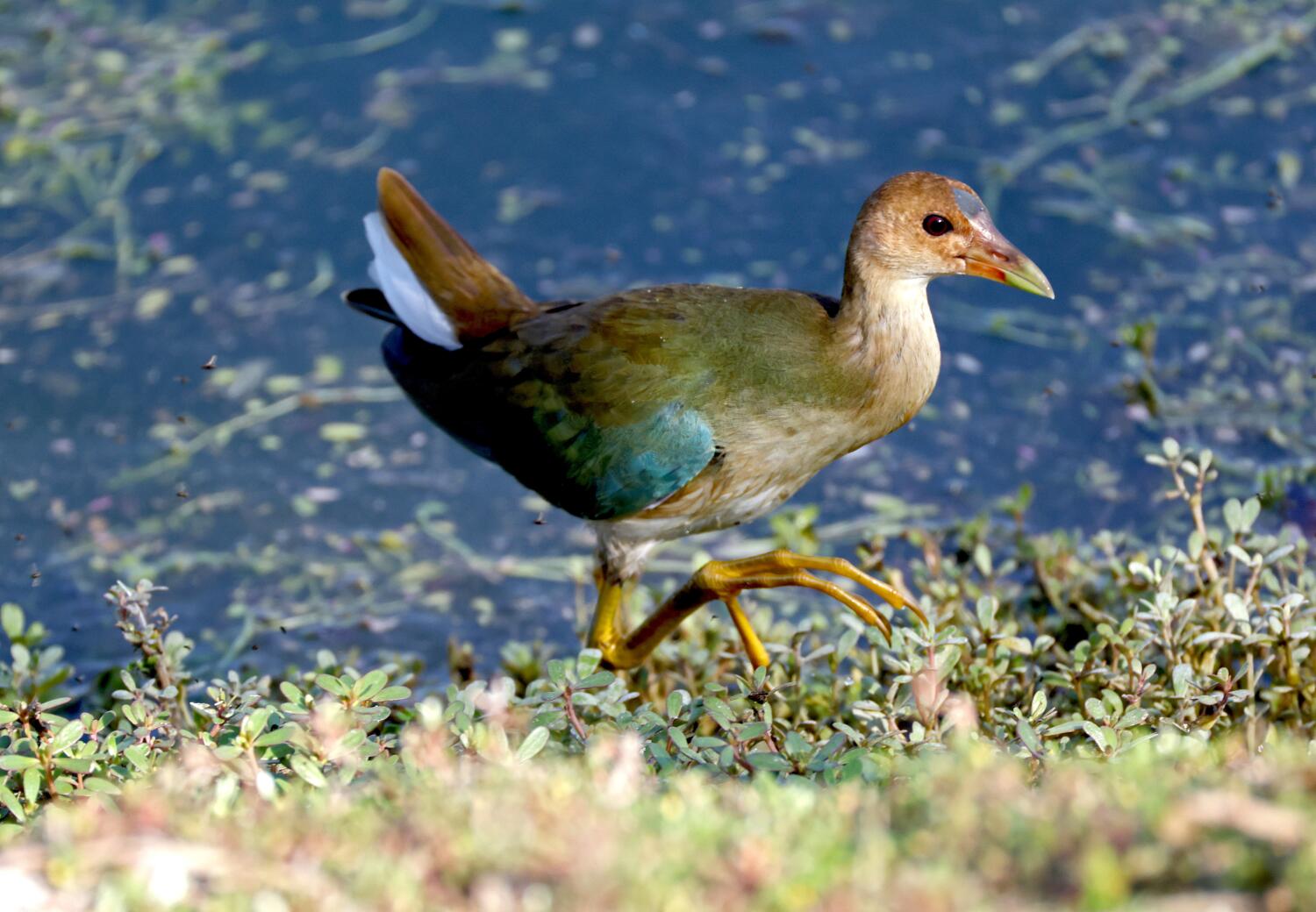
A juvenile purple gallinule has turned a 320-acre municipal water marsh in Irvine, California, into the most scrutinized patch of dirt and water in Southern California. Scores of birdwatchers equipped with tripods, high-powered spotting scopes, and telephoto lenses line the dirt berms of the Irvine Ranch Water District’s San Joaquin Marsh, tracking every step of a vagrant bird that has no business being thousands of miles away from its native range. This is only the eighth documented sighting of the species in California since 1961, and the very first for Orange County.
The arrival of Porphyrio martinica triggers a familiar subculture frenzy. Birding, often misunderstood as a passive pastime of quiet porch rocking chairs, transforms into an aggressive, adrenaline-fueled pursuit when an accidental vagrant drops into an urban wetland. This phenomenon reveals much about how modern wildlife observation intersects with accidental conservation successes in heavily paved environments.
The Mechanics of a Vagrant Bird
Why is a bird native to the Gulf of Mexico, the Caribbean, and northern South America wading through an Orange County water reclamation facility? Ornithologists point to vagrancy—a behavioral quirk where young birds experience navigational errors during migration. Driven by physiological impulses, juvenile birds occasionally miscalculate their vector, flying thousands of miles off course.
The purple gallinule is uniquely built for this kind of accidental globe-trotting. With oversized yellow-green feet and long toes that distribute its weight over floating vegetation, it navigates dense aquatic flora with ease. Yet, its physical adaptations do little to explain why it chose an engineered basin in Irvine over the endless swamps of Louisiana or Florida.
The answer lies in the sheer scarcity of alternative real estate. California has lost more than ninety-five percent of its historical coastal wetlands over the past century. When an exhausted, disoriented bird crosses the desert and mountain barriers into the urban sprawl of the Los Angeles basin, the San Joaquin Marsh stands out as a rare beacon of green and blue amidst a sea of asphalt.
Engineered Infrastructure as Wildlife Haven
The San Joaquin Marsh is an accidental triumph of civil engineering rather than a pristine, untouched wilderness. Constructed in the 1990s by the Irvine Ranch Water District, the 320-acre facility was originally designed to perform a dirty job. Its primary mandate is to naturally filter dry-weather urban runoff from San Diego Creek, scrubbing nitrates and phosphorus before the water enters Upper Newport Bay to prevent toxic algae blooms.
Water flows through a series of shallow and deep ponds flanked by dense bulrushes, cattails, and willows. The system works so efficiently at treating water that it inadvertently created a prime ecological substitute for lost natural wetlands. More than 280 bird species have been recorded here over the decades, turning a utilitarian water purification plant into one of the premier birding hotspots in the American Southwest.
This creates a fascinating paradox. The birds do not care that the water beneath them was funneled off concrete street gutters a few miles away. They respond strictly to structural cues: shallow water, dense cover, and an abundant supply of aquatic invertebrates and seeds.
The Social Ecosystem on the Berms
Back on the trail, the human element of the purple gallinule sighting is equally striking. Spotting scopes form a jagged metallic fence along the water's edge. Whispers carry down the line whenever the juvenile bird steps out from the safety of the reeds to forage on floating duckweed.
This community operates on an unwritten code of ethics and intense shared obsession. Veteran birders share exact coordinates and behavioral notes with complete strangers. Multichapters of local Audubon societies converge alongside tech workers on lunch breaks and retirees who have spent forty years chasing county life-lists.
The obsession has stakes. For many observers, adding a rare vagrant to a regional checklist validates countless hours of standing in coastal mud and scanning distant tree lines. When a bird like the purple gallinule appears, it breaks the monotony of predictable seasonal migrations, offering a jolt of genuine discovery within a heavily mapped and monitored landscape.
The bird moves cautiously through the stems, pecking at snails, entirely indifferent to the shutter clicks echoing across the water. It will eventually move on, driven by the same internal clock that brought it here, leaving the marsh to the resident mallards and egrets until the next navigational error occurs.

