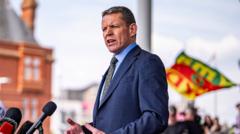
One hundred days into its historic minority administration, the Plaid Cymru Welsh Government faces a severe reality check as critics accuse ministers of trading structural reform for endless panels, taskforces, and administrative dashboards. When First Minister Rhun ap Iorwerth's cabinet first convened at Cathays Park, the political map of Wales had already fractured past recognition. Decades of uninterrupted Labour dominance gave way to a precarious new arithmetic in the Senedd, leaving Plaid Cymru to prove that nationalist ambition could successfully translate into functional governance. Yet, evaluating what has actually happened during these initial weeks reveals a deep chasm between ministerial self-congratulation and the stubborn inertia plagging Welsh public life.
To understand the rhythm of this administration, one must examine the metrics trumpeted by Cathays Park alongside the grievances echoing through the opposition benches. The government points proudly to its newly minted transparency dashboard, an interactive digital portal designed to track progress across six core priorities. Among the early victories claimed by ministers are an injection of funds earmarked for NHS elective care hubs, an expanded free school meal rollout reaching more secondary students, increased financial incentives for teacher training, and a multi-year funding agreement secured for the agricultural sector. Furthermore, ministers highlight movement on a promised childcare expansion, pushing local authorities to widen access in a bid to outpace previous administration timelines.
The Bureaucracy Trap
Critics see a very different picture when looking at those exact same milestones. Opposition leaders from both the Welsh Conservatives and Welsh Labour have characterized the administration's opening sprint not as a masterclass in planning, but as an exercise in bureaucratic displacement.
"There has been a total lack of urgency to improve people's lives, yet Plaid ministers have been quick to prioritise spending yet more time, energy and money on tinkering with the constitution," argues Welsh Conservative Senedd leader Darren Millar.
The core accusation is that instead of pulling immediate levers to alleviate the cost-of-living squeeze, ministers have retreated behind the comforting walls of expert panels and strategic reviews. Consider the flagship childcare policy. While the government claims broad structural progress, detailed rollout timelines for specific age brackets remain vague, leaving parents and local authorities guessing about capacity and funding adequacy. When tangible pressures mount—such as chronic NHS waiting lists and gridlocked infrastructure—the establishment of another advisory group reads to skeptics like a delay tactic rather than a solution.
The Constitutional Undercurrent
Plaid Cymru has never hidden its ultimate ideological destination. Self-determination and enhanced devolution remain the ideological beating heart of the party. Yet exercising power within the existing, constrained framework of devolution creates an inherent tension.
Ministers argue that pressing Westminster for control over the Crown Estate, rail infrastructure, justice, and policing is not an exercise in abstract constitutional vanity. Instead, they frame these powers as mandatory economic instruments. Without control over these financial and legal levers, Cardiff Bay remains structurally limited in its ability to spark radical economic renewal.
Opposition figures counter that this focus represents a dangerous distraction from devolved competencies.
"Instead of constantly agitating for yet more powers for the Senedd... Plaid must use the powers it already has to focus on the people's priorities," Millar insists.
This friction defines the contemporary Senedd chamber. When the minority administration attempts to pass budgets or align spending with its manifesto, it encounters a hostile legislative environment where rival parties smell blood and calculate that opposing the government's agenda yields higher electoral dividends than compromise.
The Economic and Social Reality
Beneath the political posturing lies a fragile economic ecosystem. Inflationary pressures have battered household budgets, and rural communities continue to voice anxiety over land-use policies and environmental mandates. While the multi-year agricultural settlement bought a temporary truce with farming unions, deep-seated skepticism remains regarding the long-term economic impact of accelerated environmental targets.
At the same time, health boards across Wales struggle to clear historic backlogs. Pouring capital into surgical hubs is a necessary structural step, but bricks and mortar cannot instantly manufacture specialized clinical staff. The shortage of healthcare professionals acts as a severe ceiling on throughput, rendering numerical targets on a digital dashboard vulnerable to real-world bottlenecks.
The first hundred days have exposed the brutal trade-offs of minority rule. Plaid Cymru wanted the keys to the kingdom to demonstrate that they could govern better than the predecessors who held power for over a quarter of a century. Now that they hold those keys, the grace period is over, and the friction of reality is testing whether meticulous planning can survive the chaotic demands of a restless electorate.