When British Prime Minister Andy Burnham stepped forward to address Parliament regarding the security scare at Royal Air Force Fairford, he stripped away the comforting ambiguity usually wrapped around foreign intelligence matters. There were no diplomatic pleasantries. No hedging. He confirmed an official assessment that a sophisticated, thwarted sabotage plot targeting a critical transatlantic military installation was almost certainly directed by Iran and coordinated through the Islamic Revolutionary Guard Corps.
This was not a random brush with local criminality. It was a calculated, asymmetric probe into the heart of Western military logistics situated quietly within the Gloucestershire countryside. Recently making headlines recently: Inside the Pentagon Meltdown Nobody Wants to Name.
The Anatomy of a Gloucestershire Security Breach
For months, the rural lanes surrounding RAF Fairford had hummed with an unfamiliar tension. The base, long serving as a strategic hub for United States Air Force operations, became a focal point of intense geopolitical friction when Washington received the green light from London to deploy long-range strategic bombers for defensive strikes against missile infrastructure linked to Tehran. Local residents watched heavy iron thunder roar across the tarmac, acutely aware that their pastoral corner of England had been drawn directly into the crosshairs of a widening Middle Eastern conflict.
Then came the morning of September 26. Further details regarding the matter are covered by BBC News.
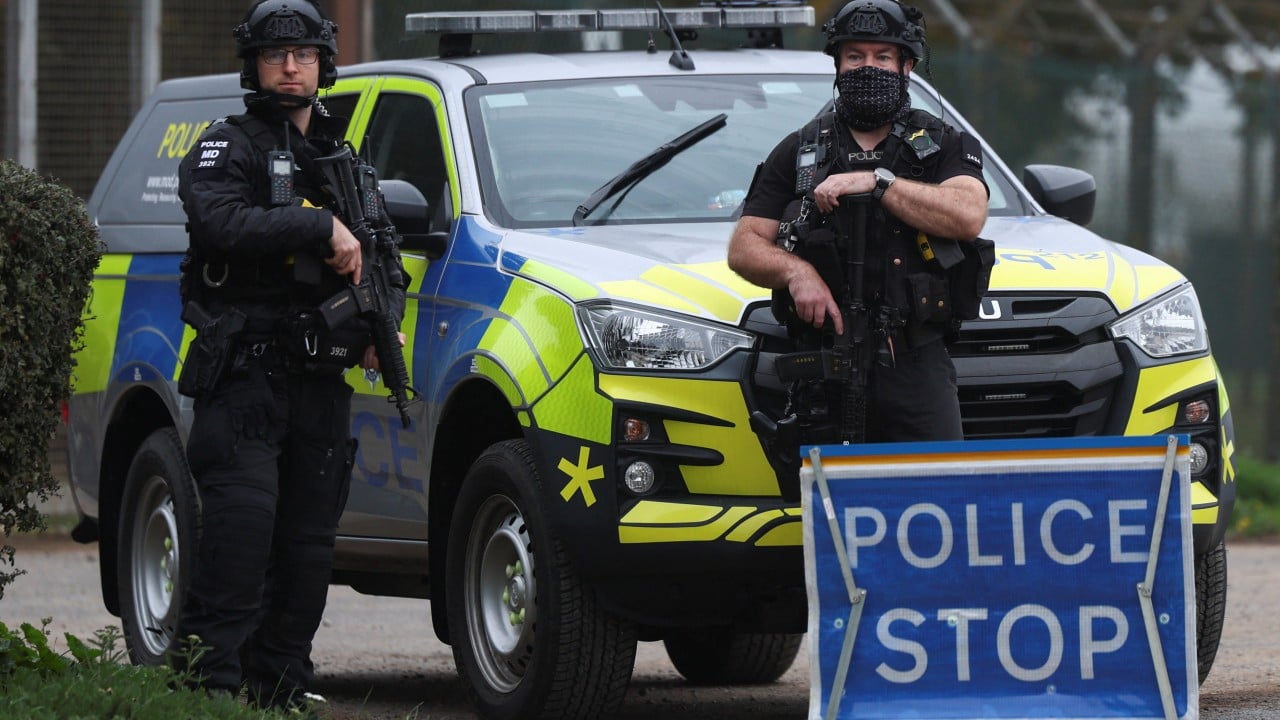
Local police officers intercepted three suspicious commercial vans approaching the perimeter of the installation. The vehicles were cleverly disguised to blend into the mundane flow of rural infrastructure maintenance, posing as fuel-delivery trucks and pool-supply services. But beneath the commercial veneer lay a different operational reality. Inside the vehicles, investigators discovered suspicious materials, chemical accelerants, and logistical setups designed to bypass outer security checkpoints or trigger a high-impact disruption.
Panic rippled through the immediate community. Authorities cordoned off the perimeter, evacuating approximately eighty-five households as bomb disposal units swept the area and secured the suspicious transport. Five men in their twenties were initially arrested on suspicion of terrorism and explosives offenses, plunging a sleepy British community into an international espionage thriller.
Shadows in the Countryside and Transatlantic Staging
While those local suspects were subsequently released on police bail, the administrative dust settled to reveal a much larger, darker blueprint. Federal prosecutors in the United States and British intelligence agencies began piecing together a transnational puzzle that extended far beyond the Gloucestershire perimeter.
According to unsealed federal indictments from the Southern District of New York, the Fairford incident was just one node in a sprawling network of hostile actions directed from afar. Investigators pointed toward veteran operatives linked directly to Iran's paramilitary apparatus and regional proxy structures, including Kata'ib Hizballah. Court documents outlined how handlers operating out of foreign safehouses orchestrated local surveillance, funded vehicle acquisitions, and directed operatives to research chemical accelerants and base access routes.
The strategy revealed a terrifying evolution in modern state-sponsored sabotage. Instead of deploying highly trained intelligence officers who immediately set off diplomatic alarms, modern hostile actors increasingly rely on localized criminal proxies, financial incentives, and front operations to do the dirty work. They buy commercial vehicles locally. They hire individuals living on the fringes of the economy who may not even fully comprehend the geopolitical magnitude of energy and military machinery they are assisting.
When intelligence services dismantle these plots, the public often focuses entirely on the low-level operatives caught carrying fuel barrels or parking vans near a fence line. That focus misses the entire structural architecture of modern gray-zone warfare. The foot soldiers are entirely disposable. The real architecture remains anchored thousands of miles away in heavily guarded command centers where handlers manage networks of encrypted communications and offshore cryptocurrency wallets.
The Operational Pivot and Northern Migration
The fallout from the Fairford incident extended rapidly across the British military ecosystem. Just days after the initial security breach and the subsequent statements from Downing Street, the United States military executed a quiet, urgent operational pivot. All B-1B strategic bombers stationed at Fairford were ordered out of the United Kingdom, redeployed back across the Atlantic or to secondary staging posts.
Critics questioned whether the withdrawal signaled a victory for the perpetrators, a tangible sign that asymmetric pressure could effectively push superpower assets away from vital forward-operating bases. Military analysts argued a more pragmatic perspective. Moving high-value assets out of the immediate firing line of localized sabotage threats is basic operational risk management. When a base's perimeter is repeatedly tested by hostile proxies, leaving multibillion-dollar strategic bombers sitting on an open tarmac becomes an unnecessary tactical gamble.
Yet, neutralizing the threat at Fairford did not extinguish the broader campaign. Weeks later, the tension migrated northward. Security officials detected fresh, credible threat indicators pointing toward RAF Mildenhall in Suffolk, another crucial installation housing the 100th Air Refueling Wing.
The response was swift and uncompromising. Ten KC-135 Stratotankers and several CV-22 Osprey transport aircraft were rapidly relocated away from Mildenhall to dispersal bases in Germany, Spain, and Scotland. Local communities near Suffolk found themselves living through the exact same psychological pressure cooker that Gloucestershire had endured weeks prior.
The Porous Reality of Open Societies
Tehran's official diplomatic channels routinely dismissed the allegations as baseless fabrications, maintaining a posture of total denial. Iranian representatives pointed out that coalition operations launched from European soil were viewed by Tehran as hostile acts of war, justifying retaliatory countermeasures under their own domestic doctrine. But public denials carry little weight when stacked against intercepted communications, financial paper trails, and detailed operational indictments filed in Western courts.
The uncomfortable truth facing Western security apparatuses is that open democratic societies present an inherently porous environment for hostile intelligence services. Unlike closed authoritarian states where every movement of a commercial vehicle is heavily monitored by internal security cameras and mandatory checkpoints, the United Kingdom operates on a philosophy of open movement and civic privacy.
An adversary can purchase vans, rent safehouses, scout perimeters, and recruit local accomplices without ever triggering an automatic state alarm until the final phase of execution. This asymmetry grants hostile states an enormous strategic advantage. They can probe infrastructure indefinitely with minimal financial and personnel investment, while the host nation must maintain a hundred percent success rate in defense to prevent a catastrophic security failure.
Law enforcement and counter-terrorism units have adapted by shifting their focus upstream, attempting to intercept financial flows and digital communications before physical assets ever reach a military perimeter. But financial trails are increasingly obscured through decentralized currency exchanges and complex shell companies, making it difficult to sever funding channels before a local cell activates.
The Permanent State of Heightened Anxiety
The public debate surrounding these incidents often bogs down in political posturing over whether local police forces handled trials correctly or whether domestic forces yielded too much operational sovereignty to foreign military units. Internal Ministry of Defence documents leaked to the press revealed simmering institutional friction between British civil authorities and American security commanders over who maintains primary jurisdiction when foreign bases experience domestic security alerts.
These jurisdictional turf wars distract from the core vulnerability. Sovereign borders no longer provide a natural moat against distant conflicts. When a nation permits its territory to serve as a launchpad for strategic coalition strikes, it effectively imports the front line directly into its own rural shires and quiet countryside towns.
The strategic implications extend far beyond the immediate geography of Gloucestershire and Suffolk. Intelligence briefings circulated among European capitals indicate that similar probing operations have targeted defense logistics nodes across the continent. Foreign intelligence agencies are systematically testing emergency response times, perimeter vulnerabilities, and the psychological resilience of host communities.
When a commercial vehicle disguised as a pool-supply truck can maneuver within striking distance of a secure flight line before drawing an armed response, it exposes critical blind spots in civilian-military coordination. Local constabularies are suddenly thrust onto the front line of counter-terrorism operations, tasked with distinguishing between routine commercial traffic and sophisticated hostile reconnaissance.
The financial cost of this constant vigilance is staggering. Airbases must upgrade their physical barriers, expand surveillance perimeters, and increase intelligence-sharing protocols with local law enforcement agencies. Yet physical hardening alone cannot solve a threat driven by networked cells and remote digital orchestration.
As geopolitical flashpoints continue to simmer across multiple continents, the security posture around Western military installations has entered a permanent state of heightened anxiety. The era of treating domestic military bases as peaceful, isolated facilities is definitively over. Every fence line is a potential battleground. Every commercial van parked on a rural road requires scrutiny. And the quiet war fought in the shadows shows no sign of slowing down.


