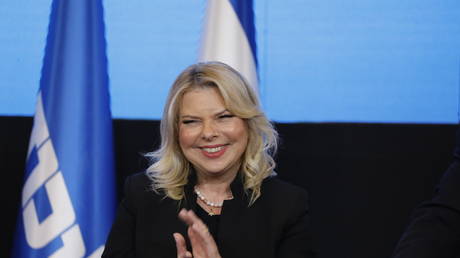
Sara Netanyahu, wife of Israeli Prime Minister Benjamin Netanyahu, publicly accused opposition politician Yair Golan of masterminding anti-government protests, framing the civil unrest as a coordinated seditious campaign rather than organic democratic dissent. This high-stakes accusation lays bare the escalating psychological warfare inside Israeli politics, where the boundaries between state leadership, family influence, and conspiracy rhetoric have steadily dissolved.
The statement, released through official family legal channels, points directly to Yair Golan, a former deputy military chief and current leader of the Democrats party, alleging he orchestrated demonstrations to destabilize the coalition from within during wartime. By shifting the narrative from policy failure to treasonous subversion, the Netanyahu inner circle attempts to delegitimize the tens of thousands of citizens who take to the streets weekly.
The Mechanics of Distraction
Political survival in Jerusalem often relies on manufactured friction. When public pressure mounts over security failures, hostage negotiations, or judicial overreach, the machinery of distraction shifts into high gear. Pointing fingers at a prominent opposition figure serves a dual purpose for the ruling establishment. It consolidates the base by painting external critics as internal enemies while drowning out policy debates in a swamp of personal vitriol.
Golan represents a distinct threat to the current administration. A combat veteran with unquestioned security credentials, he lacks the traditional political baggage of older opposition figures. When he calls for mass strikes and civil disobedience, it carries institutional weight that ordinary activists cannot replicate. Labeling this rhetoric as conspiracy rather than political opposition changes the legal and moral calculus of the state. It criminalizes dissent and elevates partisan disagreement to the level of national security threat.
Historical Precedents of Family Politics
The involvement of prime ministerial spouses in Israeli statecraft is not new, but the aggressive posture adopted by Sara Netanyahu marks a distinct departure from previous administrations. Historically, figures like Leah Rabin or Aliza Olmert maintained a degree of separation from daily partisan brawls, even if they wielded informal influence behind closed doors. Today, the office of the spouse functions almost as an extension of the prime minister's communications department, frequently deploying litigation and fiery public statements against critics, journalists, and judicial figures.
This centralization of messaging ensures absolute loyalty within the inner circle but isolates the administration from reality. When advisors and family members reinforce the belief that every domestic crisis is merely a plot hatched by shadowy political opponents, genuine feedback loops snap. The government stops listening to intelligence assessments, public opinion polls, and economic warnings, viewing all contradictory data as part of the same hostile conspiracy.
The Yair Golan Factor
Yair Golan has never shied away from incendiary rhetoric, making him an easy target for state-sponsored accusations. His career is defined by a willingness to cross political tripwires, from his controversial 2016 Holocaust Remembrance Day speech comparing contemporary Israeli trends to pre-war Europe to his active encouragement of economic disruption to force early elections.
By framing Golan as the mastermind behind the chaos, the Netanyahu camp attempts to achieve two goals:
- Discredit the broader protest movement by tying it to a single polarizing figure.
- Force the opposition onto the defensive, compelling them to spend valuable political capital refuting wild allegations rather than scrutinizing government performance.
Yet this strategy carries heavy structural risks. Elevating Golan to the status of primary antagonist inadvertently boosts his political profile within a fractured opposition desperate for a decisive leader.
The Anatomy of Wartime Polarization
Accusations of treason during an active multi-front war erode the minimal social cohesion holding the country together. Israeli society is currently stretched to its breaking point. Reservists face their third or fourth stints of duty, the northern border remains volatile, and the fate of hostages in Gaza hangs in a perpetual state of ambiguity. Into this trauma, the introduction of conspiracy claims from the highest levels of government introduces a toxic element into an already volatile mixture.
When leaders accuse their political rivals of orchestrating domestic subversion, they signal to their supporters that normal democratic rules no longer apply. This rhetoric trickles down rapidly through social media channels, encrypted messaging groups, and street-level encounters, turning neighbors against neighbors. The state apparatus, which should act as a neutral arbiter during national emergencies, becomes a weapon in a partisan civil war.
The Information Ecosystem
Modern political survival requires mastery of the digital ecosystem, where nuance dies and outrage travels at lightspeed. The claim against Golan was not designed for parliamentary debate or judicial review. It was engineered for algorithmic dominance, built to generate shares, likes, and furious counter-arguments across platforms like X and Telegram.
In this environment, truth is subordinate to velocity. By the time independent fact-checkers or legal experts can parse the absurdity of the claims, the emotional damage has already been sustained. The base has been fed its daily ration of grievance, the opposition has been forced into a reactive crouch, and the cycle of distraction resets for the next news cycle.
The battle lines for the future of the state are drawn not around security doctrine or economic reform, but around the very definition of truth. As long as conspiracy claims remain a primary instrument of governance, constructive opposition becomes impossible, leaving a traumatized public to navigate an endless loop of manufactured crises.