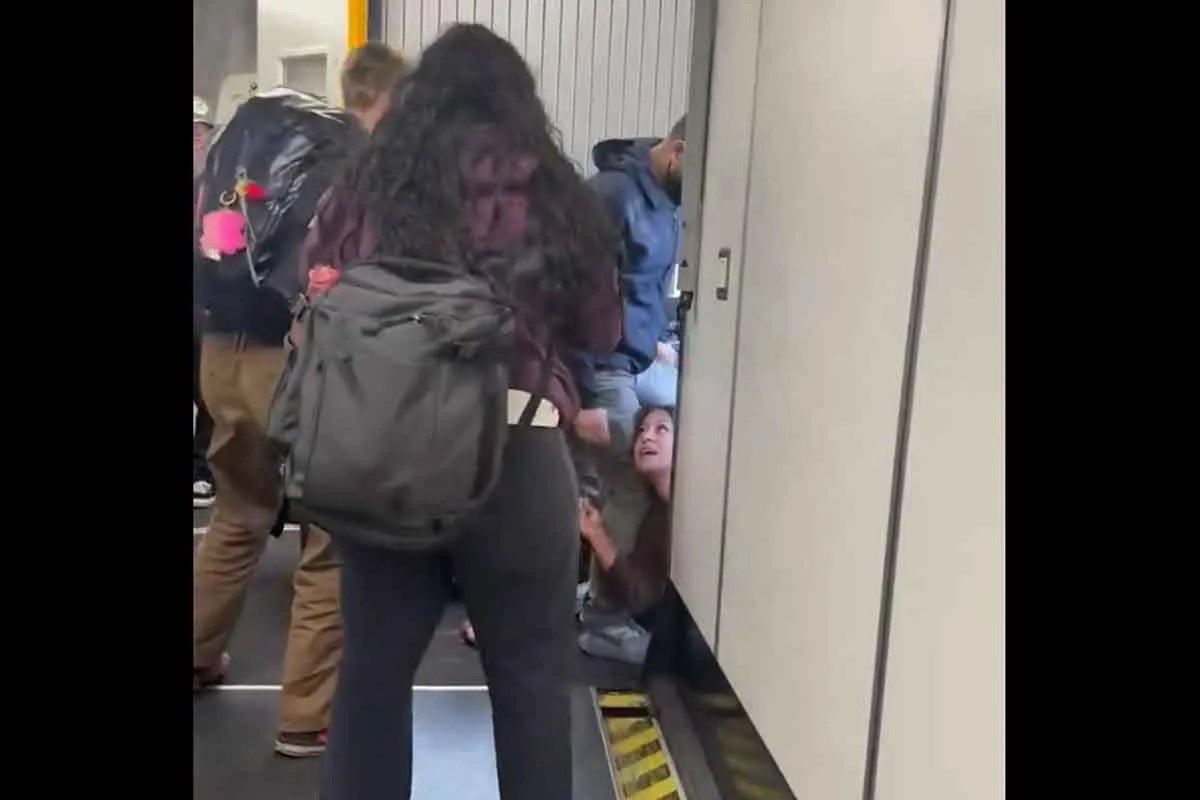
Two passengers boarding a flight at Seattle-Tacoma International Airport were detained by U.S. Immigration and Customs Enforcement on a jet bridge, turning a routine departure into a flashpoint over federal enforcement authority inside commercial aviation spaces.
That headline tells you what happened. It barely begins to explain why a narrow, enclosed walkway connecting a terminal gate to an aircraft cabin has become one of the most contentious pressure points in modern travel and enforcement. For an alternative perspective, check out: this related article.
I have covered aviation security, border policy, and municipal infrastructure long enough to know that airports rarely generate accidental theater. Every square foot of an airport operates under overlapping layers of federal statutes, airline contracts, airport operator leases, and local policing arrangements. When ICE enforcement at Seattle Airport reaches a jet bridge, it exposes friction that has been building quietly for years between federal immigration agents, airport authorities, airlines, and travelers who assume that passing through security means the hard part is over.
http://googleusercontent.com/lmdx_content/yIRQHgdUHJzyAdoRrHwzVlCwSZZrABLwvpayWofRyxJMIxkgVKSWdOuJoHGgNPCpbPrrvnoESgjJRWuTPXkvjIftfKVlahVAyBMwjiGGsYdkqLvWOfpBlOrdBcwHzLMHLZehtsmWxgiFdtXHLvtkhLtMAjsiBKEHiBiebVXchRqphdBOKJXHStWaHSZMCZbGUguSSldMislHqH1275585 Related insight regarding this has been published by NBC News.
Why Jet Bridges Create a Legal and Operational Blind Spot
A jet bridge feels like a hallway. Legally and operationally, it is a transitional chokepoint.
Most travelers view an airport in two simple halves: before security and after security. Once you clear the Transportation Security Administration checkpoint, you tend to assume your identity and travel eligibility have already been vetted for the trip ahead. That assumption confuses aviation security screening with immigration enforcement. The TSA checks for weapons, explosives, and prohibited items, and verifies that the name on a boarding pass matches government identification. Immigration agents operate under a completely different statutory mandate focused on admissibility, lawful status, and removal authority.
A jet bridge sits right on the seam of that distinction. Passengers are no longer in the open concourse where bystanders can easily record or disperse, yet they have not crossed the threshold into the aircraft cabin where flight crew authority and in-flight protocols take over. For agents looking to make a targeted stop without triggering a prolonged terminal standoff, a jet bridge offers control and containment. For everyone else—fellow passengers, gate agents, flight attendants, and airport management—it creates a sudden bottleneck in a space designed for one purpose: moving people smoothly onto a plane.
Consider a hypothetical example to see how quickly routine operations stall. Suppose a flight is boarding by zones and two passengers step into the jet bridge ahead of their rows. If federal agents intercept them inside that enclosed tube, boarding stops dead. Passengers behind them have nowhere to turn around easily. Gate agents face a choice between holding the aircraft door open—risking missed pushback slots and cascading delays across the airline network—or separating passengers from checked bags and travel companions already seated inside.
That is the real operational shock behind an arrest on a jet bridge. An airport is a tightly coupled system. A single disruption at one gate ripples through crew duty times, aircraft rotations, and connecting banks hundreds of miles away.
How Federal Authority Meets Local Airport Governance
When an enforcement action happens at a major hub like Seattle-Tacoma International Airport, public anger and confusion almost immediately collide with jurisdictional limits. People ask why airport police or local officials did not step in, or whether the airport invited the operation.
The reality is far messier. Major commercial airports are typically operated by a port authority or municipal agency under lease and regulatory frameworks overseen by the Federal Aviation Administration. While local or port police handle day-to-day law enforcement, emergency response, and perimeter security, federal agencies such as ICE and Customs and Border Protection hold distinct federal statutory authorities that do not depend on a mayor's or port commissioner's approval to walk into a public or ticketed area.
Federal enforcement agents do not need permission from a local airport director to enforce federal immigration law within their statutory jurisdiction, even when their tactics clash with local policy preferences or passenger expectations.
At the same time, airports rely on cooperation to keep terminals safe and predictable. When federal agents conduct operations in high-density transit zones without clear advance coordination with airport operations or local law enforcement, everyone is reacting on the fly. Local officers may only learn what is happening when dispatch lights up with reports of a disturbance or a stalled boarding process.
Access Control and Secure Zones
Travelers often assume that anything past security is a closed fortress controlled solely by one agency. In practice, access to sterile areas, ramps, and boarding gates is governed by strict badging and security protocols, while federal law enforcement officers carry credentials that allow them into areas necessary for official duties.
That overlap creates an uncomfortable gray area for the public:
- Passenger expectations: Many travelers believe that holding a valid ticket and clearing security grants an unspoken zone of privacy until arrival at their destination.
- Airline liability and operations: Carriers want fast, orderly boarding and minimal cabin disruption, yet they must comply with lawful federal directives and maintain safety standards.
- Airport management: Port and municipal operators must balance public accountability to local residents with federal aviation mandates and commercial tenant relationships.
None of these actors shares the exact same incentive structure. When an arrest happens on a jet bridge, each party experiences the fallout differently.
The Overlooked Factors Driving Public Reaction
Coverage of high-profile arrests often focuses on the immediate drama: surprised travelers, delayed boarding, and sharp political statements afterward. Those details matter, yet several quieter factors explain why incidents like the Seattle airport jet bridge arrest hit such a raw nerve.
First is the loss of predictability. Air travel already tests people's patience with schedule changes, tight connections, and rising fares. Seeing armed or uniformed enforcement agents intercept travelers right at the boarding threshold shatters whatever sense of routine remained in the journey. Even passengers who are not targeted feel an immediate spike in tension because the environment shifts from predictable transit to active law enforcement.
Second is information asymmetry. During an enforcement stop in a confined space, bystanders rarely know what is happening. Are the detainees being arrested on a civil immigration matter, a criminal warrant, or an administrative hold? Has a mistake been made? Without clear, immediate context—which law enforcement rarely provides on the spot—rumors fill the vacuum in seconds. On social media, a few seconds of video from a gate area can strip away context and harden positions before facts are verified.
Third is the domestic travel myth. Many people still associate immigration enforcement primarily with international borders, ports of entry, or customs checkpoints. When it occurs at a domestic boarding gate or jet bridge, it forces a confrontation with the broader reach of federal enforcement inside the country. Whether someone supports strict enforcement or opposes it, seeing it unfold along a commercial flight path challenges long-held mental maps of where border and immigration rules apply.
| Dimension | Aviation Security Screening | Immigration Enforcement Action |
|---|---|---|
| Primary Mandate | Prevent threats to flight safety and aircraft security | Enforce federal immigration laws and status rules |
| Typical Touchpoint | Security checkpoint prior to entering concourse | Can occur in public, transit, or enforcement contexts |
| Passenger Experience | Standardized queue with clear procedural steps | Unannounced or targeted stop with high uncertainty |
| Operational Impact | Built into scheduled departure buffers | Can abruptly halt boarding and delay aircraft pushback |
Counter-Arguments and Hard Trade-Offs
A serious analysis cannot pretend there is an easy, cost-free fix that satisfies every side. There are real arguments on both sides of this issue, and each carries steep trade-offs.
Supporters of assertive federal enforcement argue that immigration laws cannot rely solely on border checkpoints or post-arrival encounters if individuals with final orders or active enforcement priorities are moving through national transit networks. From that viewpoint, an airport is simply a public transit hub where federal law applies just as it does elsewhere, and waiting until a person reaches another city or state may complicate locating or detaining them. Agents also point out that conducting an arrest in a controlled, narrow space like a jet bridge can sometimes reduce the risk of a chaotic chase through a crowded concourse.
Critics push back hard on both practical and civil grounds. They argue that arresting people at boarding gates inflicts collateral disruption on dozens or hundreds of uninvolved passengers, damages public trust in travel infrastructure, and chills legitimate travel among mixed-status families or communities worried about profiling or misidentification. Critics also question whether the urgency of an arrest at the moment of boarding outweighs the operational chaos it inflicts on an entire flight crew and cabin full of travelers.
Neither side has a monopoly on concern for safety or rule of law, yet both are colliding in a space that was never engineered to host contested enforcement actions. A jet bridge is built to span a gap between concrete and aluminum—not to resolve deep national debates over federal power, civil liberties, and public order.
What Travelers and Operators Actually Face
For ordinary flyers, the practical takeaway is sobering: clearing security is a safety gate, not a shield against all law enforcement encounters. Carrying accurate, up-to-date identification and travel documentation—and understanding that federal agents operate in major transit hubs—is basic practical awareness rather than alarmism.
For airport executives, airlines, and policymakers, the challenge is harder. Every time a high-visibility arrest disrupts boarding at a major hub, confidence in the smoothness of the system takes a hit. Tighter coordination protocols, clearer rules on minimizing collateral disruption to flights, and transparent post-incident accounting of legal authority are essential if airports want to prevent every enforcement stop from turning into an operational crisis and a political storm.
When enforcement reaches the jet bridge, the distance between federal policy and everyday human friction shrinks to a few steps of metal and glass.