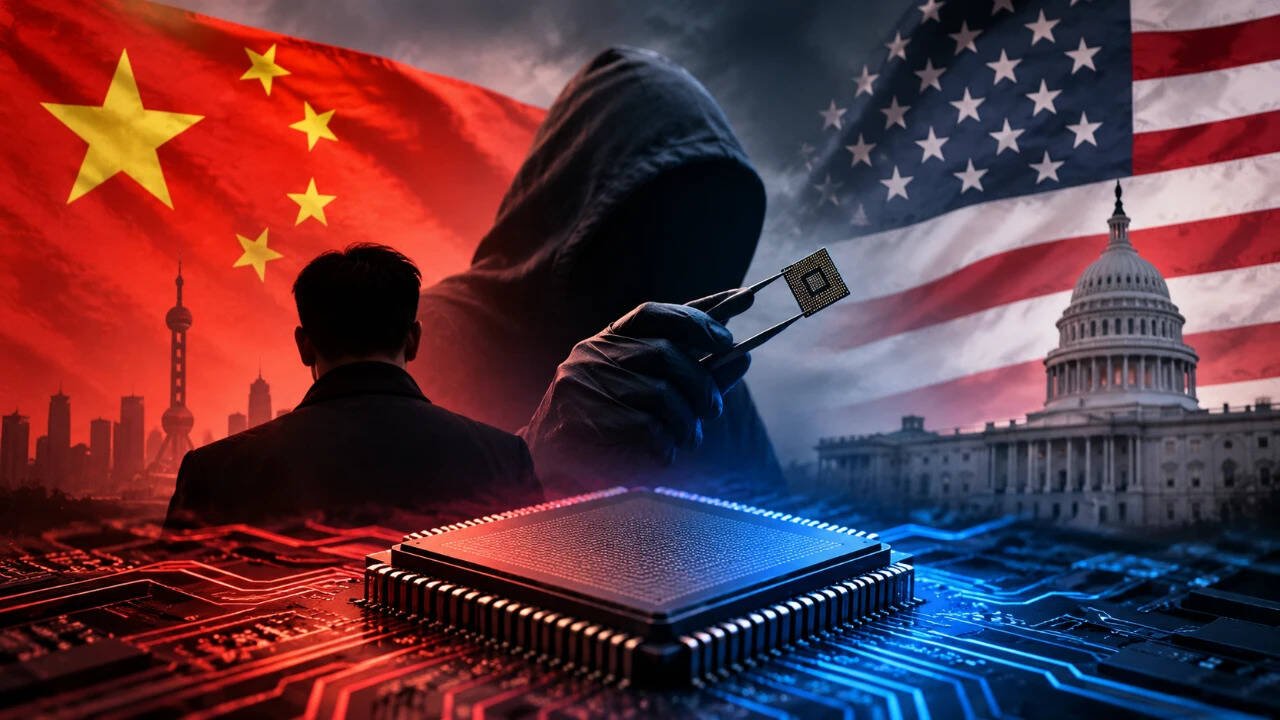
State-backed intelligence networks are bypassing American export controls on advanced semiconductors not through cinematic espionage, but through mundane corporate bureaucracy, shell companies, and gray-market logistics. When Washington tightened restrictions on high-end processors from Nvidia and AMD, it created an immediate, existential bottleneck for Beijing’s artificial intelligence ambitions. In response, China’s intelligence apparatus—most notably the Ministry of State Security (MSS)—merged its traditional human-intelligence playbook with aggressive state capitalism to keep the silicon flowing.
The result is a sprawling, decentralized procurement machine. It operates through front companies in third-party jurisdictions, academic cutouts, and cloud-computing workarounds that exploit the exact seams of global trade law. In similar developments, take a look at: The Mathematics of Existential Risk and Systemic Collapse.
The Architecture of State-Backed Smuggling
Traditional espionage steals blueprints. Modern silicon espionage moves heavy freight.
An advanced AI training cluster requires thousands of graphics processing units (GPUs), along with specialized networking gear and high-bandwidth memory. You cannot slip a server rack into a diplomatic pouch. Moving this hardware requires physical logistics, customs clearance, and millions of dollars in cross-border wire transfers. This is where the intelligence apparatus steps in—not necessarily to carry the boxes, but to build the financial and legal insulation around the buyers. Wired has analyzed this important subject in extensive detail.
Consider how a typical procurement chain operates in practice. A domestic Chinese tech firm needs restricted processors to train a large language model. Buying directly from an American vendor is impossible. Instead, the firm works through a broker linked to state-affiliated trade groups. That broker establishes a seemingly legitimate data-center startup in Southeast Asia or the Middle East—regions that initially faced fewer licensing hurdles under US Department of Commerce rules.
The overseas startup purchases the servers legally, takes delivery, and installs them in a local facility. Weeks later, the hardware is quietly decommissioned, broken down into components, and shipped through a maze of freight forwarders into Hong Kong or mainland free-trade zones. By the time US compliance officers audit the end-user certificates, the shell company has been dissolved, its directors have vanished, and the GPUs are already humming inside a secure data center in Shenzhen or Beijing.
The Intelligence Advantage
Why does an intelligence service need to be involved in what looks like commercial smuggling? Three reasons stand out:
- Counter-vetting: Western chipmakers and their distributors employ strict Know Your Customer (KYC) protocols. State intelligence agencies possess the resources to fabricate deep corporate histories, generate realistic financial statements, and coach front-company executives to pass Western due diligence checks.
- Financial obfuscation: Moving tens of millions of dollars without triggering US Treasury sanctions or anti-money-laundering flags requires access to underground banking networks, state-controlled clearinghouses, and complex trade-based money laundering schemes.
- Protection from domestic enforcement: In China, smuggling high-value electronics normally attracts severe penalties from customs authorities. When a procurement ring operates under the quiet blessing of national security organs, local border officials look the other way.
Beyond Physical Boxes The Cloud Loophole
Moving physical silicon is expensive, risky, and slow. Intelligence planners and tech executives realized early on that if you cannot bring the chips to the data, you can bring the data to the chips.
Export controls written for the physical shipment of hardware struggle to regulate remote access. A Chinese research institute—or a military-linked laboratory operating under an academic alias—does not need to own an Nvidia H100 or B200 cluster if it can rent compute cycles by the hour from a cloud provider located outside US jurisdiction.
To exploit this gap, state-backed actors rely on layers of commercial abstraction. A hypothetical example illustrates how clean this separation can be: a university research group in Beijing signs a consulting contract with a biomedical startup in Singapore. That startup rents massive GPU capacity from a regional cloud vendor, runs the model training weights provided by the Chinese team, and returns only the resulting algorithm. No restricted hardware ever crosses a border. No export license is violated on paper.
Intelligence services facilitate these arrangements by identifying vulnerable data centers, funding the intermediary entities, and ensuring that the digital footprint connecting the end user to Beijing remains scrubbed. For Western regulators, policing this activity is a nightmare. Auditing every compute job running on servers in Malaysia, the United Arab Emirates, or Europe requires an intrusive surveillance apparatus that global cloud providers fiercely resist.
Talent Recruitment and Technical Extraction
Hardware is only half the equation. Without the engineers who know how to stitch thousands of processors together and optimize the software stack, raw silicon sits idle.
Alongside physical procurement, China’s intelligence network has intensified its targeting of semiconductor talent across Taiwan, South Korea, the United States, and Europe. Rather than relying solely on crude hacking campaigns to steal intellectual property, recruiters use venture capital funds, academic exchange programs, and lucrative consulting retainers to extract tacit knowledge.
An engineer who spent a decade designing high-speed interconnects or advanced packaging techniques in Silicon Valley does not need to steal proprietary CAD files to be valuable. Simply hiring that individual to advise a state-backed startup in Shanghai transfers years of trial-and-error intuition—the exact kind of institutional knowledge that cannot be found in a patent filing. Intelligence operatives frequently act as the matchmakers in these transactions, scouting disillusioned mid-career engineers, vetting their financial vulnerabilities, and routing their compensation through offshore holding companies to avoid scrutiny from Western counterintelligence.
Why Washington’s Whack-a-Mole Strategy Struggles
The Bureau of Industry and Security (BIS) at the US Department of Commerce is tasked with enforcing export controls. It is an agency built for trade compliance, not covert counter-intelligence.
Every time Washington closes one loophole, the procurement network adapts within months. When the US banned the A100 and H100 chips, Nvidia designed modified, lower-bandwidth versions—the A800 and H800—specifically for the Chinese market. When Washington banned those too, buyers shifted to buying up consumer-grade gaming cards like the RTX 4090 in bulk, stripping off their cooling fans, and soldering them onto custom server boards in makeshift workshops across Guangdong.
When the Commerce Department expanded licensing requirements to cover dozens of countries in the Middle East and Southeast Asia to stop transshipment, the smuggling rings fragmented into smaller, lower-volume transactions. Instead of buying a thousand servers at once, brokers began buying ten at a time through hundreds of unrelated medical clinics, logistics firms, and agricultural suppliers.
The Fundamental Friction of Global Supply Chains
The core weakness of export controls lies in the nature of commercial electronics. Modern GPUs are dual-use technologies—they power both video game rendering and hypersonic missile simulations, both medical imaging and autonomous drone swarms.
Chipmakers sell their products through multi-tiered distribution networks involving original equipment manufacturers (OEMs), system integrators, and regional resellers. Once a server leaves a factory in Taiwan and enters the global wholesale market, tracking its chain of custody becomes nearly impossible. A reseller in Dubai might sell a batch of servers to a buyer in Istanbul, who resells them to a trading house in Hong Kong. Each transaction is legally distinct, and each adds a layer of plausible deniability.
Furthermore, American tech companies face massive financial incentives to maximize sales. While they comply with the letter of the law, they have little appetite for building costly investigative divisions to police every downstream buyer. That reluctance leaves a massive blind spot that state-backed procurement networks exploit daily.
The Domestic Backstop and Its Limits
Smuggling and cloud rentals are stopgap measures. Beijing knows that a superpower cannot build a permanent technological foundation on gray-market hardware.
The ultimate goal of the state-backed procurement campaign is to buy time while domestic champions—led by Huawei and its chip-design arm HiSilicon, alongside foundry giant SMIC—close the manufacturing gap. The smuggled Western chips serve two critical purposes during this transition:
- Immediate compute: They keep China’s leading AI labs—such as DeepSeek, Zhipu, and Moonshot—competitive in the global race to build frontier models right now.
- Benchmarking and reverse engineering: Domestic hardware engineers use captured Western architectures to test their own software compilers, study thermal management designs, and identify bottlenecks in local manufacturing.
Yet this strategy carries severe, undeniable limitations. Smuggled hardware comes with no manufacturer warranty, no official firmware updates, and no technical support. When a $30,000 processor burns out inside a clandestine cluster, there is no RMA process to replace it. Maintenance costs skyrocket, failure rates climb, and scaling clusters beyond tens of thousands of chips becomes an engineering nightmare when every batch comes from a different gray-market source.
Where the Shadow War Moves Next
The battle over AI compute has permanently altered the relationship between technology companies and national security agencies. Silicon Valley firms can no longer pretend they are merely selling commercial widgets to a globalized market. Every high-end processor is now treated by both Washington and Beijing as a strategic asset on par with enriched uranium or stealth coatings.
Expect enforcement to shift from export bans to hardware-level telemetry. Policymakers are already debating whether future chips must include cryptographic location verification—essentially "phone home" features that disable a processor if it detects it has been moved into an unauthorized jurisdiction. At the same time, intelligence agencies on both sides are embedding deeper into the supply chain, turning routine logistics hubs, venture capital firms, and cloud data centers into the primary battlegrounds of modern statecraft.
For the companies caught in the middle, the era of frictionless global tech trade is dead, replaced by a permanent shadow war where every shipment is suspect and every customer is a potential front.