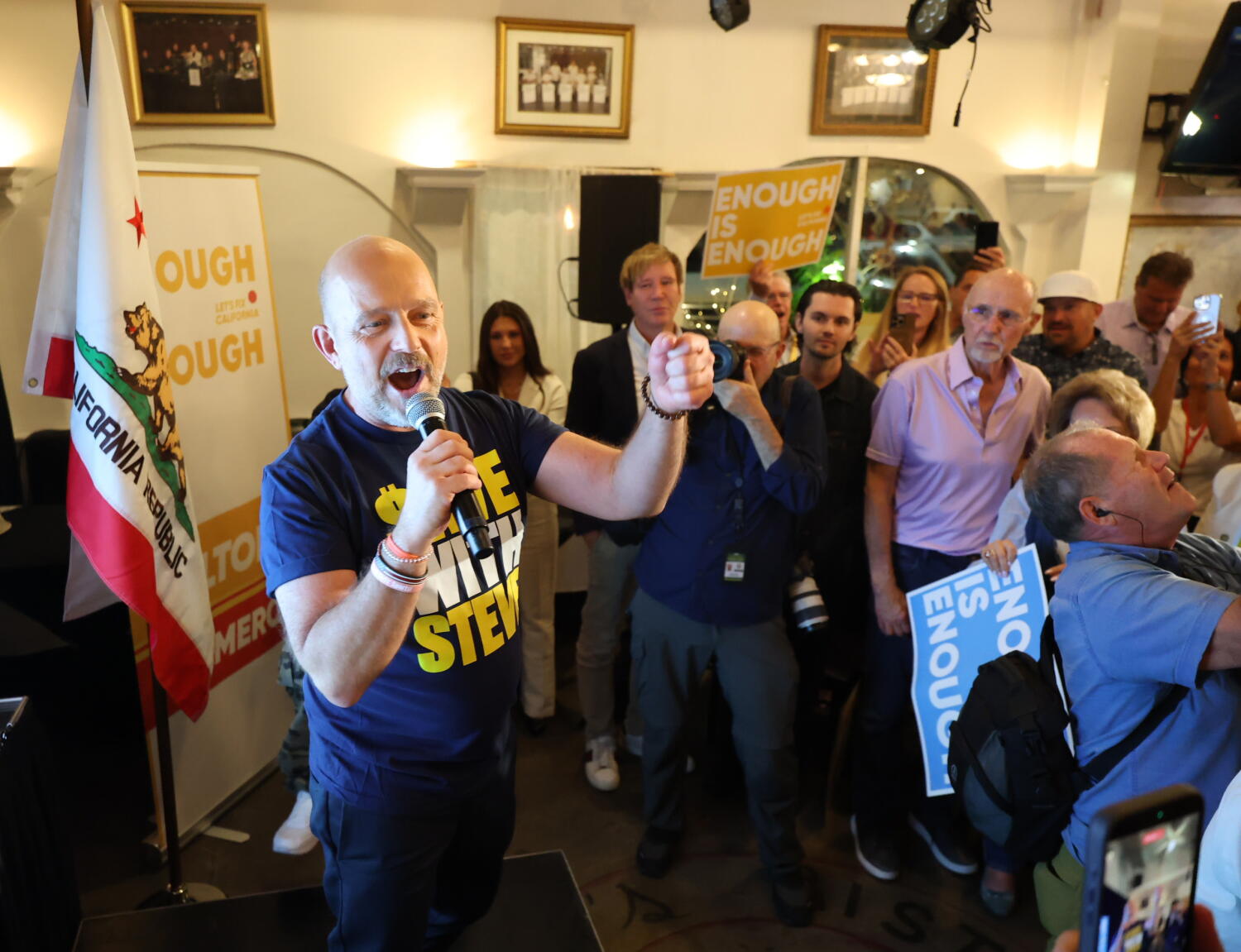
Republican Steve Hilton’s campaign for California governor relies on provocative, media-savvy advertisements and deep-seated voter frustration over the state’s high cost of living to mount an improbable challenge in a deeply blue state. While political pundits largely dismiss his candidacy as a long shot due to California's overwhelming Democratic voter registration advantage, Hilton is betting that his populist messaging, cable news visibility, and outsider credentials can fracture the traditional electorate and force a competitive race.
To understand why a former British political strategist and Fox News host believes he can capture the executive mansion in Sacramento, you have to look past the partisan registration numbers. You have to look at the simmering exhaustion of California’s middle class.
For years, the conventional wisdom in Golden State politics has been simple. Statewide office is virtually unattainable for any candidate with an "R" next to their name. Republicans have not won a statewide race in California since 2006, when Arnold Schwarzenegger secured a second term. Since then, the state’s demographic shifts and the nationalization of local politics have turned California into an impenetrable Democratic fortress.
Yet, the ground beneath that fortress is shifting. And Steve Hilton is positioning himself as the man holding the jackhammer.
The Anatomy of a Populist Insurgency
Hilton is not running the traditional Republican playbook. He isn't spending his time courting the shrinking pool of country-club conservatives in Orange County or reciting standard-issue fiscal austerity talking points that put swing voters to sleep. Instead, he is leaning heavily into populist discontent and weaponizing humor to break through a crowded, cynical media environment.
His campaign advertisements are designed for the algorithmic age. Rather than relying on grainy B-roll of candidates nodding solemnly at factory workers, Hilton’s team produces sharp, often cheeky spots that mock the state’s political establishment directly. By leaning into satire and visceral frustration—highlighting everything from sky-high gas prices and labyrinthine housing regulations to visible homelessness and retail theft—the campaign aims to bypass the traditional political filter.
It is a calculated gamble. In an era where paid television ads are increasingly ignored, a cheeky, viral-ready spot earns millions of dollars in free media coverage. Every time a Sacramento insider or a coastal pundit expresses outrage or amusement at Hilton’s latest video, his name recognition climbs among the exact voters he needs to reach: disillusioned independents and moderate Democrats who feel abandoned by single-party rule.
From Downing Street to the Pacific Coast
To grasp Hilton’s strategic instincts, you have to examine his resume. Before becoming a familiar face on American cable television as the host of The Next Revolution, Hilton was the chief strategist for former British Prime Minister David Cameron. He was the architect of the "Big Society" agenda, an effort to rebrand the UK’s Conservative Party by softening its hard edges and focusing on community empowerment, environmentalism, and social mobility.
That background makes him an unusual creature in modern American conservatism.
- He speaks the language of disruption. Having spent decades in Silicon Valley after leaving British politics, Hilton absorbed the tech industry's obsession with tearing down legacy systems. He frames Sacramento not just as overly liberal, but as fundamentally broken, bureaucratic, and obsolete.
- He understands media framing. Years in front of a camera taught him that nuance dies on television, while clear, punchy narratives survive. He distills complex policy failures—like the California Environmental Quality Act (CEQA) stalling housing construction—into simple stories about government incompetence hurting working families.
- He rejects standard partisan labels. Hilton frequently attacks corporate cronyism alongside government overreach, a stance that occasionally alienates traditional business-friendly Republicans while intriguing anti-establishment voters on the left.
This hybrid identity is both his greatest asset and his most glaring vulnerability. While it allows him to appeal to voters who would never consider a conventional MAGA Republican, it also leaves him open to attacks from the right flank of his own party, where purity tests remain fierce.
Why Voter Discontent Is the Real Wildcard
If Hilton’s campaign were merely a vanity project fueled by clever marketing, it would be easy to write off. What gives his long-shot bid a pulse is the undeniable reality of California’s affordability crisis.
You do not need a polling firm to tell you that living in California has become extraordinarily expensive. Residents feel it every time they pull up to a gas pump, open a utility bill, or look at mortgage rates in cities like Los Angeles, San Jose, and San Diego. Despite boasting one of the largest economies in the world, the state consistently ranks near the bottom in poverty rates when adjusted for the cost of living.
For over a decade, Democratic leaders in Sacramento have enjoyed supermajorities in both chambers of the legislature alongside control of the governor's office. That absolute power comes with a heavy political price. When things go wrong, there is no opposition party left to blame.
Hilton’s core thesis is built on accountability. He argues that the state’s crises—unsustainable housing costs, failing public infrastructure, and erratic energy grids—are not acts of God, nor are they the inevitable byproducts of a booming economy. They are the direct result of specific policy choices made by an entrenched political class that faces zero electoral consequences.
"When one party controls every lever of power for nearly two decades, they stop governing for the people and start governing for the special interests that keep them in office," is the central refrain echoing through Hilton’s stump speeches.
This message resonates deeply in the Central Valley, the Inland Empire, and the outer suburbs of Southern California. These are regions where working-class families—many of them Latino and Asian American—are watching their purchasing power evaporate while state taxes and regulations continue to climb. Recent election cycles have already shown notable rightward shifts among working-class minority voters in California, driven largely by pocketbook issues rather than cultural grievances.
The Structural Wall Facing Any Republican
Despite the fertile ground of voter frustration, the math in California remains brutal. Understanding the structural barriers Hilton faces requires looking at the mechanics of the state's election system and its demographic reality.
California utilizes a top-two primary system, often referred to as a "jungle primary." Regardless of party affiliation, all candidates appear on the same ballot, and the top two vote-getters advance to the general election. In theory, this system favors moderate candidates who can build broad coalitions. In practice, it often produces a general election pitting two Democrats against each other, effectively locking Republicans out of the November ballot entirely.
To survive the primary, Hilton must consolidate the Republican base while peeling off a significant chunk of No Party Preference (NPP) voters, who now make up roughly a quarter of the state's electorate. If multiple credible Republicans enter the race, they risk splitting the conservative vote, handing both general election slots to Democratic contenders.
| Factor | Advantage for Hilton | Structural Challenge |
|---|---|---|
| Voter Registration | High dissatisfaction among independent voters | Democrats outnumber Republicans by nearly 2-to-1 |
| Media Environment | National cable profile guarantees earned media | High cost of California TV markets drains campaign cash |
| Policy Focus | Cost of living and crime are top voter concerns | National GOP brand remains toxic in coastal metros |
| Primary System | Name recognition helps stand out in a crowded field | Vote-splitting among GOP candidates could end the race early |
Even if Hilton clears the primary hurdle and makes it to November, the general election landscape is treacherous. Running a statewide campaign in California is extraordinarily expensive. Reaching voters across massive, disconnected media markets—from the San Francisco Bay Area to Los Angeles, San Diego, Sacramento, and Fresno—requires tens of millions of dollars.
Democratic candidates routinely tap into a massive network of labor unions, trial lawyers, tech billionaires, and Hollywood donors to fund their campaigns. Republicans, by contrast, often struggle to raise the institutional money necessary to compete on the airwaves in the final weeks of a race. Hilton’s cheeky ads may dominate social media feeds, but social media algorithms do not always translate into turnout among low-propensity voters in November.
The Counter-Argument and the Credibility Gap
Critics of Hilton’s campaign—both on the left and among seasoned political analysts—point to a glaring flaw in his pitch: the gap between populist rhetoric and actionable governance.
It is easy to point out that housing is too expensive or that homelessness is out of control. Every candidate running for governor says the exact same thing. The hard part is explaining how you actually fix those problems when facing a hostile legislature.
Suppose Hilton somehow pulls off a historic upset and wins the governorship. On day one, he would walk into a Capitol building where Democrats hold overwhelming majorities in both the State Assembly and the State Senate. Any sweeping deregulation, tax cuts, or major overhauls to state environmental laws would be dead on arrival unless he could persuade dozens of Democratic lawmakers to break ranks.
Furthermore, opponents are eager to scrutinize Hilton’s own record and ideological consistency. Having spent years as a prominent voice on conservative cable news, he carries baggage that Democratic opposition researchers will exploit relentlessly. Every controversial monologue, every past alignment with polarizing national figures, and every shift in his policy positions—from his days advocating green policies in Britain to his current stance on domestic energy production—will be amplified in multi-million-dollar attack ads.
Voters in coastal California may despise the current state of affairs in Sacramento, but history shows they are deeply reluctant to hand the keys to someone they perceive as aligned with national right-wing media. In 2021, during the gubernatorial recall election, voters expressed immense frustration with the state's leadership, yet ultimately rejected the recall by a massive margin once the race became framed around the conservative radio host leading the Republican field.
The Strategic Reality Behind the Long Shot
So why do it? Why pour immense personal capital, time, and reputation into a race where the odds are stacked so heavily against victory?
Because in modern politics, winning the office is not always the sole metric of success. Campaigns are vehicles for shifting the Overton window—the range of policies politically acceptable to the mainstream population.
By injecting sharp, populist critiques into the gubernatorial race, Hilton forces Democratic frontrunners to defend their records on affordability, regulation, and public safety. He prevents them from coasting through a low-energy campaign focused solely on national partisan themes. When an outsider successfully frames the debate around the failures of single-party governance, the frontrunners are forced to pivot toward the center to protect their flanks.
At the same time, Hilton is testing a new model for California conservatism. If his blend of anti-establishment humor, Silicon Valley disruption, and kitchen-table economics manages to outperform traditional Republican benchmarks—say, by capturing a substantial share of independent and working-class minority voters—it will provide a blueprint for future GOP candidates in blue states across the country.
Ultimately, Steve Hilton’s campaign is a high-stakes stress test on the limits of partisan loyalty. California voters are angry about the cost of their groceries, the price of their gas, and the state of their streets. Whether that anger is strong enough to overcome decades of partisan muscle memory—and whether a cheeky, media-savvy outsider is the vessel voters trust to channel it—will determine if this race remains a footnote or becomes one of the biggest political upsets in modern American history.