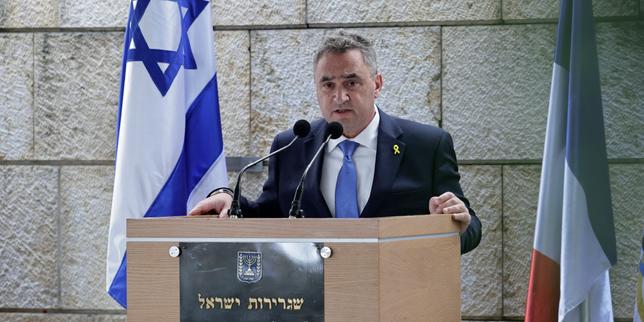
Joshua Zarka, Israel's ambassador to France, shattered centuries of diplomatic protocol on national television by explicitly stating he would prefer "anyone but Jean-Luc Mélenchon" to win the 2027 French presidential election. The stunning admission, delivered during a broadcast of the investigative program Complément d'enquête, sparked an immediate political firestorm in Paris, triggering fierce accusations of foreign electoral interference from across the political spectrum. Within hours of the broadcast, La France Insoumise (LFI) leaders demanded that the French government formally summon the ambassador to the Quai d’Orsay, highlighting a rapidly deteriorating bilateral relationship that Zarka himself now describes as the worst crisis in 35 years.
The fallout goes far beyond typical campaign trail bickering. An ambassador's primary duty is absolute neutrality regarding the domestic politics of their host country. By directly blacklisting a leading presidential candidate, Zarka did not just break a rule; he fundamentally shifted the boundaries of foreign influence in French elections.
Shifting Alliances and the Rehabilitation of the Far Right
To truly understand why the ambassador chose this exact moment to abandon diplomatic caution, one must look at the quiet realignment taking place inside the Israeli embassy in Paris. Zarka did not just attack the left; he explicitly softened Israel's historical stance toward Marine Le Pen's National Rally (RN).
When pressed on his recent discrete meetings with Le Pen, Zarka defended the outreach by claiming "the RN has changed." He acknowledged that the political entity formerly known as the Front National possessed a clear antisemitic history under Jean-Marie Le Pen. However, he argued that the party's modern iteration, led operationally by Jordan Bardella, has altered its trajectory.
- The Visit to Israel: Bardella's high-profile trip to Israel and his public declarations condemning antisemitism from both the political right and left served as the political green light the embassy needed.
- The Strategy of Pragmatism: The embassy defended these talks as routine dialogue with all major French political actors. Yet, when asked to choose between an heir to Emmanuel Macron's centrist bloc and the RN, Zarka notably claimed he held "no position," refusing to condemn the far right while maintaining his absolute veto on Mélenchon.
This creates a bizarre paradox. A foreign state is now essentially grading French political parties on their acceptability, offering a form of diplomatic kosher certificate to a political movement that the traditional French establishment has spent decades attempting to cordon off.
The Legal and Diplomatic Mechanics of Interference
French law is remarkably protective of its domestic electoral sovereignty. Under Article 40 of the French Code of Criminal Procedure, public officials are required to report foreign operations that threaten national interests. The political left was quick to deploy this terminology.
"An ambassador in office has no business giving voting instructions," remarked Mathilde Panot, head of the LFI parliamentary group.
The anger isn't confined to the radical left. Olivier Faure, the first secretary of the Socialist Party, immediately joined the chorus, labeling the remarks an "unacceptable interference" and asserting that French citizens alone would dictate their political future.
+--------------------------+---------------------------------------------------------+
| Political Actor          | Core Reaction to Ambassador Zarka's Statements          |
+--------------------------+---------------------------------------------------------+
| La France Insoumise (LFI)| Demanded formal diplomatic summons; cited interference |
| Socialist Party (PS)     | Condemned the breach of neutrality; noted RN links     |
| Israeli Embassy          | Justified talks via RN's evolution on antisemitism      |
+--------------------------+---------------------------------------------------------+
The underlying mechanism of this controversy relies on the Vienna Convention on Diplomatic Relations, which explicitly forbids foreign diplomats from meddling in the internal affairs of a host state. By breaking this convention so overtly, the ambassador has signaled that Israel views the rise of the French left not as a diplomatic challenge, but as an existential threat to its foreign policy objectives.
A Relationship on the Brink of Collapse
The timing of this diplomatic explosion is critical. Relations between Paris and Jerusalem have been in a tailspin for months, driven by fundamental disagreements over global trade, military logistics, and international law.
Zarka himself didn't mince words about the state of affairs, admitting that in his 35-year career as an Israeli diplomat, he cannot recall a bilateral crisis of this magnitude.
The friction points are concrete and escalating:
- Defense Industry Bans: The French government previously barred Israeli defense firms from participating in major European weapons expos, hit hard at Israel's commercial and strategic interests.
- Airspace Restrictions: The diplomatic rift deepened significantly following revelations that France refused to allow U.S. military resupply flights destined for Israel to use French airspace during ongoing regional conflicts.
- The Sumud Flotilla Incident: Recent tense standoffs involving the interception of activists and subsequent investigations into the treatment of individuals holding French citizenship have kept the Quai d’Orsay on high alert.
The ambassador's televised gamble appears to be a direct counter-offensive against a French state that Israel views as increasingly hostile under its current leadership. By targeting Mélenchon, who has consistently weaponized anti-war sentiment and championed the Palestinian cause to mobilize his voter base, the embassy is trying to draw a hard line in the sand before the 2027 campaign enters its decisive phase.
The Blurred Lines of Modern Statecraft
This incident highlights a broader, uglier truth about modern geopolitics. The classic image of the quiet, backroom diplomat is dead. In its place is an era of aggressive, media-driven diplomacy where foreign envoys appeal directly to the public to pressure domestic politicians.
The danger for France is the precedent this sets. If the Israeli ambassador can openly vet presidential candidates on prime-time television without facing immediate expulsion or formal censure, it opens the floodgates. There is no logical reason why Washington, Beijing, or Doha couldn't apply the exact same pressure tactics to favor or sink specific candidates in 2027.
The French government now faces a delicate calculation. If it punishes Zarka too harshly, it risks completely severing ties with an essential geopolitical player in the Middle East. If it does nothing, it signals to the world that French sovereignty can be negotiated away for the price of a television interview.