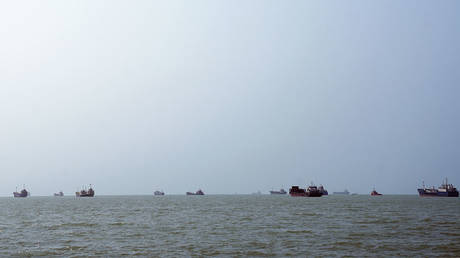
The narrow throat of water separating the Persian Gulf from the Gulf of Oman has become the most dangerous corridor on Earth. When shipping traffic through the Strait of Hormuz ground to a near-total halt following the outbreak of the United States and Israeli air campaign against Iran, global markets reeled from a shock not seen since the oil crises of the 1970s.
Washington insisted that its military pressure would force Tehran to back down, open the maritime bottleneck, and drop its defiant stance. Instead, the confrontation hardened into an intractable maritime siege. Tehran transformed the international shipping lane into a theater of war, deploying sea mines, launching drone attacks against merchant vessels, and asserting absolute sovereignty over waters that were once globally shared.
Understanding why this choke point remains sealed requires moving past the superficial narrative of a simple naval standoff. This crisis is an engineered collision of economic exhaustion, military overextension, and irreconcilable geopolitical demands.
The Miscalculation at the Outset
Before the first airstrikes hit Iranian facilities, military planners in Washington held a fundamental assumption. The conventional wisdom inside the Beltway suggested that any sweeping campaign against Iranian infrastructure would either deter Tehran completely or break its economic backbone swiftly enough to force a quick capitulation.
That premise ignored decades of institutional learning within the Islamic Revolutionary Guard Corps. Iran spent forty years preparing for asymmetric naval warfare in the Persian Gulf. Rather than folding under the weight of foreign air power, Tehran immediately weaponized its geographic advantage.
By choking off the passage through which roughly a quarter of the world's seaborne oil and a fifth of its liquefied natural gas traditionally moved, Iranian leadership created immediate economic pain points for Western administrations. Shipping insurance rates spiked exponentially within days of the initial closure, and energy futures experienced record-breaking monthly surges. Washington discovered that while its military could strike targets ashore, keeping the waterway open against an entrenched adversary laying mines and targeting commercial tankers required a continuous, high-risk naval commitment that strained resources.
The Anatomy of a Dual Blockade
The crisis quickly evolved into an economic war of attrition characterized by a dual blockade. As Iranian forces blockaded the strait to commercial vessels bound for allied nations, the United States Navy retaliated by enforcing a simultaneous blockade on Iranian ports.
Washington aimed to starve Tehran of its vital crude oil export revenue, hoping that immobilized storage capacity would force an internal collapse. Yet this strategy collided with the stark reality of modern commodity routing. Iran pivoted toward alternative regional partners, while its security apparatus treated the closure not as a temporary bargaining chip, but as a permanent strategic asset.
Tehran calculated that holding the strait hostage provided maximum leverage against Western leaders facing domestic political pressures, such as upcoming midterm elections and volatile fuel prices. Every time temporary ceasefires or diplomatic memorandums of understanding were floated, underlying mistrust shattered the agreements almost immediately.
Consider a hypothetical tanker trying to navigate the corridor during a fragile truce: even if regional mediators secure safe passage along a narrow maritime corridor near Oman, the constant threat of sudden naval skirmishes or renewed mine-laying makes commercial operators unwilling to take the risk without exorbitant risk premiums. Insurance underwriters simply refuse to back voyages where the rules of engagement change by the hour.
The Logistics of Exhaustion
Beneath the diplomatic posturing lies a grinding industrial reality. Sustaining high-intensity naval operations in a confined body of water demands staggering amounts of precision munitions and defensive interceptors. Recent Pentagon disclosures highlighted the immense strain placed on global stockpiles of long-range precision missiles and tactical systems.
When a superpower has to choose between depleting its strategic reserves in the Middle East or preserving capability for other global theaters, the math of deterrence shifts. Tehran understands this friction point intimately. Iranian officials have maintained a maximalist list of demands for reopening the waterway—including the complete withdrawal of foreign military assets, full compensation for war damages, and the permanent lifting of economic sanctions.
Washington has attempted to bypass the bottleneck through regional diplomacy, working through intermediaries like Oman to carve out localized shipping corridors while maintaining economic sanctions. Yet Tehran draws a sharp line between administrative discussions over safe passage and the unconditional reopening of the strait itself. One is treated as a humanitarian or regional necessity; the other is guarded as the regime's ultimate defensive shield.
The standoff persists because both sides are trapped by their own escalatory rhetoric. Washington cannot walk away without looking defeated in a critical global maritime hub, and Tehran cannot surrender its primary source of leverage without inviting renewed external assault. As long as these hard boundaries remain fixed, the waters of the Persian Gulf remain hostage to a zero-sum game where neither side can afford to blink first.