The arrival of 1,600 foreign rescue workers in Venezuela following the devastating magnitude 7.2 and 7.5 twin earthquakes looks, on the surface, like a triumph of global solidarity. Underneath the official state television broadcasts showing arriving cargo planes and uniform rows of international personnel lies a chaotic, heavily bottlenecked operation that is actively cost-inducing for the search for survivors. Bureaucratic gridlock, the sudden closure of critical arterial roads by the national government, and a massive discrepancy between official data and ground reality are severely hindering the crucial 72-hour golden window for life-saving rescues.
While interim President Delcy Rodriguez promises that rescuing those trapped beneath the rubble of collapsed coastal high-rises remains the absolute priority, the decision to seal off major transit routes has effectively stranded vital heavy machinery away from the worst-hit zones. International teams from over 17 countries, including the United States, the United Kingdom, Spain, and Colombia, are finding themselves entering a theater where the logistical infrastructure has broken down completely.
The Bottleneck at the Gate
The immediate crisis is not a lack of international will or personnel. It is a failure of local distribution. On Friday evening, the Venezuelan government closed the main highway connecting the capital city of Caracas to La Guaira state, the coastal region bearing the brunt of the structural destruction.
The official justification was clear. Authorities claimed the road needed to be cleared of civilian traffic to allow emergency vehicles and foreign rescue teams unhindered passage. The practical reality on Saturday morning proved starkly different.
National police turned back civilian volunteers who had spent the previous days ferrying supplies and clearing debris. Meanwhile, the older secondary road, the only remaining alternative route, became completely choked with gridlocked traffic. Specialized search teams carrying delicate acoustic listening devices and fiber-optic cameras are getting stuck in traffic jams rather than deploying to unstable concrete ruins.
Without credentials issued directly by the state ministries, access to La Guaira is heavily restricted. This policy effectively sidelines thousands of local volunteers who possess the most valuable asset in an urban disaster: intimate, structural knowledge of the neighborhoods.
The Battle of the Numbers
A dangerous gap has emerged between the data used by the state and the figures compiled by independent networks on the ground. The divergence is massive, altering how international aid allocations are being calculated.
- Official State Tally: The government reports a death toll of roughly 900 people across the affected states, with hundreds officially listed as missing.
- The Opposition Database: A public portal tracked by independent civil groups and opposition networks lists more than 54,000 individuals as completely unaccounted for.
- USGS Projections: The United States Geological Survey modeled structural vulnerability against the twin shocks, estimating that final fatalities could exceed 10,000.
This data mismatch is not merely political posturing. It dictates where foreign assets deploy. If a rescue team relies solely on state-sanctioned damage assessments, they risk ignoring peripheral communities where informal housing structures collapsed without official documentation.
In towns like Morón, close to the epicenter, the electricity grid remained entirely offline well into the weekend. Without power, local communications are dark, rendering it impossible for trapped survivors or their families to register their status on official logs.
When Geopolitics Meets the Rubble
The sheer scale of the disaster has forced unprecedented diplomatic compromises. The United States State Department mobilized $150 million in emergency aid and temporarily eased economic sanctions to facilitate the movement of humanitarian goods. Two US Navy ships and a contingent of military transport aircraft are actively participating in the supply chain.
Yet, this sudden influx of diverse international actors creates its own friction. A multi-national rescue operation requires unified command. When units from El Salvador, the UK, China, India, and the European Union arrive simultaneously, they bring different radio frequencies, distinct operational protocols, and varying structural engineering standards.
+-------------------+-----------------------------------------+
| Nation / Entity   | Dispatched Personnel & Equipment        |
+-------------------+-----------------------------------------+
| United States     | 2 Urban Search Units, 2 Navy Ships      |
| United Kingdom    | 68 Search Specialists, 6 K9 Units       |
| Mexico            | 250 Military Rescuers, 5 K9 Units       |
| European Union    | 520 Responders (Multi-nation alliance)  |
| India             | 41-Member Team, 2 Portable Hospitals    |
+-------------------+-----------------------------------------+
The United Nations has attempted to establish a centralized coordination hub, but the Venezuelan military maintains tight control over field operations. Foreign engineers must wait for state clearance before utilizing heavy excavators, even as family members use their bare hands to dig through shattered concrete apartment blocks in La Guaira.
The Lifespan of the Golden Window
In disaster medicine, the first 72 hours are definitive. After this period, the probability of extracting living survivors drops exponentially. Factors such as dehydration, crush syndrome, and exposure become rapidly fatal.
We are past that critical threshold. While isolated successes exist, such as the rescue of a 15-year-old girl by Salvadoran teams, the broad reality is shifting from an active rescue operation to a recovery and stabilization effort.
The immediate threat to survivors still trapped is matched by a growing security crisis on the surface. Incidents of looting have broken out across several sectors of La Guaira, driven by desperate shortages of drinking water and food. The government responded by deploying 14,000 military and police personnel to patrol the streets, prioritizing security and sanitary enforcement over active excavation.
Technical Deficiencies in the Ruins
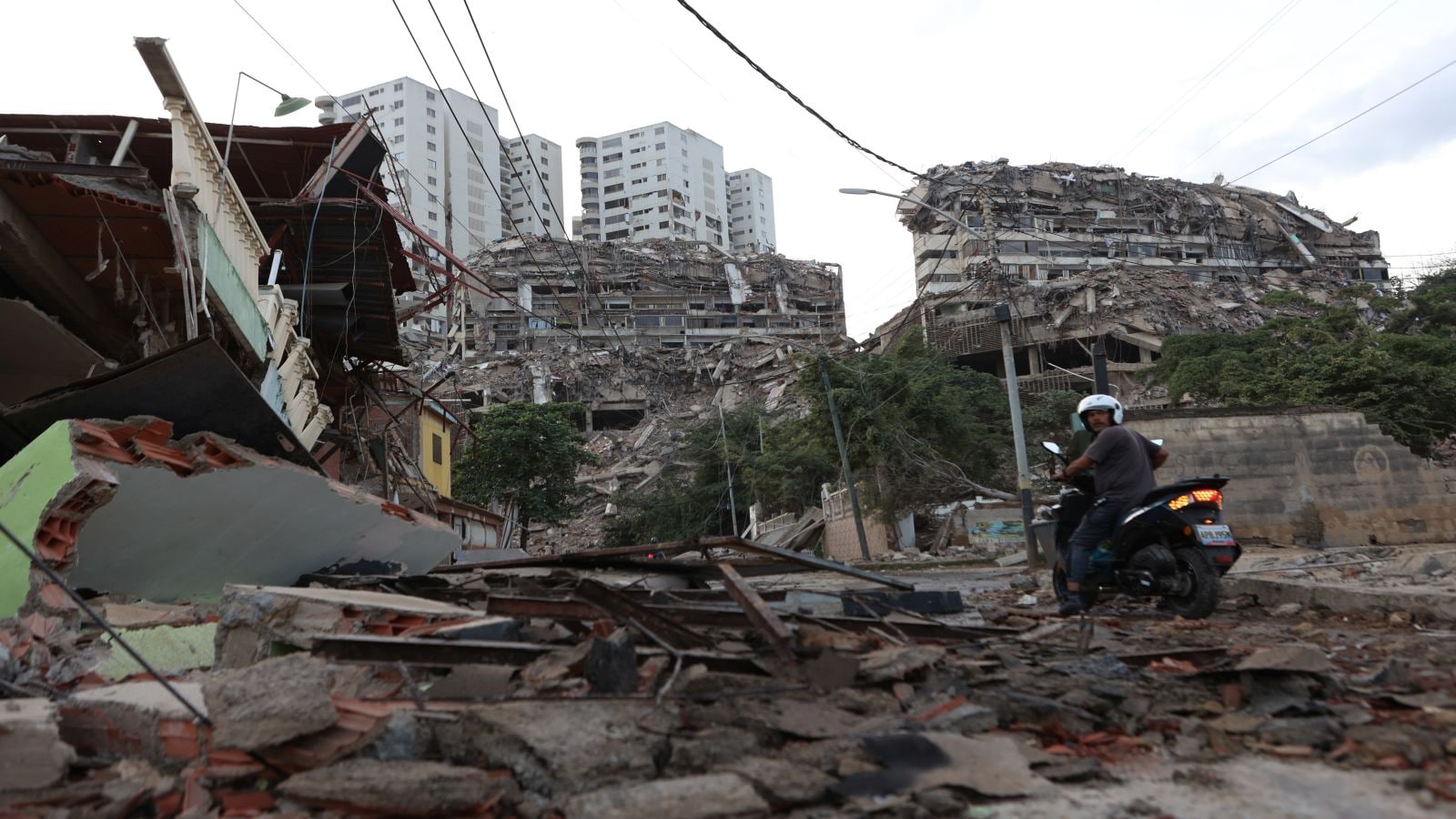
The structural failure observed in La Guaira reveals a deeper systemic issue. Many of the coastal high-rises destroyed were built during economic booms without adequate adherence to modern seismic building codes. When the twin shocks hit, these structures experienced classic pancake collapses, where upper floors drop directly onto lower ones, leaving very few of the structural voids that allow people to survive for days.
International teams brought advanced tools, including the UK’s deployment of specialized drones designed to map compromised roofs and identify thermal signatures. However, these high-tech tools are ineffective if heavy lifting equipment cannot reach the site to clear the top layers of concrete. The lack of heavy cranes and earth-moving machinery remains the single greatest physical barrier to success.
The International Federation of Red Cross and Red Crescent Societies launched an emergency appeal for 50 million Swiss francs to address the medium-term fallout: safe water, sanitation, and disease prevention. This highlights the next impending wave of the crisis. Once the international rescue teams inevitably pack up their gear and head home, the country will face a ruined coastline, an shattered infrastructure network, and tens of thousands of displaced citizens living in temporary camps.
The focus must shift immediately from the optics of arriving foreign flights to the brutal mechanics of ground logistics. If the credentials bottleneck is not resolved and if heavy equipment is not prioritized over military checkpoints, the presence of 1,600 elite international rescuers will remain a squandered resource.