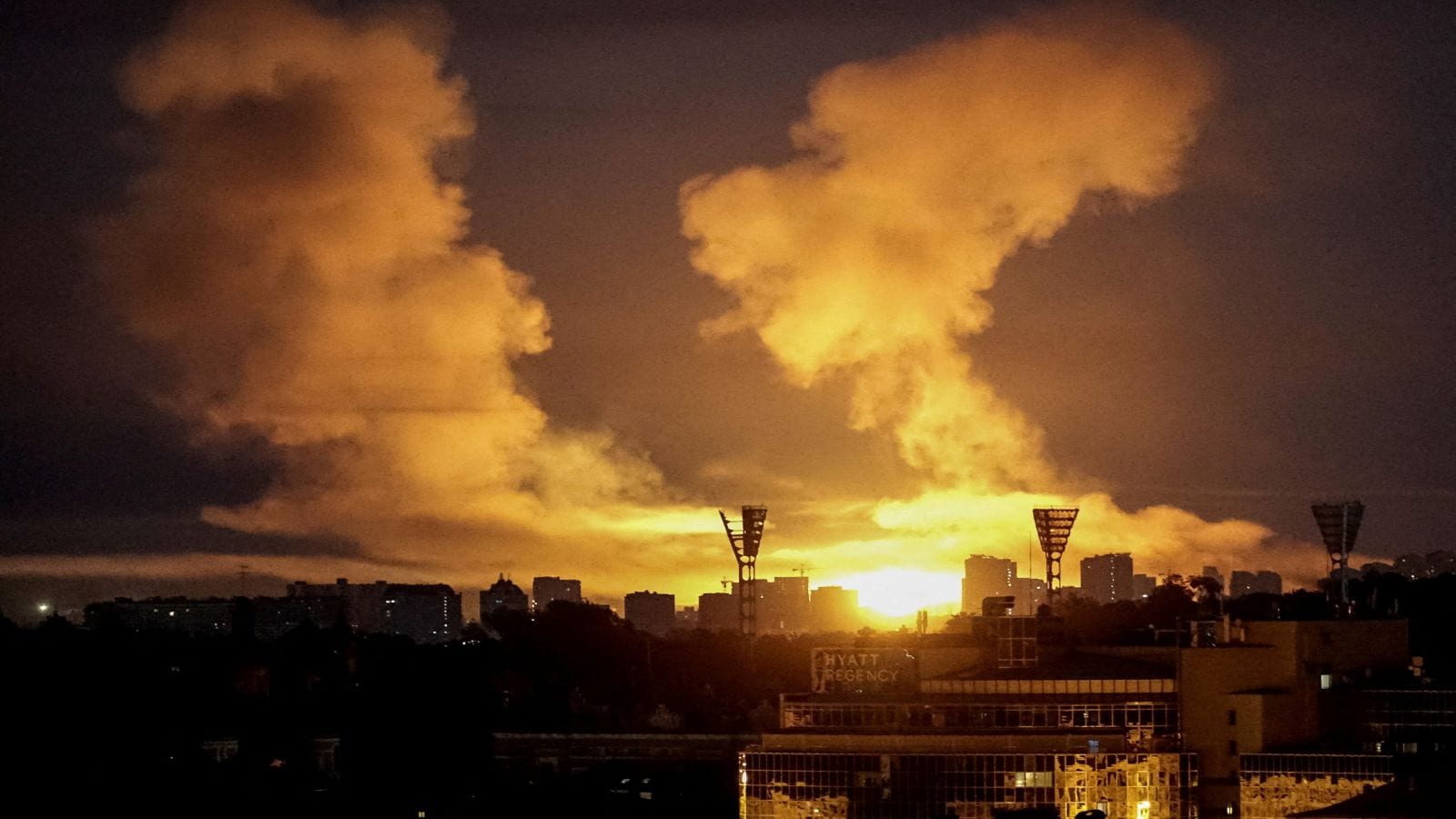
Millions of Ukrainians face an agonizing winter equation where staying means enduring systematically destroyed power grids and sub-zero apartments, while leaving threatens permanent uprooting, shrinking European welfare safety nets, and separation from family. As Russian missile and drone strikes target centralized heating plants and electrical substations, the decision to remain or flee is no longer driven purely by frontline proximity. It has become a cold, logistical calculation of thermal survival, household cash reserves, and the diminishing hospitality of host nations.
The Architecture of Winter Weaponization
To understand why this winter represents a sharper breaking point than previous years of the conflict, look at the shift in targeting doctrine. Early in the full-scale invasion, strikes on Ukrainian infrastructure largely aimed at transmission networks—high-voltage transformers and distribution lines that repair crews could bypass or rebuild within days or weeks. Over successive campaigns, the focus shifted toward base-load generation. Learn more on a connected issue: this related article.
Thermal power plants and hydroelectric facilities cannot be patched with spare parts from a warehouse. Their turbines, boilers, and control systems are bespoke industrial giants that take months or years to manufacture and install. When a thermal plant goes offline in a major industrial center like Kharkiv, Dnipro, or Odesa, the loss is twofold. First, the grid loses massive electrical capacity. Second, because Ukrainian cities rely heavily on district heating—a Soviet-era system where centralized plants pump hot water through underground pipes to entire neighborhoods—losing a power plant simultaneously cuts off municipal heat.
The math is brutal. Without electricity, water pumps fail. Without water circulation, stagnant water inside unheated pipes freezes and expands, rupturing the plumbing infrastructure of entire high-rise apartment blocks. Once those pipes burst, restoring power does not restore habitability. A building with shattered internal plumbing becomes unlivable until spring thaw and massive capital reconstruction. Additional journalism by The New York Times highlights related views on the subject.
Why Leaving Is Harder Than It Was in 2022
In the spring of 2022, crossing the border into Poland, Germany, or the Czech Republic meant stepping into an emergency reception architecture built on unprecedented solidarity. Free rail tickets, immediate housing stipends, and open-ended temporary protection made departure viable even for families with minimal savings.
That safety net has frayed. Across the European Union, host governments facing domestic inflation, housing shortages, and political fatigue have steadily tightened eligibility rules and slashed financial support.
- Housing subsidies have expired or narrowed. Countries like Poland and the Czech Republic have moved away from open-ended state-funded accommodation, requiring refugees to cover rent out of pocket after an initial grace period.
- Labor market friction persists. While millions of Ukrainians have found work abroad, those most vulnerable to a harsh winter—the elderly, the disabled, single mothers with young children, and people with chronic illnesses—are precisely the demographics least able to earn a living wage in Western European rental markets.
- Re-entry penalties complicate seasonal migration. Refugees who returned to Ukraine during milder months often forfeited their host-country registration, housing spots, or benefit tiers, meaning a second departure leaves them starting from scratch in saturated European cities.
For a pensioner in Kyiv or Zaporizhzhia receiving the equivalent of a few hundred dollars a month, fleeing abroad is no longer an option of last resort. It is financially impossible without relatives already established in the West willing to absorb the cost.
The Micro-Economics of Staying Put
Those who remain are adapting through what amounts to decentralized survival engineering. Walking through residential courtyards in central Ukraine before winter sets in reveals an informal economy of resilience. Gasoline and diesel generators sit chained to concrete pillars outside ground-floor shops. High-rise residents pool money to buy inverter systems and lithium-iron-phosphate battery banks, wiring them directly into apartment breaker boxes to keep gas boilers, refrigerators, and routers running during twelve-hour blackouts.
Yet this adaptation has created a stark energy class divide.
Consider a hypothetical example of two families living in the exact same sixteen-story panel building in Kyiv. The first family works in the tech sector or earns stable wages. They spent two thousand dollars over the summer on a high-capacity inverter, two battery modules, and a portable camp stove. When the grid drops, their apartment loses elevator access and overhead lighting, but their internet stays live, their food stays cold, and they can boil water.
Two floors down, a retired couple living on a fixed state pension has none of that hardware. When the power cuts out, their electric stove dies, their tap water stops flowing because the building's booster pumps lack power, and their apartment temperature drops steadily toward freezing. For them, winter is not an inconvenience managed by apps tracking outage schedules. It is a physical siege.
The High-Rise Trap
Urban density turns blackouts into acute logistical crises. In rural villages across western or central Ukraine, residents often have wood-burning stoves, private wells, and root cellars. A power outage stops the television, not basic survival.
In cities, modern life depends entirely on uninterrupted municipal services. When elevators stop running in twenty-story buildings, elderly or mobility-impaired residents become prisoners in their own apartments. Carrying five-liter jugs of water up fifteen flights of stairs in the dark becomes a daily endurance test. Municipal authorities have set up heated tents and public shelters—known as Points of Invincibility—equipped with generators and satellite internet, where people can warm up and charge phones. These hubs prevent immediate freezing deaths, yet they cannot replace a functioning home over four months of winter.
The Demographic Dilemma Keeping Men and Families Anchored
Martial law regulations barring most men aged eighteen to sixty from leaving the country remain the single heaviest anchor holding families in place. For millions of women, leaving Ukraine to escape a freezing apartment means splitting the household indefinitely, with no clear timeline for reunion.
Many women who fled with their children in 2022 returned in 2023 and 2024 specifically because prolonged separation was tearing their families apart. Children struggled to adapt to foreign school systems while simultaneously trying to keep up with Ukrainian online curricula. Marriages strained across time zones. Facing a choice between a warm apartment in Germany alone or a cold apartment in Lviv together, thousands chose the cold.
This emotional calculus is reinforced by deep-seated skepticism about returning later. Many Ukrainians fear that if they leave now, their empty apartments will be vulnerable to looting, squatters, or unaddressed water damage from burst pipes. Staying becomes an act of property preservation and community defense. Local businesses stay open on generator power not because running a cafe on diesel is profitable—fuel costs often eat the entire margin—but because closing signals surrender and accelerates neighborhood abandonment.
What European Capitals Are Watching
Western policymakers and humanitarian agencies track border crossing numbers closely every autumn, looking for signs of a massive new wave of displacement. So far, the mass exodus predicted by worst-case models has largely failed to materialize, replaced instead by internal displacement.
Rather than crossing into Poland or Slovakia, families from heavily damaged eastern and southern regions—such as Donetsk, Kharkiv, and Kherson oblasts—are migrating toward western Ukrainian cities like Lviv, Ivano-Frankivsk, and Uzhhorod. These areas sit further from Russian launch sites and benefit from stronger cross-border electrical interconnectors with the European Union grid.
However, internal migration carries its own breaking points. Rent prices in western Ukraine have surged, pricing out displaced families whose savings have been depleted by years of war. Shelters and dormitories converted into housing for internally displaced persons are operating near capacity. If Russian strikes successfully sever the high-voltage transmission lines linking western Ukraine to the central and eastern grids, even these relative safe havens will face severe rationing.
The Grid's Asymmetric Race Against Time
Behind the scenes, Ukrainian energy engineers and Western donors are locked in a race defined by asymmetrical economics. An attack drone or cruise missile costs a fraction of the air defense interceptor required to shoot it down, and an infinitesimal fraction of the transformer or turbine it destroys.
To counter this, Ukraine's energy sector has scrambled to implement three primary defenses:
- Physical fortification. Crews have encased critical substations in massive concrete bunkers, gabion walls filled with sand, and steel anti-drone netting designed to detonate warheads before they reach sensitive oil-filled transformers.
- Distributed generation. Instead of relying on a handful of giant power plants that serve as easy targets, energy companies and municipalities are installing dozens of smaller, decentralized gas-piston and gas-turbine generators. Knocking out ten small units requires ten times the munitions needed to destroy one massive plant.
- European grid synchronization. Ukraine synchronized its power grid with the continental European network (ENTSO-E) just weeks after the 2022 invasion. Expanding the physical import capacity allows Ukraine to draw emergency megawatts from neighboring countries during peak winter demand, provided the internal transmission lines remain intact to carry that power east.
None of these measures guarantees uninterrupted warmth. Concrete bunkers cannot stop heavy ballistic missiles. Distributed gas turbines take time to procure, ship, and hook into municipal networks, and they depend on uninterrupted natural gas supplies. Importing electricity from Europe is expensive and capped by physical wire limits.
A Choice Without a Safe Option
Strip away the geopolitical rhetoric, and the winter decision facing ordinary Ukrainians comes down to risk management under conditions where every option carries severe penalties.
Leaving offers physical warmth and safety from aerial bombardment, yet it demands surrendering social standing, draining remaining savings in expensive foreign economies, and fracturing family structures for an unknown duration. Staying preserves family unity, employment, and community ties, while exposing households to dark, freezing apartments, failing municipal water systems, and the constant psychological grind of air raid sirens.
Most Ukrainians who remain have already made their calculation. They have taped their windows against blast waves, stocked shelves with canned goods and bottled water, wired battery packs into their walls, and decided that enduring the dark at home is preferable to starting over as a stranger abroad.