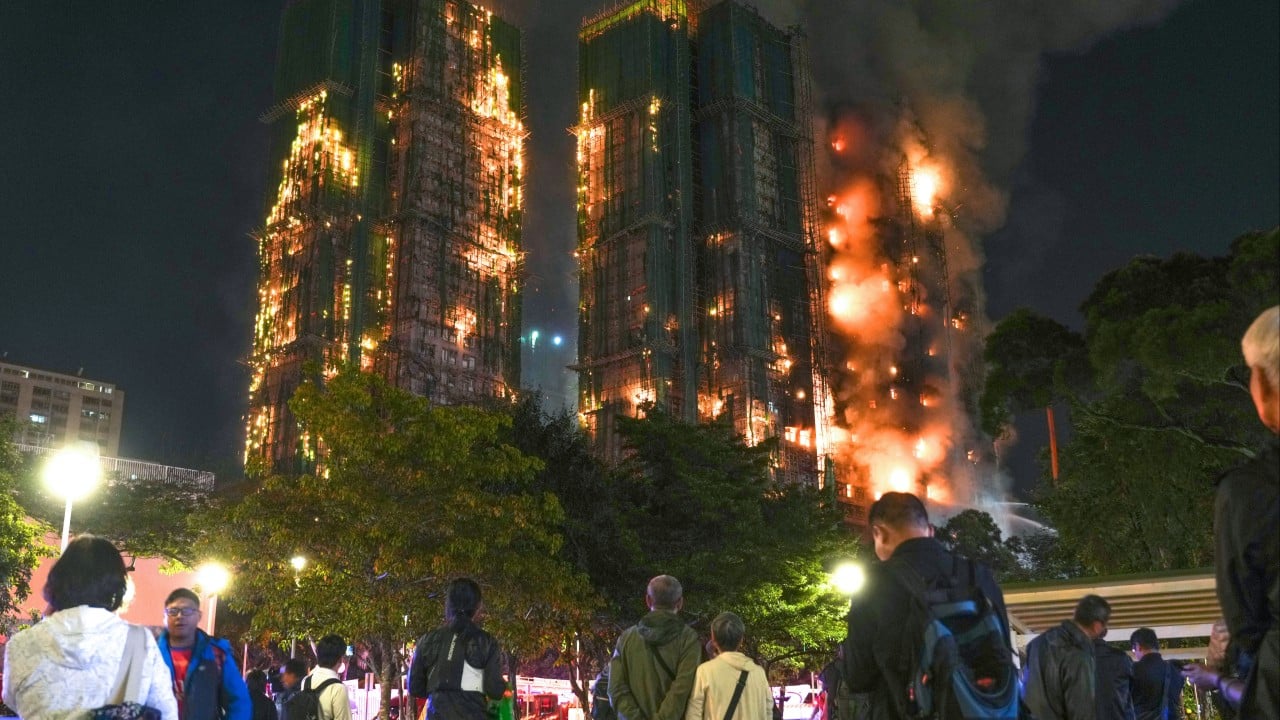
The failure of fire safety oversight in high-density urban environments is rarely a product of missing regulations; it is an emergent property of jurisdictional fragmentation. In the wake of the Tai Po probe, the systemic collapse of accountability highlights a fundamental disconnect between the Housing Department, the Fire Services Department (FSD), and the Buildings Department. This is not merely a bureaucratic overlap but a "structural blind spot" where the velocity of urban decay outpaces the statutory agility of the governing bodies.
The Triad of Jurisdictional Inertia
The primary driver of oversight failure in Hong Kong’s older residential districts is the misclassification of responsibility across three distinct domains. When an incident occurs, the post-mortem typically reveals that each agency operated within its narrow mandate while ignoring the interstitial risks.
- The Regulatory Domain (FSD): Responsible for the maintenance of fire service installations (FSI) such as hydrants, sprinklers, and hoses. Their focus is technical and hardware-centric.
- The Structural Domain (Buildings Department): Responsible for the "passive" fire safety elements, including means of escape, fire-rated doors, and unauthorized building works (UBWs).
- The Management Domain (Housing Department/Home Affairs): Responsible for the human element—coordinating owners’ corporations and ensuring that common areas remain unobstructed.
The Tai Po investigation confirms that when these three domains fail to synchronize, a "responsibility vacuum" forms. For instance, the FSD may certify that a fire extinguisher is functional (Technical compliance), while the Buildings Department ignores that the door it is mounted on is blocked by illegal partitioning (Structural failure), and the Housing Department fails to identify that the building management has no protocol for evacuation (Management failure).
The Economic Incentive for Non-Compliance
To understand why fire safety fails, one must quantify the cost of compliance versus the probability of enforcement. In high-density districts like Tai Po, the economic profile of "tong lau" (tenement buildings) creates a perverse incentive structure.
- The Compliance Ceiling: For many low-income owners or subdivided flat operators, the cost of upgrading a building to modern Fire Safety (Buildings) Ordinance standards can exceed 20% of the property’s total equity value.
- The Enforcement Gap: The Buildings Department issues thousands of Fire Safety Directions annually, yet the rate of compliance remains low because the legal penalties are often cheaper than the physical repairs.
- Asset Depreciation: There is a logical hesitation to invest in "passive" fire safety (like widening stairwells) because it reduces the rentable square footage of a subdivided unit, directly hitting the landlord’s ROI.
This creates a scenario where the government’s insistence on "self-management" by owners’ corporations is fundamentally flawed. You cannot expect a volunteer board of elderly residents to navigate the technical specifications of the Fire Safety Ordinance without external project management and significant capital subsidies.
The Mechanics of "Passing the Parcel"
The Tai Po probe reveals a specific failure in the Referral Mechanism. When one department identifies a risk outside its jurisdiction, the process of referring that risk to the "correct" department is slow and lacks a tracking loop.
This systemic friction is defined by three bottlenecks:
I. The Definition of "Urgency"
The FSD operates on a life-safety immediate risk model. The Buildings Department operates on a structural stability model. If a corridor is narrowed by illegal construction, the FSD might view it as a secondary obstruction, while the Buildings Department might view it as a low-priority "non-dangerous" structure. Because the definitions do not align, the risk is downgraded during the transfer.
II. The Documentation Lag
Current oversight relies on physical inspections and manual filing. By the time an inspection report from the FSD reaches the Buildings Department for a joint-action operation, the site conditions may have changed, or the "responsible person" (landlord or tenant) may have vacated the premises.
III. The Absence of a Single Point of Accountability
Under the current framework, no single official is responsible for the total fire safety profile of a building. Instead, three different officials are responsible for three different sub-systems. This allows for "jurisdictional arbitrage," where agencies defend their lack of action by citing the limits of their statutory power.
Quantifying the Risk of Subdivided Units (SDUs)
Subdivided units represent the ultimate stress test for fire oversight. These units increase the "occupancy load" of a building far beyond its original design capacity. The Tai Po probe underscores that the current inspection regime does not account for the heat release rate (HRR) of modern domestic materials in high-density settings.
The fire load in an SDU is exponentially higher due to:
- Partitioning Materials: Often made of non-fire-rated timber or low-quality gypsum.
- Electrical Overload: Single circuits forced to power multiple air conditioning units, cooktops, and water heaters, increasing the probability of electrical fires.
- Blocked Egress: The very nature of "subdividing" involves creating corridors that are too narrow for two-way traffic during a panic-induced evacuation.
The Data-Driven Solution: Unified Risk Scoring
To move beyond the "confusion" cited in the Tai Po probe, Hong Kong requires a transition from Mandate-Based Oversight to Risk-Based Oversight. This involves the implementation of a Unified Fire Risk Score (UFRS) for every aging structure.
A UFRS would aggregate data points into a single metric:
- Age of Building (Proxy for structural decay).
- FSI Maintenance History (Binary: Pass/Fail).
- Number of Outstanding UBW Orders (Quantified by severity).
- Socio-economic Density (Based on postal data or electrical consumption spikes).
Instead of waiting for an annual inspection, buildings with a UFRS above a certain threshold would trigger a "Joint Task Force" intervention. This eliminates the need for referrals because the high score automatically mandates a multi-departmental raid.
Reforming the Owners' Corporation Model
The reliance on Owners' Corporations (OCs) to manage fire safety is a legacy strategy that no longer fits the reality of urban decay. Many buildings in Tai Po and Sham Shui Po are "three-nil" buildings: no owners' corporation, no residents' organization, and no property management company.
The state must intervene by treating fire safety as a Public Good rather than a private property obligation. This requires:
- Direct Government Tendering: The government should perform the fire safety upgrades itself and then place a charge on the property titles to recover the costs over 10-20 years.
- Statutory Professional Management: Mandatory appointment of licensed property managers for buildings over 50 years old, with the manager held personally liable for fire safety compliance.
The Institutional Pivot
The confusion identified in the Tai Po probe is a symptom of an antiquated organizational structure trying to manage a 21st-century urban crisis. The solution is not more "coordination meetings" or "inter-departmental memos." It is the legislative consolidation of fire safety powers under a single Urban Safety Authority.
This new entity would absorb the Fire Safety sections of the Buildings Department and the FSD, creating a unified inspectorate with the power to issue fines, order immediate structural remediation, and manage the procurement of safety upgrades. Until the jurisdictional silos are physically merged, the "responsibility vacuum" will continue to be filled by smoke and debris.
The strategic imperative is clear: Remove the "referral" step from the safety equation. If an inspector sees a blocked exit, they must have the power to clear it, fine the owner, and order the structural repair regardless of which department "owns" the wall. Efficiency in life safety is measured by the time between detection and remediation; the current multi-agency model is a deliberate obstacle to that speed.