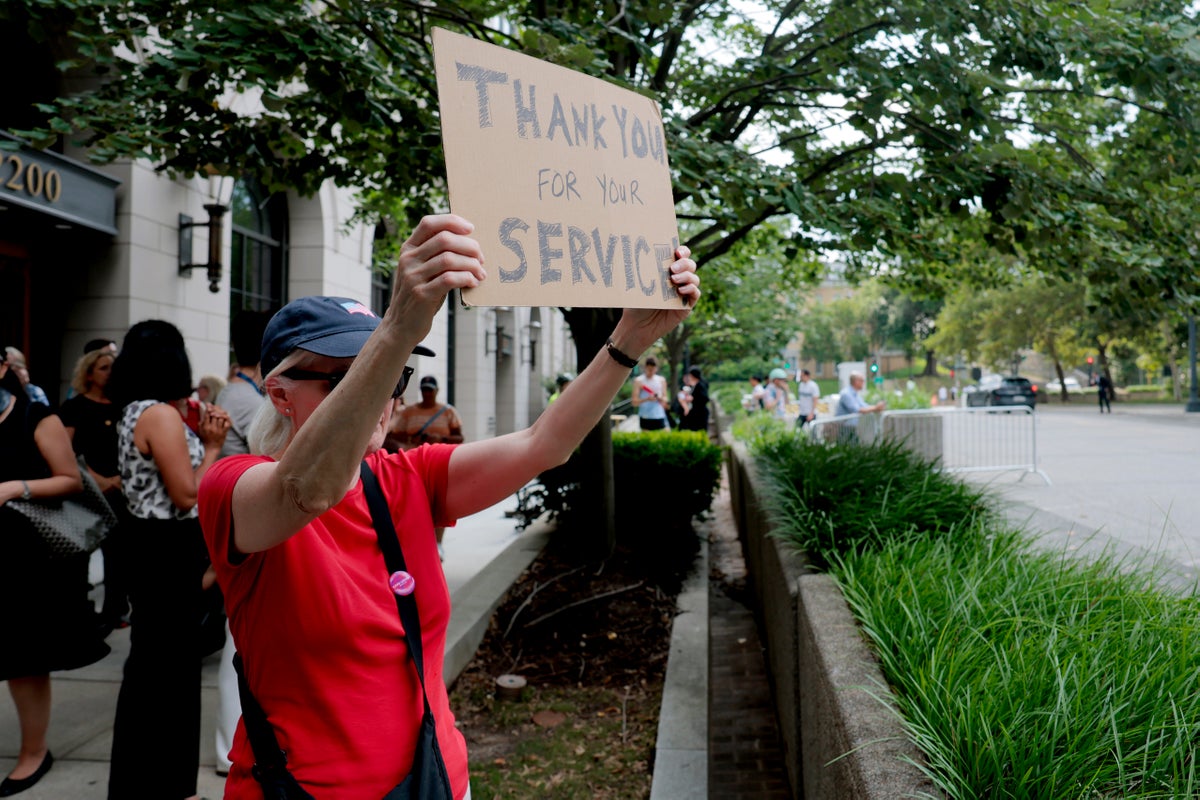
The "Sammies"—formally the Samuel J. Heyman Service to America Medals—function as the premier non-partisan validation mechanism for the United States federal workforce. When the Partnership for Public Service reports a significant decline in the quantity and quality of nominations during a specific presidential administration, it signals a breakdown in the Incentive-Recognition Loop that sustains the civil service. This phenomenon is not merely a matter of political optics; it is a measurable shift in the operational psychology of the federal bureaucracy.
To understand why a non-partisan awards body would struggle to find "winners" under the Trump administration, one must analyze the structural friction between executive-led "Deconstruction of the Administrative State" and the traditional metrics of bureaucratic excellence.
The Mechanism of Disincentivization
The scarcity of award-worthy nominations is the logical output of three distinct institutional pressures. These pressures act as a filter, removing the high-impact projects that typically populate the Sammies’ shortlist.
- Project Life-Cycle Interruption: Federal innovation requires multi-year stability. Significant breakthroughs in public health (CDC), aerospace (NASA), or infrastructure (DOT) often span multiple administrations. When an administration initiates mass budgetary rescissions or pivots away from long-term scientific objectives, the "completion" phase of these projects—the point at which they become eligible for recognition—is never reached.
- The Visibility Paradox: For a career civil servant, winning a high-profile award during a period of intense executive scrutiny on "Deep State" actors introduces significant career risk. The Sammies celebrate individuals who have navigated the system to achieve results. In an environment where the "system" itself is framed as the antagonist by the Chief Executive, public recognition becomes a liability rather than an asset.
- Leadership Vacuum in Senate-Confirmed Roles: Awards require nominators. Historically, the highest volume of quality nominations comes from political appointees who want to showcase the efficacy of their agencies. The Trump administration’s reliance on "Acting" officials and its slower pace of filling key leadership positions created a vacuum in the advocacy layer of the hierarchy. Without a permanent Secretary or Undersecretary to champion an initiative, the administrative labor required to submit a competitive nomination package remains unperformed.
The Taxonomy of Bureaucratic Value
A functional meritocracy requires an agreed-upon definition of "value." The Sammies traditionally reward efficiency, cost-saving, and public impact. However, the Trump administration’s metric for value shifted toward Compliance and Deregulation.
- Metric Shift A: Efficiency vs. Deletion: If an agency’s mandate is to reduce its own footprint, a civil servant who streamlines a process is less valuable to the executive than one who removes the process entirely. The former is a Sammies-style win; the latter is a political objective that often lacks the "public service" narrative required for a non-partisan award.
- Metric Shift B: Risk Aversion as a Survival Strategy: In high-stakes agencies like the Department of Justice or State Department, the "optimal" performance under high political volatility is the maintenance of the status quo. Innovation—the primary driver of award nominations—requires a level of psychological safety that is absent when civil service protections (such as Schedule F) are under threat.
The Cost Function of Recognition Scarcity
The inability to identify and celebrate top performers creates a measurable "brain drain" effect, which can be quantified through the lens of Human Capital Flight. When the recognition loop breaks, the following economic and operational costs accrue:
Replacement Cost and Institutional Memory Loss
The cost to recruit, vet, and train a GS-14 or GS-15 level employee is estimated at 1.5x to 2x their annual salary. More critically, the loss of "Institutional Memory"—the unwritten knowledge of how to navigate complex regulatory frameworks—creates a drag on agency velocity. If the best workers feel their contributions are invisible or politically radioactive, they exit to the private sector, taking that "Intellectual Property" with them.
The Erosion of Recruitment Brand Equity
The Sammies serve as a marketing tool for the federal government to compete with Silicon Valley and Wall Street for top-tier talent. When the awards cycle founders, the "Employer Brand" of the U.S. Government depreciates. High-potential graduates from elite policy and engineering programs view the federal government not as a platform for impact, but as a stagnant environment where excellence is ignored or punished.
The Conflict of Agency and Executive Intent
The Partnership for Public Service operates on the assumption that "good government" is a non-partisan objective. This assumption fails when the executive branch views the "administrative state" as a competitor for power rather than a tool for governance.
In this framework, the Sammies are caught in a Principal-Agent Problem.
- The Principal (The Taxpayer/Public): Wants efficient, expert-led services.
- The Agent (The Civil Servant): Wants to provide these services and be recognized for expertise.
- The Intermediary (The Executive Branch): May have a mandate to disrupt the Agent’s ability to function.
When the Intermediary actively discourages the Agent's autonomy, the "service" being measured by the awards group becomes a form of resistance. An award for a scientist who protected climate data, for example, would be seen by the Partnership as "service to America," but by the White House as "insubordination." This misalignment makes the selection of "winners" a political minefield that many organizations simply cannot navigate without losing their non-partisan status.
Structural Decay in the Nomination Pipeline
The decline in nominations is also a symptom of Administrative Atrophy. The process of submitting a candidate for a service medal is labor-intensive, requiring narrative writing, data verification, and multiple levels of internal clearance.
Under the Trump administration, several agencies underwent forced relocations (e.g., USDA’s ERS and NIFA moving to Kansas City) or significant staffing cuts. When an agency is in "survival mode," the administrative bandwidth for non-essential tasks like award nominations evaporates. The "High-Performance Culture" required to sustain an awards program is replaced by a "Maintenance Culture" focused on basic task completion and risk mitigation.
Quantifying the Silent Exit
The "Hard Time Finding Winners" headline is a lagging indicator of a broader trend: The Quiet Exit of the Expert Class. Data from the Office of Personnel Management (OPM) during the 2016-2020 period showed a disproportionate exit rate among "highly specialized" roles in scientific and technical fields.
If the pool of eligible "impact players" shrinks, the probability of finding a Sammie-level winner decreases exponentially. This is not because the remaining workers are incompetent, but because the Impact Ceiling has been lowered. A civil servant cannot win an award for a breakthrough they were never allowed to start, or for a program that was defunded in its second year.
Strategic Reconstitution of Federal Meritocracy
To restore the validity of federal recognition programs, the definition of "service" must be decoupled from the immediate political priorities of the executive branch. This requires a three-pronged approach to institutional stabilization:
- Legislative Fortification of Civil Service Protections: For excellence to be visible, it must be safe. Codifying protections against the reclassification of career roles into political appointments (preventing "Schedule F" style maneuvers) is a prerequisite for a healthy nomination pipeline.
- Decentralized Recognition Metrics: Awards bodies must move beyond "Agency-Head Approval" models. By integrating peer-nomination systems and third-party data audits (such as measuring cost-savings via GAO reports), organizations can identify winners even in agencies where political leadership is hostile to the mission.
- Long-Term Funding Cycles: By shifting critical research and infrastructure projects to five or ten-year mandatory funding cycles, the government can insulate the "Impact Lifecycle" from the volatility of four-year political cycles. This ensures that projects reach the maturity required for national recognition.
The crisis of the Sammies is a warning. A government that cannot celebrate its best workers will eventually find itself without them. The strategy for the next decade must focus on rebuilding the "Status Economy" of the civil service, ensuring that expertise is not only preserved but publicized as a core component of national security and economic stability.