We have all stood before the open refrigerator door at midnight, holding a package of chicken or ground beef, staring at a printed calendar date.
The label says today. The nose says maybe. The gut says don't risk it.
So what do we do? Most of us throw it away. Billions of pounds of perfectly edible protein vanish into municipal landfills every single year, sacrificed to a system of food safety that relies on an arbitrary stamp of ink rather than reality. We treat expiration dates like absolute laws of physics, when in truth, they are nothing more than educated guesses scribbled in advance.
Rot doesn't follow a calendar. It follows temperature fluctuations, microscopic breaches in packaging, humidity, and time. It is a biological race between invisible bacteria multiplying in the dark and the human senses trying desperately to catch up before disaster strikes.
For most of human history, we smelled our way through survival. We sniffed. We poked. We doubted. We gambled.
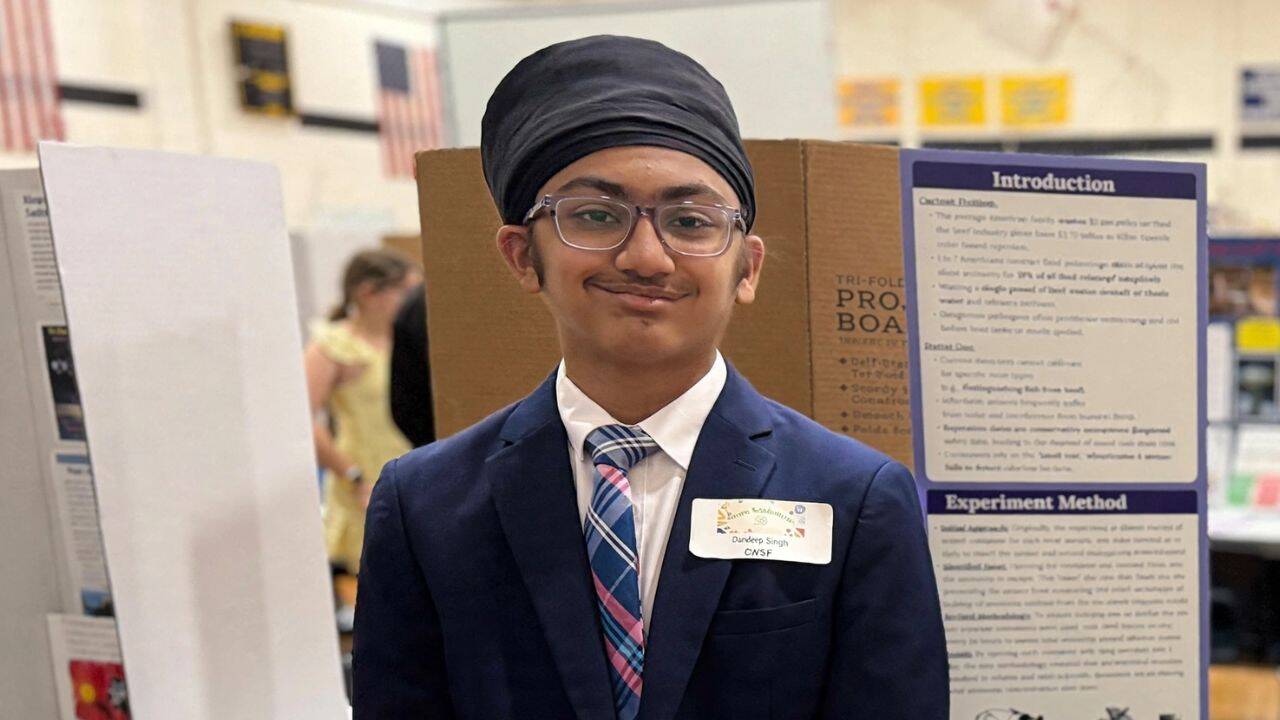
Then came a student named Sartaj Singh Gandhi, who looked at this ancient gamble and decided it was entirely unacceptable.
Consider what happens inside a package of meat long before the human nose can detect a hint of sulfur or sourness. Spoilage bacteria—organisms like Pseudomonas or lactic acid bacteria—begin to colonize the protein. As they feed and multiply, they do not merely change the texture; they release volatile organic compounds, amines, and other chemical signatures into the trapped air of the container.
They talk in molecules. Sartaj Singh Gandhi wanted to listen.
He didn't come at the problem from the vantage point of a corporate boardroom or a multi-million-dollar laboratory with endless grants. He approached it with the relentless curiosity of a young mind looking at a broken world and asking a very simple, dangerous question: Why do we just accept this?
What he built was not just a sensor. It was a translator.
By engineering a low-cost, highly sensitive detection mechanism capable of identifying the specific chemical gases emitted by decaying meat, Sartaj created a bridge between invisible decay and human awareness. Imagine a tiny, unassuming indicator patch integrated directly into food packaging. As the meat begins its silent descent past the threshold of safety, the chemistry of the package shifts. The sensor registers the rise in biogenic amines. It changes.
No guessing. No sniffing raw poultry like a nervous detective. No throwing away a $15 steak just because the calendar rolled over to a new Tuesday.
To understand why this matters so deeply, you have to step outside the gleaming aisles of modern supermarkets and look at the broader architecture of our global food supply. Food waste is not merely an economic inefficiency; it is a profound moral dissonance. While millions go hungry, mountains of unspoiled food rot in bins because our safety metrics are too crude to tell the difference between "spoiled" and "safe." Conversely, millions of people fall victim to foodborne illnesses annually—pathogens like Salmonella, E. coli, and Listeria that do not always announce their presence with a foul odor.
A nose can fail. A printed date can lie. A molecular sensor does neither.
Sartaj’s work represents a shift away from static metrics toward dynamic truth. In technology, we obsess over speed, processing power, and connectivity, often forgetting that the most revolutionary innovations are the ones that quietly touch our most fundamental, daily vulnerabilities. We want smart homes and faster phones, but what about smart packaging that protects a child from food poisoning before they take their first bite?
This is where the true brilliance of the invention lies: its accessibility. A sophisticated laboratory spectrometer can detect meat spoilage with ease, but it is useless to a mother in a remote kitchen, a backpacker on a trail, or a grocer trying to manage inventory in a developing nation. By focusing on practical, scalable engineering, Sartaj bridged the chasm between high-end analytical chemistry and everyday life.
We live in an era that loves to celebrate disruption, yet true disruption is rarely loud. It does not wear a hoodie or pitch venture capitalists on a stage. Sometimes, it looks like a teenager in a workshop, tinkering with circuit boards and chemical reactions, refusing to accept that the way things have always been done is the way they always have to be.
The next time you stand in front of that refrigerator, holding a package of meat and wondering about the invisible clock ticking away inside the plastic wrapper, remember that the future is already being rewritten.
The guesswork is ending. The era of silent safety has begun. And it was unlocked not by a massive corporation, but by a student who simply decided to pay attention to what the air was trying to tell us.