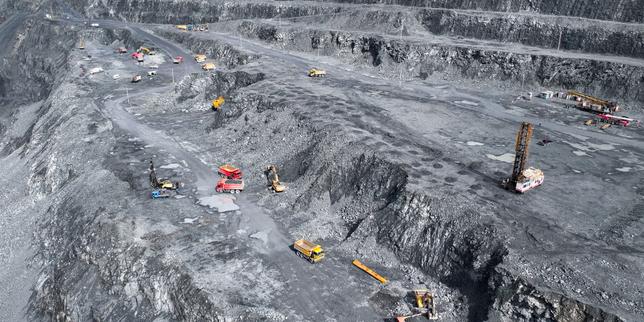
The air inside the processing plant smells faintly of sulfur and scorched metal. If you stand near the loading docks, the sound of heavy machinery vibrates right through the soles of your boots, a low, rhythmic thrumming that never stops.
To the casual observer, this is just heavy industry at work. But to people like Elena, a supply chain strategist who has spent the last decade tracking how raw earth transforms into high-tech machinery, this room represents the front line of a quiet, global chess match. She spends her days staring at spreadsheets that track the movement of rocks—specifically, lithium, nickel, cobalt, and rare earth elements. These are the building blocks of every electric vehicle battery, every wind turbine, and every smartphone on the planet.
For years, the public narrative surrounding the green energy transition has been remarkably sunny. We are told that we are moving away from the dirty, conflict-ridden geopolitics of oil and gas toward a clean, democratized future powered by the sun and the wind.
But there is a sharp disconnect between that clean vision and the gritty reality of global logistics.
The International Energy Agency recently released data that pulled back the curtain on this transition. The numbers reveal a stark truth that many in the industry have quietly feared. While the world is pouring staggering amounts of money into digging up these critical minerals, the actual production and refining of these materials is not becoming more diversified.
It is doing the exact opposite. It is concentrating into fewer, more powerful hands.
The Illusion of Abundance
Walk into any modern automotive boardroom, and you will hear executives talking about the massive capital they are deploying. Investment in critical mineral development has soared. Billions of dollars are rushing into new mining projects from Australia to Chile. On paper, it looks like a boom. We are digging more out of the earth than ever before.
But mining the rock is only the first step of a long, fragile journey.
Consider what happens next. A chunk of spodumene ore mined in Western Australia cannot simply be dropped into a Tesla or an iPhone battery. It is essentially useless in its raw form. It must be crushed, treated with acid, heated to extreme temperatures, and chemically converted into battery-grade lithium hydroxide.
This chemical refining process is where the grand narrative of a diversified green future falls apart.
The IEA’s findings highlight a unsettling trend: the geographic concentration of refining operations is actually intensifying. A single nation dominates this middle tier of the supply chain. China now processes the vast majority of the world’s synthetic graphite, refines over two-thirds of its lithium, and controls an overwhelming share of the processing capacity for cobalt and rare earths.
Elena keeps a map on her office wall, marked with colored pins representing processing facilities worldwide. Nearly all the pins cluster in a few specific provinces.
"We built a system where we think we are independent because we buy the raw rocks from a friendly neighbor," she says, pointing to a pin in Australia. "But then we ship those rocks thousands of miles away to be refined, because no one else has the infrastructure, the environmental permits, or the cheap energy to do it at scale. If that middle link breaks, the whole chain snaps."
This is not a theoretical problem. It is a structural bottleneck that dictates the pace of the global energy shift.
The Cost of the Bottleneck
To understand why this concentration matters to the average consumer, you have to look at how market volatility ripples down to the window sticker of a new vehicle.
When a single region controls the refining of a vital component, any disruption—a power shortage, a sudden regulatory shift, or a geopolitical disagreement—sends shockwaves through the market. We saw a preview of this when lithium prices spiked dramatically a few years ago, forcing automakers to raise the prices of electric vehicles just as they were trying to make them affordable for the masses.
Prices have since cooled, but the underlying vulnerability remains unchanged.
The market operates on a razor's edge. Because building a chemical refining plant takes years of planning, massive capital, and intense regulatory scrutiny, Western nations cannot simply build their way out of this corner overnight. The IEA notes that despite heavy government subsidies in the United States and Europe aimed at bringing supply chains back home, the market share of the dominant players has actually grown or held firm in several key sectors.
The reality is stubborn. The West has the ambition, but the East has the infrastructure, the specialized labor force, and the decades of operational experience.
The Human Element in the Clean Energy Race
We often talk about these dynamics in the abstract language of economics: supply curves, trade deficits, and metric tons. But behind every statistic is a human story of reliance and risk.
Think of a manufacturing manager in Ohio, tasked with keeping an electric delivery van assembly line running. He does not think about geopolitical strategy in the abstract. He thinks about the container ships delayed at a port, or the sudden notice from a supplier that a specific grade of refined anode material is delayed by three weeks.
When those delays happen, the line stops. Workers are sent home. The transition slows down.
There is a profound irony at play. The global push toward clean technology was supposed to break our reliance on volatile petrostates. We wanted to move away from a world where a decision made in a single foreign capital could cause gas prices to skyrocket at local pumps. Yet, in our haste to build a new energy economy, we have constructed a system that relies on an even tighter, more concentrated choke point.
The challenge is not that the earth is running out of these minerals. The crust of our planet holds plenty of lithium, copper, and nickel to power the transition. The true scarcity is not geological. It is industrial.
The Path Forward Requires Friction
Fixing this imbalance will not be easy, nor will it be cheap.
For governments and corporations looking to break this hold, the path forward requires accepting a difficult truth: diversifying the supply chain means paying a premium. Building processing plants in regions with stricter environmental laws, higher wages, and more rigorous safety standards means the end product will cost more.
It means choosing resilience over rock-bottom prices.
Automakers are beginning to realize this. Some are bypassing traditional suppliers entirely, striking direct deals with junior mining companies and investing directly in domestic refining startups. They are becoming chemical companies out of sheer necessity.
Elena looks back at her map, studying the vast, empty spaces where new pins need to be placed if the world wants a truly stable energy future. It is a daunting task, requiring hundreds of billions of dollars and decades of sustained effort.
The transition to a cleaner world is well underway, and the momentum is irreversible. But the journey will not be smooth, and it will not be free from the old, familiar struggles of global power and resource dominance. The rocks beneath our feet are changing the world, but only if we can figure out how to share the keys to the factory floor.