The morning air over the Champ de Mars carried a bitter chill that bit straight through wool coats and thick scarves. Thousands of people converged on the iron lattice of the Eiffel Tower, breathing clouds of white vapor into the gray Parisian dawn. Tourists clutched crumpled tickets like lottery stubs holding no prize. Staff members stood behind closed gates, shrugging shoulders wrapped in heavy parkas.
Iron does not care about schedules. But human hands, refusing to pull levers or check tickets, can bring a monument of steel to a dead standstill.
For the first time in memory, Paris stood paralyzed not by a general transit strike, not by political riots in the Place de la République, but by a sudden, total labor walkout sparked by an unfamiliar name echoing off the stone quays of the Seine.
BAPS.
To the average commuter dodging puddles near the Trocadéro, the acronym sounded clinical. Foreign. Abstract. Yet beneath that bureaucratic shell lay a sprawling global spiritual movement with roots stretching thousands of miles away from France, deeply embedded in the ancient soil of Gujarat, India.
Consider what happens next: a visitor from Lyon looks up at the locked elevators, frustrated, while thousands of miles eastward, a craftsman in a dusty workshop chisels a block of pink sandstone with absolute, meditative precision. The strike in Paris was never just about wages or local labor disputes. It was a violent collision between two entirely different worlds. One world measured time in hourly shifts, union contracts, and statutory breaks. The other measured eternity in carved stone, temple pillars, and absolute devotion to a divine master.
To understand why the iron heart of Paris stopped beating, we have to look past the picket lines and trace the lineage of BAPS. The full name is Bochasanwasi Akshar Purushottam Swaminarayan Sanstha. It is a mouthful for a Western tongue, but its presence is vast. BAPS is a socio-spiritual Hindu faith rooted in the Swaminarayan tradition, which blossomed in the late eighteenth century. It preaches moral purity, absolute vegetarianism, family harmony, and intense devotion to Bhagwan Swaminarayan.
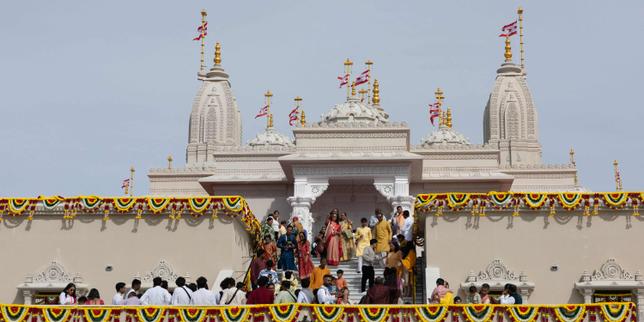
Most people picture modern religion as something confined to Sunday mornings, Friday afternoons, or quiet prayer books. BAPS operates on an entirely different operational frequency. It is communal, monumental, and hyper-organized. When a BAPS temple rises, it does not look like a local chapel. It looks like an architectural wonder pulled straight from the ancient texts of the Vedas, assembled entirely by volunteers who view their labor not as a job, but as an act of profound worship.
This brings us to the friction point.
Imagine walking onto a modern European construction site governed by strict labor unions, rigid overtime caps, and standardized safety regulations. Now, imagine bringing in volunteer artisans or workers whose entire framework of existence is anchored in religious service, selfless devotion, and a willingness to work around the clock because every hammer strike is an offering to God.
This is where the invisible gears ground to a halt.
The strike that shuttered the Eiffel Tower was fundamentally a clash of paradigms. On one side stood French labor organizers, fiercely protective of worker rights, safety protocols, and strict contractual boundaries. On the other side, allegations and tensions swirled regarding the deployment of volunteers and foreign laborers associated with temple projects, raising fierce questions about labor exploitation versus religious devotion.
When modern labor law meets ancient spiritual duty, sparks fly. The French union representatives saw underpaid, overworked individuals caught in a system that bypassed standard protections. The community associated with the movement saw dedicated devotees freely offering their time and sweat to build a sacred space. Both sides were speaking entirely different languages, even when they used French words.
Language barriers are deceptive. They make us think the problem is just vocabulary. It is not. It is worldview.
To a secular Parisian, a job is a contract traded for currency, granting leisure time to sit at a café along the boulevard with a glass of Bordeaux and a cigarette. To a committed follower within the broader cultural orbit of these transnational spiritual movements, work can be a spiritual discipline, a path toward liberation, a cosmic duty. When these two philosophies crash into each other in the shadow of a global landmark, the city itself holds its breath.
The closure of the Eiffel Tower served as a dramatic, jarring symptom of a much larger, quieter transformation happening across the globe. We live in an era of hyper-globalization where ancient traditions do not stay neatly compartmentalized in their countries of origin. They travel. They build. They buy land in suburban New Jersey, London, Robbinsville, and Paris. They erect towering stone mandirs out of millions of hand-carved pieces of marble and sandstone, defying local zoning expectations, architectural norms, and secular expectations.
And as they expand, they carry with them social structures that do not always fit neatly into Western bureaucratic boxes.
The protest at the Eiffel Tower was loud, visible, and disruptive. But the real story was happening beneath the surface, in the quiet tension between individual rights and collective spiritual submission. How do you regulate an organization whose members view their labor as divine service? How do you apply a thirty-five-hour workweek to a devotee whose clock is ticked by eternity?
These are not easy questions. The answers will not fit onto a picket sign or a union pamphlet.
As the sun began to set behind the Trocadéro, casting long, bruised shadows across the iron beams of the tower, the crowds slowly dispersed. The cafes filled up. The strike would eventually be resolved, agreements would be signed, and the elevators would resume their mechanical climb up into the Parisian fog.
Yet the monument remained marked by that strange, sudden interruption. It stood as a reminder that the world is no longer neatly divided into distinct, isolated cultures. The ancient and the modern, the sacred and the secular, the local union and the global faith are now locked in a permanent, complicated dance.
A lone pigeon landed on a silent steel beam, cocked its head, and looked out over a city that thought it had seen everything, only to realize it was just beginning to learn the names of the builders.


