The standard headline reads like a tired script from a third-rate political thriller. Police sweep through Lahore, drag away family members, and slap emergency detention orders on middle-aged women whose primary crime is sharing DNA with a deposed prime minister. The global press corps predictably wrings its hands over human rights violations, international observers issue polite condemnations, and local analysts write elegies for a dying democracy.
Everyone has got it backward.
When a state apparatus backed by tanks, intelligence bureaus, and an entire corporate-military complex resorts to locking up a politician's sisters under colonial-era emergency statutes, it is not a display of iron-fisted authority. It is a full-blown admission of structural bankruptcy. It is the tactical flailing of an elite class that realizes it has lost the argument, lost the street, and lost control of the narrative.
Let us strip away the moralizing and look at the brutal mechanics of power in contemporary Pakistan.
For years, the lazy consensus among foreign correspondents and domestic pundits was that the establishment held all the cards. The formula was simple: remove the populist leader through a parliamentary vote of no confidence, disqualify him legally, stack the courts, herd compliant political puppets into office, and let time erode his base. It was a neat, bloodless recipe for managed democracy.
Only, reality refused to cooperate.
Imran Khan sitting inside Adiala Jail as Prisoner 804 has proven to be exponentially more dangerous to the ruling status quo than he ever was sitting in the Prime Minister's office. His incarceration did not neutralize him; it consecrated him. Every legal absurdity, every midnight raid, and every barred courtroom door has acted as rocket fuel for a public that views the current governing coalition not as legitimate administrators, but as administrative caretakers for an unelected military command.
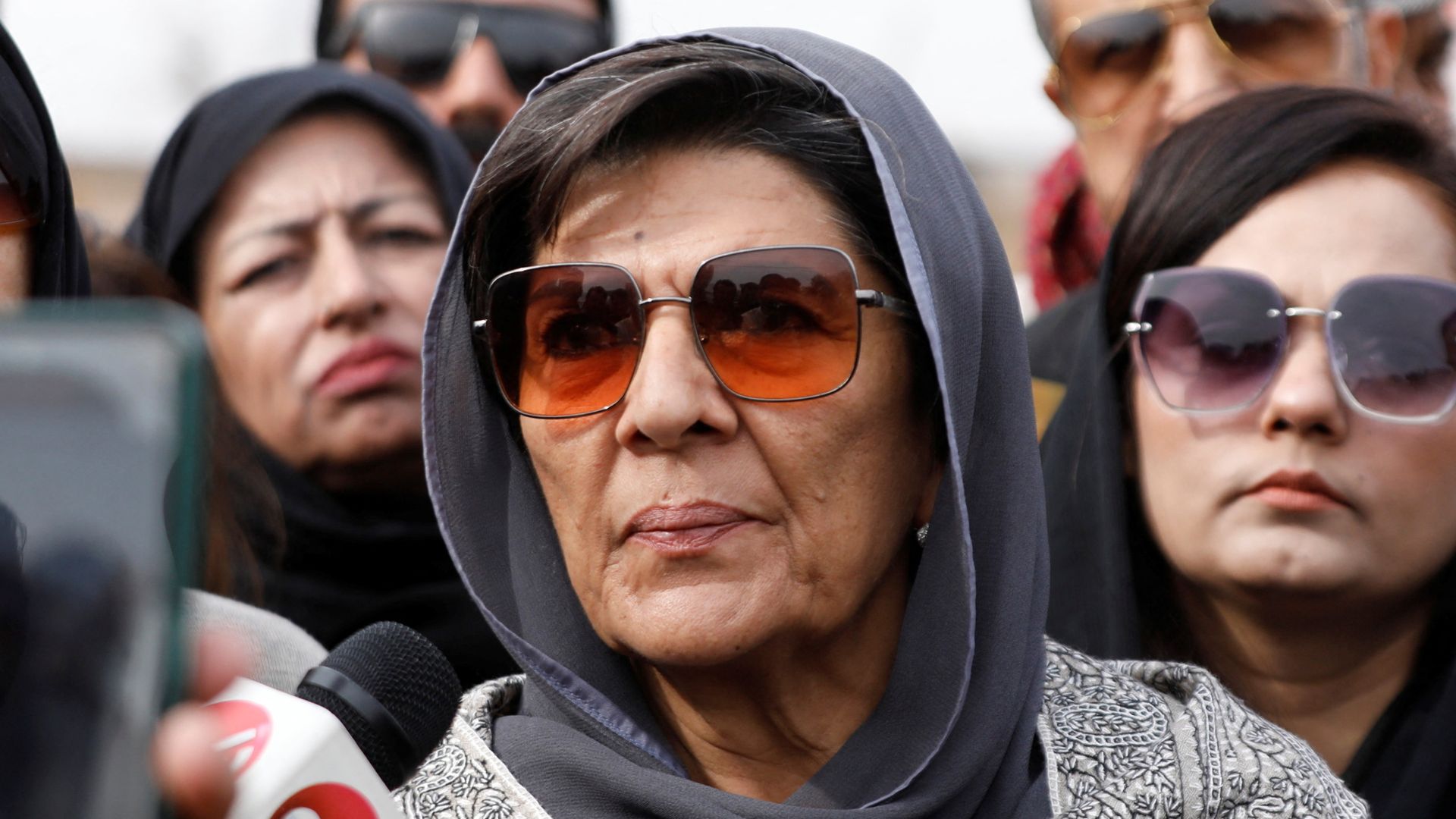
Enter the sisters. Aleema Khan and Uzma Khan became flashpoints not because they wielded executive power or commanded secret militias, but because they stepped into the vacuum left by a decimated party leadership. When thousands of Pakistan Tehreek-e-Insaf workers were hunted, threatened, or driven underground, family members became the last remaining conduits of organizational continuity.
And that is precisely why the state panicked.
To understand why the state pulled the trigger on administrative detentions using the Maintenance of Public Order Ordinance, you have to look at the sheer fragility of the system. The ruling coalition, spearheaded by the Pakistan Muslim League-Nawaz and stitched together under the watchful eye of Army Chief General Asim Munir, operates under a terrifying mathematical reality. They cannot afford an open street. They cannot afford a sustained march toward Islamabad. Because if the public square fills up and stays full, the illusion of administrative normalcy shatters completely.
Here is where the conventional analysis fails. Observers look at the batons, the shipping containers blocking highway arteries, and the mass arrests of PTI members, and they conclude that the state is too powerful to defeat. That is a category error. True strength does not need to criminalize family lineage. A confident government does not treat a septuagenarian's relatives as existential security threats.
When you arrest women because you are terrified of what they might say to a crowd, you are confessing that your entire legal and political architecture rests on cellophane foundations.
Let us examine the legal tool of choice here: the Maintenance of Public Order Ordinance, commonly known as the MPO. Originally drafted by the British colonial administration in 1960, this relic of imperial control allows the state to lock people away without trial on vague suspicions of disturbing public peace. It is the administrative equivalent of a legal cheat code. Whenever the courts fail to provide a convenient conviction, the executive simply dusts off a six-decade-old authoritarian shortcut.
Yet, every time the MPO is invoked against non-violent citizens, its legitimacy erodes further. It turns a routine political protest into a David-versus-Goliath morality play. The establishment is caught in a fatal feedback loop: the more they repress to maintain order, the more disorder they manufacture. They arrest the sisters to stop a march, the arrest sparks outrage, the outrage hardens public resolve, and the next mobilization becomes larger and angrier than the last.
Any experienced strategist will tell you that repression without a political exit strategy is just acceleration toward collapse.
Yet, to be entirely honest, the opposition bears its own structural flaws that the establishment quietly banks on. The Pakistan Tehreek-e-Insaf is not immune to critique. By centering its entire organizational universe around a single charismatic figure and his immediate family, the party created a brittle hierarchy. When the leader is caged, the chain of command fractures into panic and improvisation. A movement built purely on personality worship struggles to build institutional resilience. The reliance on family members as proxy leaders is a symptom of this very vulnerability. If your entire political survival depends on who shares your bloodline, your party is an echo chamber rather than an institution.
This structural defect within the opposition gives the military establishment its only remaining playbook: decapitation. The calculation is simple: remove the focal points, isolate the leader, and let internal friction tear the movement apart from within. But this playbook was written for an analog era. In an age of decentralized digital communication and hyper-charged public grievance, cutting off the head of a movement often multiplies its hydra-like impulses. Every time a prominent figure is hauled off to prison under dubious legal pretexts, local cells activate autonomously, proving that the anger has outgrown any single leader or family member.
Consider the role of the judiciary in this theater of control. Courts that once maintained a veneer of institutional independence have increasingly become rubber stamps for executive overreach. When high courts issue blanket bans on public assembly or look away from arbitrary detentions, they strip away the last remaining safety valve of the republic. A system that closes every legal escape hatch for peaceful dissent inevitably invites uncontained explosion. When peaceful assembly is criminalized by judicial fiat, the state essentially signals that change through ballots is a dead letter.
This brings us to the macroeconomic backdrop that the political elite desperately tries to ignore. While Islamabad obsesses over perimeter security, shipping containers, and emergency ordinances, the country's economic arteries are hardening. Foreign exchange reserves remain perpetually on life support, inflation grinds the middle class into poverty, and tax collection targets are met through punitive extraction rather than structural reform. International lenders look at Pakistan not as a recovering market, but as a perpetual political volatility risk.
The ruling coalition believes that stabilizing the political arena means silencing the opposition. They have it completely backward. Silencing the opposition only deepens the crisis of confidence that prevents foreign investment and domestic economic revival. Capital flees uncertainty, and nothing creates uncertainty quite like a state that treats political opposition as high treason.
The establishment is fighting a ghost with handcuffs. They can detain Aleema Khan and Uzma Khan, they can issue non-bailable arrest warrants, and they can throw up endless walls of shipping containers across every major thoroughfare. But they cannot jail an idea born of systemic exhaustion.
A government that relies on prison guards, colonial emergency ordinances, and barricaded capitals is not governing a sovereign republic. It is running an occupied garrison. And history shows that garrisons eventually run out of walls.