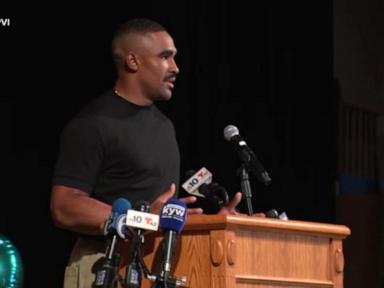
Jalen Hurts donated $600,000 through his foundation in September 2026 to bring air conditioning to part of Northeast High School, Philadelphia's largest high school, routing the gift through The Fund for the School District of Philadelphia.
It sounds like a clean, textbook sports-philanthropy story. Quarterback signs a massive contract, spots a headline about sweltering classrooms, writes a check, and cameras flash. Look closer at the wiring inside a 3,400-student building in Cottman Avenue, though, and that tidy narrative fractures immediately. Six hundred thousand dollars does not magically turn an aging industrial-era public high school into a climate-controlled sanctuary. In Philadelphia, it buys partial relief, forces electrical compromises, and exposes an uncomfortable truth about who ends up subsidizing basic municipal infrastructure.
Why an NFL Quarterback Is Buying Cooling Equipment
Hurts did not stumble into school cooling by accident. His foundation's Keep It Cool initiative has been circling this exact bottleneck for over two years. In April 2024, Hurts put up $200,000 for more than 300 air conditioning units across ten Philadelphia district schools, standing at Edward Gideon School in Brewerytown while students and teachers talked openly about early dismissals and classroom misery. Later in 2024, his foundation pushed another six-figure wave into cooling upgrades. Then came September 2026, when dozens of district schools still had to dismiss early during hot early-autumn stretches and Hurts stepped up with $600,000 aimed at Northeast High School.
Why cooling? Because athletes and donors usually gravitate toward shiny, photogenic causes—laptop labs, after-school gyms, scholarship awards. Cooling is unglamorous. Nobody puts a banner on a scoreboard celebrating a compressor. Yet heat is one of the most direct, measurable barriers to schooling in American cities. When classrooms push past 85 or 90 degrees, cognitive stamina drops, tempers fray, asthma flares, and principals end up sending kids home early. Hurts picked a physical bottleneck nobody can spin away with a pep talk.
Still, his $600,000 gift for Northeast High School is explicitly targeted at cooling part of the building. Read that word again. Part. Not the whole campus. Not a turnkey modernization. A targeted slice of a massive footprint serving more than 3,400 teenagers.
What Six Hundred Thousand Dollars Actually Buys in an Old Building
Anyone who has covered municipal capital budgets for twenty years knows the first rule of school facilities: the sticker price of the equipment is rarely the real bill.
Philadelphia's school stock is notoriously old. District leadership has repeatedly noted that the average age of district buildings sits north of seven decades, with dozens of structures pushing past a century. When you try to drop modern cooling loads into mid-twentieth-century or older masonry walls, you run straight into three walls at once:
- Electrical capacity: Legacy switchgear, undersized feeders, and aging panels cannot simply absorb hundreds of high-draw cooling units without tripping breakers or risking fires. District officials pointed out during Hurts's earlier 2024 rollout that wiring networks often have to be reworked before units can even stay running.
- Envelope and distribution: Window or through-wall units solve single rooms; central chilled-water or VRF systems solve whole wings. Each path carries wildly different engineering, ductwork, and maintenance realities.
- Hidden hazards: Disturbing walls, ceilings, or mechanical chases in older public buildings can uncover asbestos, lead paint, or deteriorated structural elements, turning a straightforward installation into a multi-month relocation headache.
In a high school with more than 3,400 students, $600,000 goes fast once engineering fees, electrical upgrades, permitting, labor, and equipment procurement take their cut. That is why the announcement centered on bringing air conditioning to part of Northeast High School rather than declaring the entire building finished.
Consider a hypothetical example to see how the math behaves in practice. Suppose a district facility team wants to cool forty instructional spaces in an older wing. If equipment alone runs $4,000 per room, that is $160,000 on paper. Add panel upgrades, dedicated circuits, conduit runs, structural sleeves, union labor, and contingency reserves, and the true cost per room can easily double or triple—eating up the entire $600,000 before the rest of the campus ever feels a breeze. That arithmetic explains why Hurts's check is a serious intervention without being a silver bullet.
The Structural Trade-Off Nobody Wants to Name
There is a sharper tension sitting underneath every celebrity donation to a public school district.
On one side, families and principals at Northeast High School get real relief sooner than municipal bond cycles or capital queues would otherwise deliver it. When Mayor Cherelle Parker, Superintendent Tony B. Watlington Sr., and district leaders stood beside Hurts in September 2026, their gratitude was genuine. Principals do not turn down $600,000 when kids are sweating through algebra.
On the other side, privatized philanthropy for core physical plant creates a quiet distortion. Public education infrastructure is supposed to be funded predictably through tax base, state formulas, and capital borrowing—not patched together through the charitable instincts of a 28-year-old football star. When a high-profile athlete funds cooling at one flagship campus, it generates headlines and momentum, yet it can also mask how slow, fragmented, and politically fragile district-wide capital planning remains.
Critics of donor-driven infrastructure make a fair point: philanthropy loves visible wins and struggles with multi-decade maintenance. A quarterback can fund equipment and electrical work for a section of a building. He cannot write a check for thirty years of preventive HVAC servicing, filter replacements, refrigerant compliance, or sister schools still waiting in line.
Supporters of Hurts's approach counter that waiting for perfection is a luxury nobody in a 90-degree classroom can afford. If a $600,000 commitment via The Fund for the School District of Philadelphia gets hundreds of students into cooler rooms this school year—and keeps teachers from watching instructional days evaporate to early heat dismissals—that practical gain matters right now.
How Philanthropy and Public Dollars Collide
Routing the gift through The Fund for the School District of Philadelphia was a deliberate structural choice. Rather than dumping boxes of units at a loading dock, channeling money through the district's philanthropic arm ties the contribution to formal district priorities, procurement rules, and leadership oversight.
Even so, partnerships like this live on a knife-edge. Three variables determine whether a $600,000 infusion turns into lasting value or a temporary patch:
- Scope discipline: Locking down exact rooms, electrical capacity, and completion milestones before demolition or installation starts prevents scope creep from swallowing the budget.
- Lifecycle ownership: Someone has to own the filter schedules, coil cleanings, and repair tickets once the press release fades.
- Equity across the map: Philadelphia has dozens of schools. When one high school gets $600,000, neighboring schools with equally battered mechanical systems inevitably ask what their timeline looks like.
Hurts has been remarkably consistent on this front. Unlike athletes who scatter small checks across a dozen causes every December, he has stuck to a narrow, physical problem in Philadelphia schools since 2024—moving from $200,000 across ten schools to $600,000 aimed at Northeast High School. Persistence gives his foundation credibility that one-off PR stunts never earn.
What Comes Next for School Cooling
A $600,000 donation does not solve Philadelphia's school facilities backlog. It does something narrower and harder: it proves that targeted private capital can break a logjam in a specific building when paired with district execution.
The real test is not the ribbon-cutting or the photo next to city leaders. The real test is whether the district uses the momentum from Northeast High School to publish transparent, room-by-room cooling timelines and electrical upgrade budgets across the rest of the system, so keeping classrooms cool stops depending on who decides to write the next check.