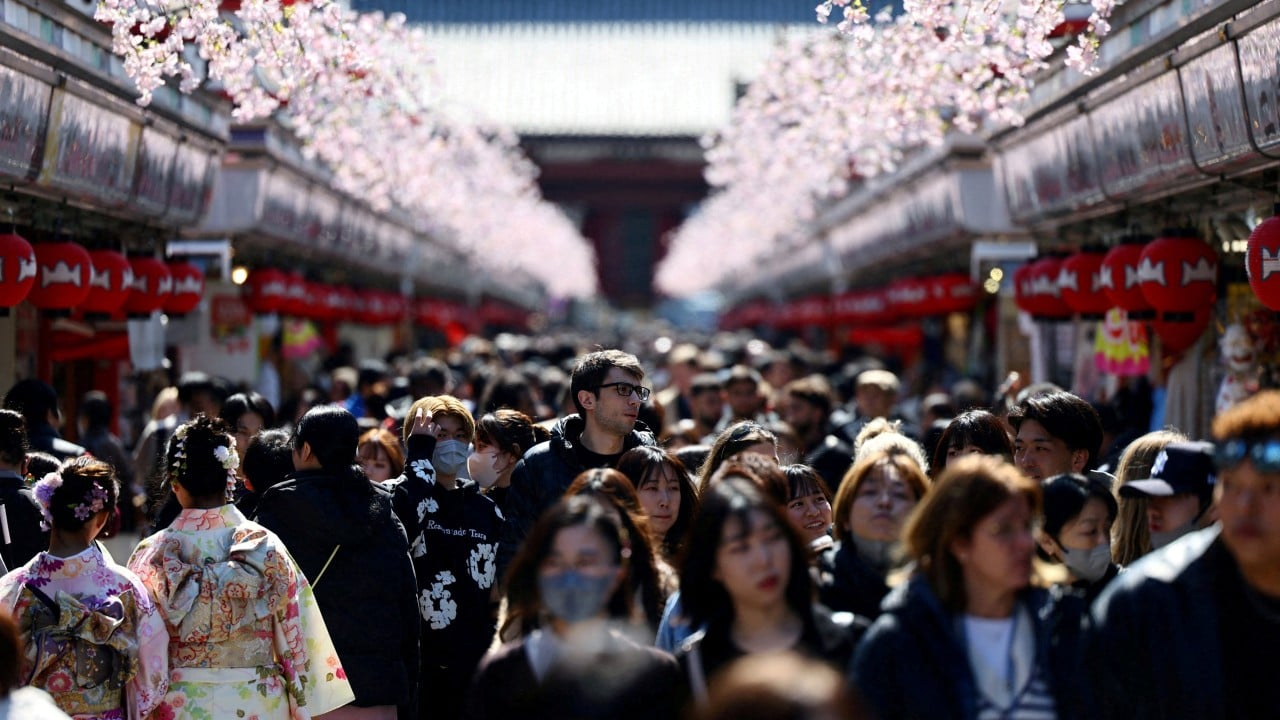
The herd is sprinting toward a cliff, and they’re doing it with a smile while carrying yen-denominated luggage.
The prevailing narrative—the one being peddled by every major brokerage from Hong Kong to London—is that Japan’s hotel sector is a gold mine. They point to the weak yen. They point to the surge in "revenge travel" from Hong Kong families. They point to the yield spread. They tell you it is a safe haven in a world of geopolitical chaos. You might also find this similar story insightful: Why Trump is Right About Tech Power Bills but Wrong About Why.
They are wrong.
What they call a "boom" is actually a desperate grab for the last scraps of a structural anomaly. If you are buying into Japan’s hospitality market today based on the "undervalued" yen or the record-breaking tourist arrivals, you aren’t an investor. You are a liquidity provider for the savvy players who entered in 2019 and are currently looking for the exit. As discussed in recent articles by The Wall Street Journal, the effects are significant.
The Yen is a Drug Not a Strategy
Most of the current "success" in Japan’s hotel market is a currency play disguised as a real estate play. When the yen plummeted, Japan became the world’s bargain bin. Of course, families from Hong Kong and Singapore are flocking to Kyoto and Niseko; it is functionally 30% cheaper than it was five years ago.
But banking on a weak currency is a precarious way to run a business.
The moment the Bank of Japan (BoJ) finally loses its nerve and actually hikes rates—not the tiny, symbolic nudges we’ve seen, but a real move to protect the currency—the "cheap Japan" thesis evaporates. Suddenly, those high occupancy rates in mid-tier hotels vanish as the cost of a bowl of ramen doubles for a tourist.
If your investment thesis requires the local currency to stay in the gutter forever just to keep the rooms full, you don't have a hospitality business. You have a short position on the yen.
The Operational Death Spiral Nobody Mentions
Investors love to look at RevPAR (Revenue Per Available Room). It’s a clean, sexy metric that makes for great slide decks. But RevPAR is a vanity metric in a country facing the most aggressive demographic collapse in modern history.
I have sat in boardrooms where private equity groups talk about "scaling" hotel portfolios in Japan. I ask one question: "Who is going to change the sheets?"
Japan is running out of people. The hospitality sector is currently cannibalizing itself to find staff. To keep a luxury ryokan or a boutique hotel running at the standard global investors expect, you have to pay wages that are skyrocketing.
- Labor costs are not rising linearly; they are exploding.
- The "hidden" cost of recruitment and retention is gutting Net Operating Income (NOI).
- Automation is a pipe dream for the luxury segment.
A robot can check you in, but a robot cannot provide the omotenashi (hospitality) that justifies a $1,000-a-night price tag. You are buying assets into a labor market that is a vacuum. The spread between your gross revenue and your actual take-home profit is narrowing every single month.
The Hong Kong Family Fallacy
The "competitor" logic says that Hong Kong families are the bedrock of this market. This is a fundamental misunderstanding of consumer psychology.
Hong Kong travelers are among the most sophisticated and fickle in the world. They go to Japan because it is currently the best value-for-money proposition on the planet. They have no brand loyalty to your specific real estate asset. The second the yen strengthens, or the second a new "it" destination opens up with easier flight paths, they will move.
Furthermore, the "investment" by Hong Kong families into Japanese vacation homes and small hotels is often an emotional hedge, not a cold-blooded financial one. They want a piece of the Japanese lifestyle. When retail investors start buying assets because they "love the culture," that is the universal signal that the top is in.
The Yield Spread is a Mirage
The "lazy consensus" loves to talk about the yield spread in Japan compared to the US or Europe. "Look!" they cry. "Borrowing costs are near zero, and yields are at 4-5%! It’s free money!"
It isn't.
In a standard market, you have two ways to win: cash flow or capital appreciation.
- Capital Appreciation: Japan’s real estate market (outside of prime Tokyo Grade A office space or ultra-luxury residential) has been a graveyard for capital appreciation for three decades. You are buying an asset that, in real terms, is likely to be worth less in ten years than it is today.
- Cash Flow: As discussed, the labor crisis is eating the cash flow.
When you factor in the "exit risk"—the reality that there are very few buyers for a mid-market hotel in a secondary Japanese city—the spread doesn't look like a gift. It looks like a trap.
The Quality Trap: New vs. Old
There is a massive surge in new hotel supply. Global brands are planting flags in every corner of the archipelago. This is creating a "quality trap."
International investors are pouring money into new builds, thinking they can out-compete the legacy Japanese hotels. What they miss is that Japan’s building codes and maintenance requirements are among the most stringent (and expensive) in the world.
The depreciation schedules on these "modern" assets are brutal. By the time you’ve stabilized your guest list, the building requires a massive CapEx (Capital Expenditure) injection just to stay competitive. You are on a treadmill where you have to run faster and faster just to keep your valuation flat.
Stop Asking if Tourists are Coming
People always ask: "Will Japan stay popular for tourists?"
That is the wrong question. Of course it will. Japan is an incredible destination.
The right question is: "Can I make a risk-adjusted return on a fixed asset in an economy with no people, rising interest rate risk, and an oversaturated luxury market?"
The answer, for 90% of the people currently "lured" by the headlines, is a resounding no.
If you want to play Japan, stop buying the buildings. The real money isn't in the stones and the mortar; it's in the specialized management companies that know how to squeeze efficiency out of a dying labor force. But even then, you're fighting gravity.
The Brutal Reality of "Geopolitical Strains"
The industry likes to pretend that Japan is a safe harbor from the tensions between the West and China. This is a fantasy.
Japan is the front line. If there is a major maritime disruption in the South China Sea, the Japanese tourism industry doesn't just "dip"—it ceases to exist. Your "safe" investment is a highly leveraged bet on regional peace in an increasingly volatile decade.
The Playbook for the Brave (and the Skeptical)
If you must ignore my warning and buy into Japan, do not do what the Hong Kong families are doing.
- Avoid the "Lifestyle" Assets: Don't buy a boutique hotel in Niseko because you like to ski. You will lose your shirt on the seasonal labor costs.
- Look for Distress, Not Momentum: The time to buy was when the world was closed. Buying now, at the peak of the hype, means you are paying for everyone else’s optimism.
- Focus on Logic, Not Aesthetics: The most profitable "hospitality" assets in Japan aren't the beautiful ones. They are the boring, high-efficiency business hotels near major transit hubs that serve domestic travelers—the people who will still be there when the exchange rate corrects.
The smart money is already looking at Southeast Asia or rethinking the European Mediterranean, where the demographics aren't quite as terminal and the entry prices haven't been pumped by a currency fire sale.
Japan is a beautiful place to visit. It is a terrible place to chase a trend.
The party is still loud, the sake is still flowing, but the sun is setting, and you’re the only one who hasn't noticed the bill is due.
Stop looking at the arrival numbers and start looking at the balance sheets. The math doesn't care about your vacation photos.