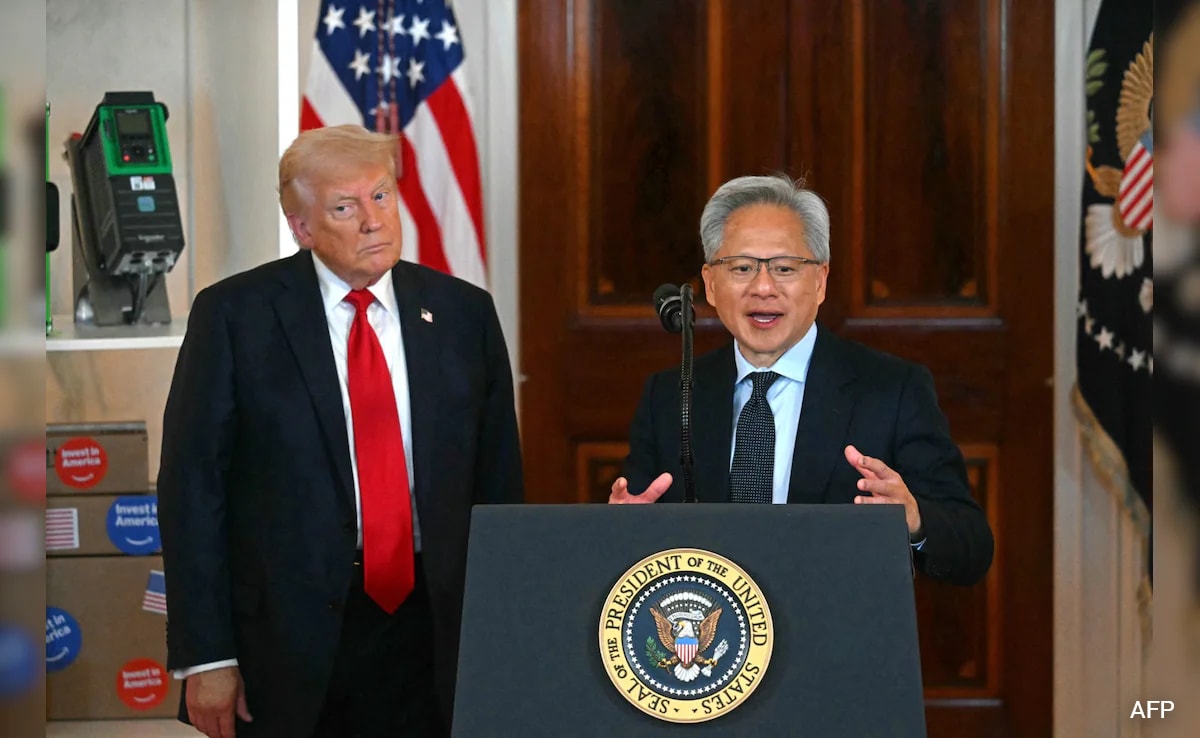
The media wants you to believe that Jensen Huang joined the presidential delegation to China as a "strategic power move." They are painting a picture of a tech titan acting as a diplomatic bridge, a high-stakes negotiator smoothing over the jagged edges of a semiconductor war.
It is a comforting narrative. It is also completely wrong.
Huang isn't in China to lead. He is there to beg for permission to survive.
The consensus suggests that having the CEO of the world’s most valuable chipmaker on the plane signifies Nvidia’s leverage over global trade. In reality, it signifies the exact opposite: the total subordination of the private tech sector to nationalist industrial policy. If you think this trip is about Nvidia’s "influence," you are looking at the chessboard upside down.
The Myth of the Tech Diplomat
We have entered an era where we mistake visibility for power. Every major outlet is treats Huang’s late-minute inclusion like a wildcard entry that changes the math of US-China relations.
Here is the cold truth: CEOs do not make foreign policy. They get conscripted into it.
I have watched dozens of these "business delegations" over the last decade. They are theater. The state department and the executive branch use these executives as human props to signal "business as usual" while the actual policy experts tighten the screws on export controls in the background. Huang isn't there to negotiate a rollback of the $H100$ and $H200$ restrictions. He is there to be the face of a "compromise" that has already been written by people who don't know how to code but know everything about leverage.
By joining this trip, Huang is effectively signaling that Nvidia has accepted its role as a tool of the state. The moment a private company hitches its wagon to a specific administration’s diplomatic tour, it loses the ability to claim it is a neutral, global entity.
Nvidia Is Not Too Big To Fail
The "lazy consensus" argues that the US government needs Nvidia more than Nvidia needs the government. This is a fundamental misunderstanding of how power works in 2026.
People point to the market cap. They point to the dominance in AI training. They argue that the US cannot afford to hobble its own champion. But look at the math of the "China-specific" chips Nvidia has tried to peddle—the $H20$, the $L20$. These are neutered versions of the real thing. They are the leftovers.
The Chinese market, which once accounted for roughly 20% to 25% of Nvidia’s data center revenue, is not just "slowing down." It is being actively cannibalized by local players like Huawei and Biren Technology. These local firms don't need to beat the $H100$ on raw specs; they only need to be "good enough" while being locally available and politically safe.
Huang’s presence on this trip is a frantic attempt to keep the door from slamming shut. It isn't a show of strength; it’s a desperate bid to convince Beijing that Nvidia is still a "friend" while simultaneously trying to prove to Washington that he is a loyal soldier. You cannot serve two masters when they are both preparing for a cold war.
The Cost of Compliance
Every time a tech CEO smiles for a photo op on a tarmac in Beijing or D.C., the company’s long-term agility dies a little.
Nvidia’s "moat" has always been its hardware-software tight integration—CUDA. But the more the US government dictates who can buy what, the more it incentivizes the rest of the world to build an "Anything But Nvidia" ecosystem.
- Scenario: Imagine a world where China successfully standardizes an open-source AI framework that runs on non-Nvidia silicon.
- The Result: Nvidia doesn't just lose a market; it loses its status as the global standard.
By participating in these high-level diplomatic stunts, Huang is inadvertently accelerating the bifurcation of the global tech stack. He is validating the idea that silicon is a weapon, not a commodity. Once you accept that premise, you invite every regulator on earth to treat your supply chain like a nuclear arsenal.
Stop Asking if He’s Helping
The "People Also Ask" sections of the internet are obsessed with whether Huang can "save" the US-China tech relationship. This is the wrong question.
The right question is: Why are we still pretending that "saving" it is an option?
The decoupling is not a "risk" to be managed; it is a reality to be navigated. The idea that a 72-hour trip and a few handshakes can reverse the momentum of the CHIPS Act or China’s "Self-Reliance" mandate is delusional.
Huang is a brilliant engineer. He is a visionary leader. But in this context, he is a passenger. The administration didn't bring him along because they value his input on trade policy. They brought him along because his presence provides a veneer of economic legitimacy to a trip that is fundamentally about geopolitical containment.
The Reality of the "Special Invite"
If you were truly a "game-changer"—to use a word I despise—you wouldn't be a "last-minute call." You would be the architect of the meeting.
The "last-minute" nature of this invitation suggests a scramble. It suggests that the administration needed a "win" or a visual cue that the tech sector is aligned with their aggressive stance. Nvidia’s stock might tick up on the news because the market loves proximity to power, but the savvy insider sees the trap.
Nvidia is now a ward of the state. Its roadmap is no longer determined by R&D alone, but by the shifting whims of the National Security Council.
The Unconventional Advice for Investors
Stop trading the headline and start trading the constraint.
If you are betting on Nvidia because you think Huang is "fixing" the China problem, you are going to get burned. The China problem is unfixable. The real play is recognizing that Nvidia is being forced to pivot its entire growth strategy toward sovereign AI—helping individual nations build their own clusters because the global, open market is effectively dead.
This trip isn't a victory lap. It is a funeral for the era of the borderless tech company.
Jensen Huang is a master of the leather jacket and the keynote stage. He knows how to command a room of developers. But in the room he’s entering now, he isn't the one holding the remote. He is the one being told what to display on the screen.
The photo of Huang in China won't be a symbol of a new era of cooperation. It will be the evidence used later to show exactly when the independence of the American tech giant finally expired.
Don't watch the handshake. Watch the export license applications that get denied the week after he returns. That is where the real story lives.