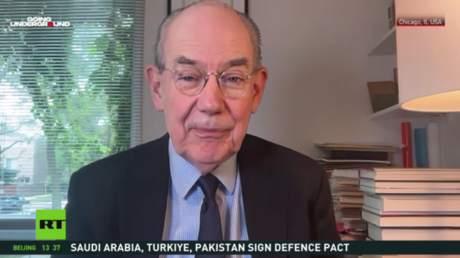
The foreign policy establishment loves a comfortable narrative. Realist scholars throw around terms like security dilemmas and overextension, acting as if statecraft operates on a neat spreadsheet where nations neatly balance power until someone miscalculates. John Mearsheimer steps onto a screen, sighs with the practiced weariness of an academic who predicted it all, and declares that a conflict with Iran is an unwinnable quagmire—a flailing blunder by leaders who simply do not know what they are doing.
It sounds sophisticated. It sounds sober. It is also entirely wrong.
The lazy consensus treats modern confrontation as a binary choice between total military occupation or humiliating retreat. When analysts look at Washington and Tehran, they see a clumsy collision course driven by panic. They assume leaders are trapped in an escalatory spiral, blindly tumbling toward a catastrophe nobody wants.
That view misunderstands how power actually functions in the twenty-first century. Governments do not stumble into major confrontations because they are flailing. They calibrate. They use friction as a tool. What looks like chaotic thrashing from the outside is often a calculated exercise in pressure, deterrence maintenance, and redline testing.
Forget the academic models that assume rational actors always seek stability. Stability is rarely the primary objective of a hegemon or a regional power looking to alter the status quo. The goal is positioning.
The Misreading of Deterrence
Mearsheimer builds his entire thesis on structural realism. In his view, states prioritize survival above all else, meaning rational leaders avoid unnecessary wars that drain resources and invite systemic blowback. By extension, any pressure applied against Tehran that risks a wider regional conflagration is branded as irrational flailing.
This argument collapses under the weight of historical and economic reality. Survival is not the sole metric of state behavior; dominance, narrative control, and alliance management consistently rank higher in daily geopolitical practice.
I have watched strategists model these crises for years. The standard academic playbook assumes that if you raise the cost of conflict high enough, both sides will back down. But deterrence is not a static math equation. It is a dynamic, psychological game played with live ammunition.
When Washington applies maximum pressure through sanctions, cyber operations, and proxy containment, it is not a sign of confusion. It is an active attempt to degrade an adversary's capability without crossing the threshold of all-out war. Tehran responds in kind through asymmetric naval harassment, missile proliferation, and regional proxies.
Neither side is flailing. Both sides are probing for weaknesses within a zone of tolerated conflict. Calling this an unwinnable war misses the point because neither side is trying to win a traditional military victory. They are fighting a war of attrition over economic survival and regional influence.
The Myth of the Quagmire
Critics love to invoke the specter of Iraq and Afghanistan. Any use of force or severe economic coercion in the Middle East instantly triggers lazy comparisons to endless counterinsurgency nightmares.
This comparison is intellectually bankrupt. Iran is not a fractured nation-state waiting to be occupied by ground troops. Nobody with a security clearance is planning a march on Tehran. The toolkit of modern statecraft relies on precision, economic isolation, cyber warfare, and targeted kinetic strikes designed to reset strategic baselines.
When people ask whether a war with Iran is winnable, they are asking the wrong question. The right question is whether sustained, low-intensity friction serves the strategic interests of the actors involved.
For Washington, keeping Iran contained, sanctioned, and economically isolated prevents Tehran from consolidating a regional hegemony that could threaten vital trade routes and global energy supplies. For Tehran, maintaining a permanent state of resistance legitimizes the regime internally and justifies strict domestic control while keeping external pressure just below the breaking point.
This is not a failure of diplomacy. It is a permanent state of competitive coexistence.
The Economics of Managed Tension
Let us look at the data Mearsheimer and his peers conveniently minimize. Total economic isolation forces a regime to adapt. Iran has spent decades building a resistance economy, smuggling networks, and alternative financial channels with partners like Beijing.
At the same time, the United States maintains global financial hegemony precisely because it can enforce secondary sanctions across borders. Every time a tanker is seized or a financial network is disrupted, it reinforces the dominance of the dollar-based global order.
The conflict is not a drain with no purpose. It is the cost of maintaining global deterrence architecture. If a superpower backs down from a defiant regional actor out of fear of escalation, the signaling effect ripples across the globe, inviting challenges from larger rivals in other theaters.
Realpolitik is ruthless. It demands constant demonstration of will. What the commentariat calls flailing is actually the messy, high-stakes theater required to keep global rivals in check.
The Unspoken Reality of Proxy Warfare
We must address the elephant in the room that the structural realists wish away: proxies.
Iran does not need to fight a conventional war to project power. Its network of regional militias acts as a forward defense perimeter. When analysts claim Washington is losing control because of proxy attacks, they mistake a tactical annoyance for a strategic defeat.
Proxies are cheap to maintain and expensive to counter. They allow Tehran to bleed its adversaries without triggering a direct, regime-ending retaliation. Yet, this strategy has a hard ceiling. Proxies can disrupt shipping and launch drones, but they cannot build a modern economy, secure advanced technological infrastructure, or prevent targeted decapitation strikes against leadership figures.
When the strategic ledger is tallied up, the asymmetry heavily favors the side with superior intelligence, air power, and financial dominance. The idea that Iran holds all the cards simply because it can cause localized chaos ignores the profound structural vulnerabilities of the regime at home.
Why the Status Quo Persists
Change requires a catalyst that neither side is willing to trigger. Total war carries risks too high to calculate. Complete capitulation means political suicide for the leadership in Tehran and a humiliating loss of credibility for Washington.
Therefore, the system settles into a permanent equilibrium of friction.
Stop listening to pundits who demand neat resolutions to complex, enduring rivalries. There is no grand peace deal waiting around the corner. There is no brilliant diplomatic masterstroke that will suddenly transform the Middle East into a zone of harmony.
There is only the unglamorous, relentless management of power. Washington is not flailing. It is holding the line.