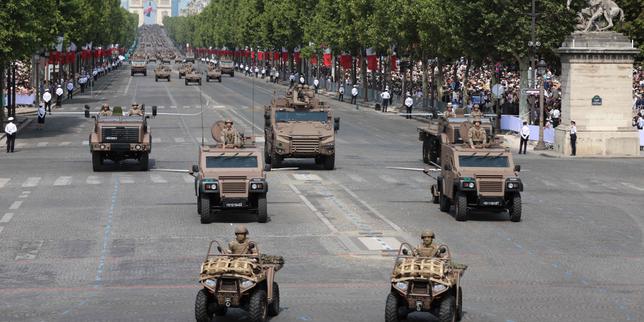
Bastille Day parades love a good spectacle. The synchronized marching, the roar of fighter jets over the Champs-Élysées, and the calculated seating arrangements on the VIP stage. The latest iteration—heavy on symbolism with Ukrainian President Volodymyr Zelensky and a "coalition of volunteers" front and center—delivered exactly what the cameras wanted. It painted a picture of unified European resolve and ready-to-deploy military might.
It is a comforting theater. It is also completely detached from the realities of modern warfare.
Mainstream media coverage of these events falls into a predictable trap. Commentators gush over the "strong signals" sent to adversaries and the "unprecedented solidarity" on display. They treat ceremonial pageantry as a proxy for actual strategic capability.
Having analyzed European defense procurement and joint military doctrines for over a decade, I can tell you the hard truth: marching together down a Parisian boulevard does not mean you can fight a high-intensity war together. The assumption that symbolic unity equals operational readiness is a dangerous myth.
We need to stop confusing choreography with combat capability.
The Coalition of Volunteers is an Logistics Nightmare, Not a Force Multiplier
The headlines focused heavily on the "coalition of volunteers" marching in Paris. The narrative implies a seamless, multinational fighting force ready to defend European borders.
The reality? It is an administrative headache masquerading as an alliance.
True military effectiveness relies on three things: standardization, interoperability, and deep supply chains. When you patch together a "coalition" of various European nations, you are not mixing strengths; you are compounding vulnerabilities.
Consider the basic issue of ammunition. Europe currently struggles to standardize something as fundamental as 155mm artillery shells. Different nations produce variants that technically fit the same barrels but suffer from software incompatibility or minor dimensional variances, leading to jamming or reduced accuracy.
If a coalition cannot even standardize its shells without bureaucratic friction, how does it expect to share real-time battlefield telemetry, coordinate integrated air defense systems, or manage complex cross-border logistics during a hot conflict?
Marching in lockstep on pavement requires zero technical compatibility. Fighting in a degraded electronic warfare environment requires total compatibility. The parade hides this massive gap behind shiny uniforms.
The Cult of Symbolism is Starving Real Defense
Every Euro spent polishing tanks for a parade or flying high-altitude flyovers for public relations is a Euro distracted from deep-stockpile procurement.
Western defense policy has become obsessed with optics. Governments want the political credit for "supporting the cause" without making the hard, boring choices required to sustain a modern military.
Imagine a scenario where a country boasts a fleet of advanced, fifth-generation fighter jets. They look incredible flying over a crowd on July 14. But behind the scenes, that same nation only possesses enough precision-guided munitions to sustain three weeks of high-intensity combat. Worse, their domestic manufacturing capacity takes eighteen months to replace a single lost airframe.
This is not a hypothetical. It is the current state of multiple European air forces.
We have prioritized high-tech, low-volume "trophy assets" because they look good in press releases and parades. Meanwhile, we neglect the unsexy realities of mass: artillery barrels, drone interception systems, raw explosives, and industrial manufacturing capacity. A parade celebrates the inventory you have today; it completely ignores your inability to replace it tomorrow.
Dismantling the Pundit Narrative
Let's address the inevitable pushback from traditional defense analysts.
Does strategic signaling not hold deterrent value?
No. Not anymore.
Adversaries do not look at a televised parade and tremble. They look at industrial output metrics. They look at energy dependency. They look at the fact that European factories take months to produce what peer competitors manufacture in days. Signaling only works if there is a credible, massive industrial engine backing it up. Without the factories, a parade is just an expensive bluff.
Does presence at these events not cement alliances?
It cements political photo-ops. True alliance cohesion is forged in grueling, untelevised joint training exercises, unified command structures, and legally binding procurement agreements that force nations to abandon domestic defense protectionism. Putting ten different flags in a single row achieves none of this.
The Cost of the Illusion
The downside to this contrarian view is obvious: it is politically depressing. It forces leaders to admit that Europe's security architecture is brittle and heavily reliant on external powers. It requires telling taxpayers that billions more are needed not for flashy new projects, but for boring warehouses filled with spare parts and artillery shells.
But the alternative is continuing to believe our own propaganda.
We watch a video of foreign leaders standing shoulder-to-shoulder in Paris and sleep soundly, thinking Western security is intact. We treat a ceremonial display as a substitute for hard power.
Stop looking at the stage. Look at the factories. If the factories are empty, the parade is meaningless.

